Verbal de-escalation: validate, offer choices and set limits
Fictional scene. Late afternoon in an emergency department. A man has been waiting for hours with his elderly father, who has a fever. He approaches the counter, speaks loudly and says that "nobody here knows what they are doing". The professional who receives him feels her heart speed up, notices that other people in the room are watching and has to choose her first sentence. What she says in the next seconds can reduce the tension, keep it the same or make the situation worse.
Verbal de-escalation is the set of communication resources used to help someone agitated or angry regain control, without resorting to restraint or threats. The Cochrane review on psychosis-induced aggression describes it as a psychosocial intervention that helps the person monitor their own emotions and self-manage their behavior, to prevent aggression from escalating (Du et al., 2017).
This article works with fictional, commented dialogues. They illustrate four moves that appear repeatedly in the recommendations: validate the experience without agreeing with everything, reframe to check what the person wants, offer choices that actually exist and set limits without turning them into threats. The lines are study examples, not validated scripts. The evidence on the effect of these techniques is limited, and that is part of the content too.
Key points
Validating means acknowledging the person's experience; it does not mean agreeing with accusations, threats or impossible requests.
Reframing out loud lets you check whether you understood what the person wants, even when the request cannot be met.
Choices only help when they are real; promising what does not exist tends to break trust.
Limits work better when they describe the behavior and its consequence objectively, without a tone of punishment.
Systematic reviews do not allow us to state that de-escalation reduces aggression; studies are few and mostly lack a control group.
In the face of immediate threat, conversation is no longer the priority: stepping away and calling for support come first.
The Project BETA consensus, from the American Association for Emergency Psychiatry, organized verbal de-escalation into ten domains. Among them are respecting personal space, not being provocative, establishing verbal contact with one person speaking at a time, being concise and repeating, identifying wants and feelings, listening closely, agreeing or agreeing to disagree, setting clear limits, offering choices and optimism, and talking with the patient and the team after the episode. The document contrasts the traditional goal of "calming the patient", with a connotation of domination, with the goal of helping the patient calm down, described as more collaborative (Richmond et al., 2012).
The NICE NG10 guideline recommends communicating respect and empathy at every stage of de-escalation and, when someone becomes agitated or angry, that a single team member take the lead role in communication. This professional assesses safety, seeks clarification with the person and negotiates a solution in a non-confrontational way. The guideline's scope is the short-term management of violence in mental health, health and community services, and its principles are used here within that limit (NICE NG10, 2015).
The uncomfortable question is whether this works. The Cochrane review by Du and colleagues, on psychosis-induced aggression or agitation, found no randomized trial that met the criteria. The authors conclude that de-escalation seems accepted as good clinical practice, but is not supported by evidence from randomized trials (Du et al., 2017).
The Cochrane review by Spencer and colleagues, on aggression not induced by psychosis in adults, included a single cluster-randomized study, conducted in nursing homes with older adults with dementia. It did not measure outcomes considered central, such as injuries, and the reliability of the evidence was rated as very low. The authors' conclusion is that it is not possible to say whether de-escalation techniques are effective or which ones work best (Spencer et al., 2018).
A more recent systematic review, by Seiyad and colleagues, gathered studies on verbal de-escalation in the prevention and management of violence in health care work. There was great heterogeneity in how the intervention was defined, applied and evaluated. Training programs often reported improvement in staff knowledge, confidence and preparedness. Most of the evidence came from observational or before-and-after studies, and the authors warn that the associations found cannot be interpreted as causal (Seiyad et al., 2026).
In forensic psychiatric services, the review by Brenig and colleagues found five studies, none randomized and all without a control group. There was no relevant impact of training on the rate of violent incidents, although the team seemed to feel safer afterwards (Brenig et al., 2023).
These limits do not make the conversation useless. They change the way it is presented: the techniques are consensus recommendations and descriptions of practice, not treatments with demonstrated efficacy. Anyone who studies de-escalation needs to know this so as not to promise results that the sources do not support and so as not to blame themselves or a colleague when a well-conducted conversation does not prevent an aggression. The article on violence against health professionals discusses prevention and response more broadly; here, the focus is on the sentences.
Four moves of verbal de-escalation, with fictional examples
Move
Goal
Fictional example
Frequent pitfall
Validate
Show that the experience was heard
“You have been waiting for a long time, and your father still has a fever.”
Saying “I understand how you feel” without knowing what the person is going through
Reframe
Check the real request
“If I understood, you want to know when he will be seen and whether someone is monitoring the fever. Is that it?”
Responding to the tone and ignoring the content
Offer choices
Give some control back to the person
“I can check his position in the queue now or call the triage nurse to reassess him. Which would you prefer first?”
Offering something the service cannot deliver
Set limits
Define what cannot continue
“I want to help your father. For that, I need you to stop hitting the counter.”
Turning the limit into a threat or punishment
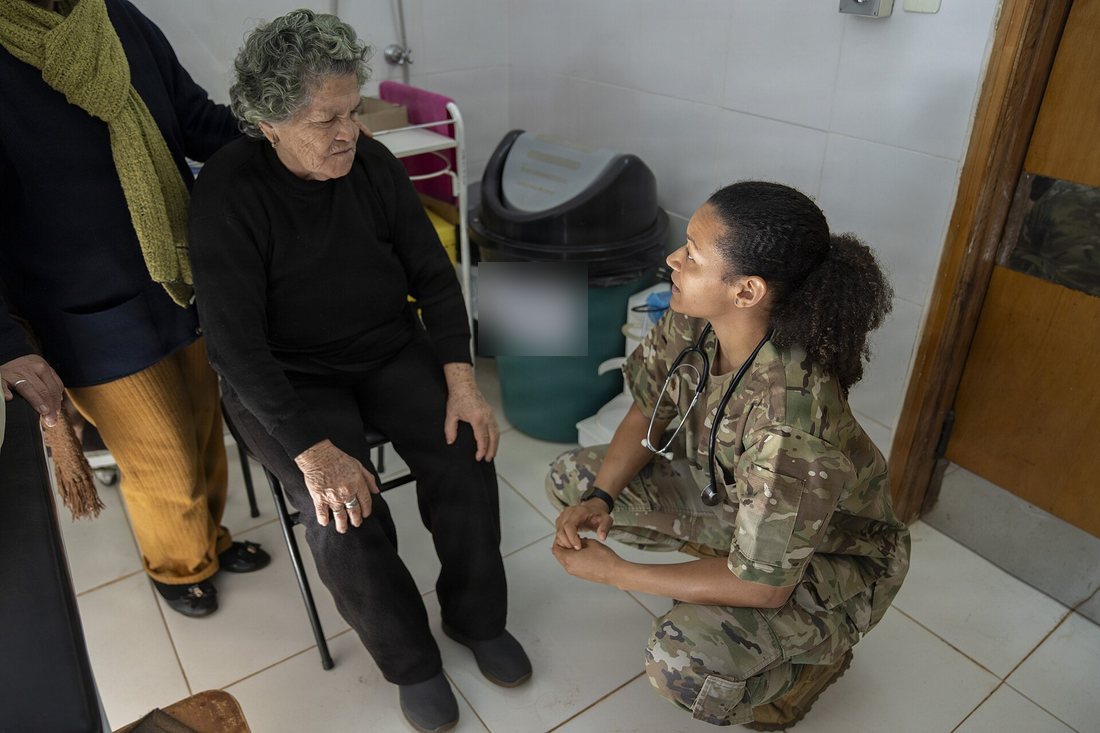
A professional crouches to talk with an older patient seated, in a family health unit. The photograph illustrates a conversation during care, not the fictional scene of the article. Localized blurring of text. Credit: Andrea Jenkins, U.S. Air Force, Public domain (license), via Wikimedia Commons (file page).
Validate without agreeing with everything
To validate is to communicate that the person's experience makes sense from their point of view. In the qualitative study by Price and colleagues, with professionals and patients from acute inpatient psychiatric units, “confirming and validating” appears as its own domain in the taxonomy of techniques. It includes agreeing when possible, apologizing, authentic empathy, honesty, respect, not interrupting and allowing the person to “save face”, that is, to back down without humiliation (Price et al., 2024).
Project BETA describes three ways of agreeing without lying. The first is agreeing with the truth: if the person has already been punctured three times, the fact can be acknowledged. The second is agreeing in principle: you do not have to accept an accusation to say that everyone deserves to be treated with respect. The third is agreeing with the probability: other people would also be bothered by a long wait. When there is nothing honest to agree with, the alternative is to agree to disagree (Richmond et al., 2012).
Fictional dialogue 1, first version.
Companion: “Nobody here knows what they are doing! My father is abandoned in this chair.” Professional: “Sir, if you keep shouting, I will not be able to attend to anyone. Everyone here is waiting.”
The answer describes a true fact, but it starts by correcting the behavior and compares his complaint with other people's. The implicit message is that the problem is the tone, not the father's fever. The chance of the person feeling heard decreases.
Fictional dialogue 1, second version.
Companion: "Nobody here knows what they're doing! My father is just left in this chair." Professional: "You've been here for quite a while and he still has a fever. It makes sense to be worried. My name is Ana, I'm from nursing. Tell me what has changed with him since you arrived."
Here the professional agrees with the truth (the wait was long), acknowledges the emotion without judging it, introduces herself and opens space for clinical information. She does not agree with the statement that "nobody knows what they're doing". She also does not argue with that sentence; she simply does not make it the center of the conversation.
A frequent trap is the sentence "I understand how you feel". In the workshop with standardized patients described by Gouge and colleagues, one of the cases was built precisely around the use of this sentence as an automatic listening tool. The authors do not forbid it, but they point out that it is problematic when the professional does not actually know the person's experience or context. Qualified formulations, such as "I understand how this may be a difficult choice for you", align with the understanding component of the NURSE mnemonic, which brings together naming, understanding, respecting, supporting and exploring (Gouge et al., 2025).
The link to the article on empathy and clinical reasoning is direct. Naming an emotion and acknowledging its reason does not interrupt information gathering; often, it is what makes it possible. Validation also does not require long speeches. In a tense situation, short sentences usually work better, as recommended by the Project BETA domain that calls for conciseness and repetition, since someone who is very agitated may have difficulty processing verbal information (Richmond et al., 2012).
Acknowledge a true fact before correcting any behavior.
Name the emotion provisionally: "it seems that", "I imagine that".
Avoid comparing the person's complaint with those of other patients.
Do not argue with every accusation; choose what can be answered.
Prefer short sentences and allow time for the response.
Paraphrasing to find out what the person wants
An angry person usually expresses an emotion and a request at the same time. Project BETA recommends always asking what the person expects, even when the request cannot be met, and suggests a caveat: "even if I can't offer that, I'd like to know so we can work on it together". The document also recommends active listening, in which the professional must be able to repeat what the person said, and cites the so-called Miller's law: to understand what someone says, assume it is true and try to imagine what it could be true of (Richmond et al., 2012).
Paraphrasing means giving back, in your own words, the central content of what you heard, and asking for confirmation. The technique has two functions. For the person, it shows that there was listening. For you, it tests whether the interpretation is correct before you respond. A wrong paraphrase is also useful: when the person corrects it, the conversation gains precision.
Fictional dialogue 2.
Companion: "You only see people who have someone known in here. People have gone ahead of him three times." Professional: "You saw other people go in before your father and got the impression that the order isn't fair. Is that it?" Companion: "It's not an impression. And nobody explains anything to me." Professional: "So, besides the wait, there's a lack of explanation. Can I tell you how the order works here and then check where he is?"
The professional does not confirm the accusation of favoritism. She paraphrases the observation ("other people went in before") and the meaning attributed to it ("the order isn't fair"). The person's response reveals the most important need: information. The second paraphrase names that need and proposes a concrete next step.
In the study by Goodman and colleagues, in high-security psychiatric hospitals, professionals, patients and carers described relationships based on trust, fairness and consistency as central to de-escalation. Validating the patient's perspective appeared among the necessary skills, alongside empathy, respect, reassurance and sincerity. The context is very different from a general emergency department, but the perception of unfairness as a trigger for conflict is a point that deserves attention (Goodman et al., 2020).
Reframing depends on mutual understanding. If the person speaks another language, has hearing difficulty or is confused, repeating more loudly does not solve it. The text about a professional interpreter at the appointment discusses why a communication barrier can be mistaken for hostility. Likewise, agitation of recent onset may have a clinical cause; the article about the patient who seems to be just drunk shows how a behavioural label can hide another problem.
A professional listens to a patient during a consultation at a temporary health post. The photograph illustrates listening, not the fictional scene of the article. Crop of the original photograph. Credit: Maddelin Angebrand, U.S. Navy, Public domain (license), via Wikimedia Commons (file page).
Real choices, not sham choices
Anger in a health service often comes with a sense of loss of control: over time, over the body, over information. Offering choices gives part of that control back. Project BETA states that, for someone who feels only fight or flight is left, a choice can be a powerful resource, and recommends proposing alternatives quickly. The same source brings a clear condition: the choices must be realistic, and the person must never be misled by promising something that cannot be offered (Richmond et al., 2012).
In the taxonomy of Price and colleagues, autonomy includes involving the person, transferring responsibility, offering options, suggestions and alternatives, giving time and space and asking permission. A nurse interviewed describes the practice as offering a range of options, such as drinking something, going to the room to rest or talking about what is happening, so that the person chooses (Price et al., 2024).
Fictional dialogue 3, sham choice.
Professional: "If you calm down, I promise he is next."
The sentence may work for a few minutes. If the promise does not depend on who is speaking, as usually happens in triage by severity, it will be broken, and the next attempt at conversation will start with less trust. The sentence also makes attention conditional on behaviour, which can sound like bargaining.
Fictional dialogue 3, real choice.
Professional: "I cannot guarantee that he is next, because the order depends on how serious each person is. What I can do now is one of these two things: check his temperature again or take you to the room next door, which is calmer, while I confirm the position in the queue. Which would you prefer first?"
The professional explains a real limit of the service and offers two actions she can carry out. Both meet a need that came up in the conversation (clinical concern and information). The final question transfers the decision to the companion within a safe space.
The workshop described by Shenai and colleagues, with medical students facing agitated standardised patients, shows how difficult this step is in practice. Reviewing the recordings indicated that the students used the skills, but many jumped to a quick solution, and some offered inappropriate choices to end the encounter (Shenai et al., 2024).
A real choice has three features: it depends on the person offering it, it is acceptable whichever option is chosen, and it responds to something the person expressed. If you do not know whether something is possible, the honest choice may be to find out: "I don't know whether he can have a blanket now; I'll ask and come back in five minutes". Coming back at the agreed time is part of the intervention. The same logic of explaining what happens next appears in the text about safety netting at the appointment.
Offer only what depends on you or the team present.
Present two or three options, not a long list.
Explain the limit of the service when the request cannot be met.
If you promise to come back, come back at the agreed time.
Avoid making care conditional on behavior as a form of bargaining.
Limits without threats
De-escalation is not accepting any behavior. Project BETA devotes a domain to establishing "basic working conditions": the person must be clearly informed about what is acceptable, and the document states that hurting someone is unacceptable. If necessary, the person can be informed that an assault can lead to arrest and prosecution, and this must be said objectively, not as a threat. Limits must be reasonable and respectful, showing the intention to help without accepting being assaulted (Richmond et al., 2012).
The same domain adds that, if the person's behavior makes the professional uncomfortable, this must be acknowledged. Saying that the behavior is frightening can help when it comes with an empathetic statement that the desire to help can be harmed when the professional feels anger or fear. Violating a limit must have a consequence related to the specific behavior, reasonable and presented with respect (Richmond et al., 2012).
Price and colleagues describe the limit as a specific, clear and objective description of the behavior and its impact, which creates choice but sets limits in the face of real risk (Price et al., 2024). The review by Seiyad and colleagues records a warning: imposing limits aggressively can worsen the behavior when the technique is used on its own, instead of accompanied by strategies that support autonomy (Seiyad et al., 2026).
Fictional dialogue 4.
Companion (banging on the counter): "If no one comes now, I'm going in there and sorting it out my way." Professional: "I want your father to be seen. Banging on the counter and talking about forcing your way in frightens people here, including me. I need you to stop banging and stay on this side. That way I can keep helping you both." Companion: "And if I don't stop?" Professional: "Then I'll need to call security to make sure everyone is safe. I'd rather not do that. Can I call triage now and ask for him to be reassessed?"
The limit describes the behavior ("banging on the counter", "talking about forcing your way in") and its effect ("frightens people"), without labeling the person as violent. The consequence is related to the behavior and proportionate; the professional presents it without a challenge and immediately returns to a real choice. She does not accept the condition imposed by the threat ("if no one comes now") and also does not promise what she does not control.
The difference between a limit and a threat lies less in the words and more in the function. A threat seeks to win the dispute or punish. A limit states what needs to stop, why, and what will happen if it does not stop, leaving a dignified way out open. That is why tone matters: Project BETA calls for "objective" communication, and Price and colleagues include allowing the person to save face as part of validation (Richmond et al., 2012; Price et al., 2024).
Who speaks also matters. NICE recommends that a single professional lead the communication (NICE NG10, 2015). Project BETA makes the same recommendation and explains that several people talking to the patient can confuse them and worsen the escalation; meanwhile, another team member can alert colleagues and keep uninvolved people away. The document treats repetition as essential: someone who is very agitated may need to hear the same limit and the same alternative more than once (Richmond et al., 2012).
Describe the behavior, not the personality: "banging on the counter", not "you are aggressive".
State the effect of the behavior and what needs to change.
Present the consequence objectively, proportionately and related to the act.
Then offer a possible alternative.
Do not accept conditions imposed by threat, and do not negotiate other people's safety.
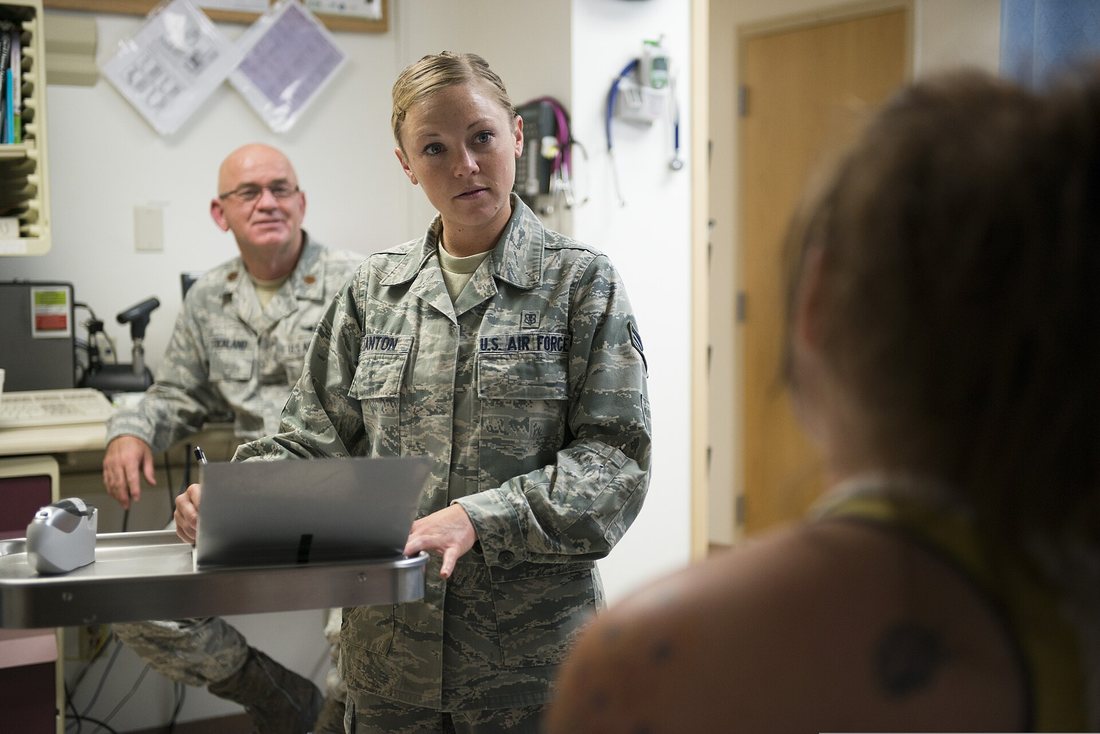
A professional listens to the patient explain her condition in an emergency department, with a doctor in the background. The photograph illustrates the care setting, not the fictional scene in the article. Credit: Samuel Morse, U.S. Air Force, Public domain (license), via Wikimedia Commons (file page).
When conversation is not enough, and what comes next
There are situations in which no sentence is enough. A weapon, an ongoing assault or a concrete threat change the priority: protecting yourself and protecting others comes before finishing the conversation. Stepping away, keeping an exit clear and calling for support through the service's channels are not communication failures. In the qualitative study by Suh and colleagues, clinicians in an emergency department described a common mental model that prioritizes verbal de-escalation before pharmacological or physical restraint, with real-time assessment of threats to safety and team decision-making. Participants also acknowledged that unconscious biases and identity dynamics, such as age, gender and race, can influence the perception of threat (Suh et al., 2026).
That last point deserves attention. The same sentence said out loud can be read as venting or as a threat, depending on who says it and who hears it. The article on stigma and clinical language shows how a recorded label can follow the patient into other appointments. Describing concrete behaviors helps reduce that risk.
The professional's fear is also part of the scene. Goodman and colleagues observed that fear, present in professionals and in patients, drove many behaviors, and they recommend that the factors feeding it be addressed in training (Goodman et al., 2020). The text on acute stress and clinical reasoning discusses how physiological activation affects attention and performance. Knowing this does not oblige anyone to stay calm in any circumstance; it helps to recognize when it is time to ask someone else to take over.
After the episode, Project BETA recommends talking with the patient to restore the relationship, letting them explain what happened from their point of view and planning what can help next time. It also recommends talking with the team about what worked, what did not work and what can improve (Richmond et al., 2012). For the professional who suffered an assault or feels they "failed", the text on the second victim addresses the support needed after difficult events.
Training helps to prepare, but does not solve it alone. In the study by Johnston and colleagues, in forensic units, the authors concluded that de-escalation behavior is unlikely to change with knowledge and skills training alone. They propose complementary interventions, such as advance de-escalation planning, debriefing after incidents, changes to the physical environment and leaders who set an example (Johnston et al., 2022). The review by Seiyad and colleagues observes something similar: the studies with the most expressive reductions in violence tended to embed de-escalation in interventions with several components, including notification systems, team response protocols and clear institutional policies (Seiyad et al., 2026).
In education, simulation with standardized patients allows practice without exposing real people. The workshop by Gouge and colleagues reported improvement in students' self-reported confidence and in their ability to assess common sentences, a learning outcome and not a reduction in aggression (Gouge et al., 2025). In the workshop by Shenai and colleagues, students felt that standardized patients calmed down too quickly, which shows a limit of realism (Shenai et al., 2024). The article on simulation of care and the text on feedback in clinical cases help to plan this type of practice.
In the face of immediate threat, prioritize stepping away, a clear exit and support.
Describe concrete behaviors when reporting the episode.
Acknowledge your own fear and ask someone else to take over when necessary.
Talk afterward with the patient and with the team, without looking for someone to blame.
Treat training as one part of a set that includes environment, team and institutional policy.
How NEXO fits into the study of communication
In NEXO, the case of the day is fictional, with a real clinical presentation and up to six progressive clues, and you propose the diagnosis by searching for the ICD-10 code. The game does not train difficult conversations or simulate agitated patients. The connection with this article is elsewhere: noticing how a new piece of information changes the reading of a clinical picture.
In the fictional dialogues above, the professional discovers that the companion needed information, not an immediate appointment, and that the father's fever continued. In a clinical case study, something similar happens when a clue reveals that the first impression was incomplete. After playing, you can note which piece of data changed your hypothesis and why. This reflection on diagnostic reasoning is different from communication training, which needs simulation, supervision and feedback. You find the daily case in NEXO.
Frequently asked questions
Is there a phrase that always calms things down?
No. The sources describe principles, such as validating, listening, offering choices and setting limits, not phrases with proven effectiveness. Cochrane reviews found insufficient evidence to say which techniques work best. The dialogues in this article are study examples, to be adapted to the person, the language and the service (Du et al., 2017; Spencer et al., 2018).
Does validating mean agreeing with someone who is shouting?
Not necessarily. Project BETA proposes agreeing with what is true, agreeing in principle or agreeing with the probability, and agreeing to disagree when none of that is possible. You can acknowledge a long wait without accepting an accusation against the team (Richmond et al., 2012).
Can I promise something to buy time?
Project BETA recommends never deceiving the person with promises that cannot be kept. A broken promise tends to make the next conversation harder. If you do not know whether something is possible, the honest alternative is to say you will check and come back with an answer (Richmond et al., 2012).
Does setting limits make the situation worse?
It depends on how the limit is set. Seiyad and colleagues note that limits imposed aggressively and in isolation can worsen the behavior, while Project BETA recommends respectful, objective limits with proportionate consequences. A limit accompanied by a possible alternative tends to be different from a threat (Seiyad et al., 2026; Richmond et al., 2012).
If de-escalation did not prevent the aggression, did someone make a mistake?
That cannot be concluded. The evidence on the effectiveness of de-escalation is limited, and qualitative studies show that the environment, team culture and service organization influence the outcome. An aggression is the responsibility of the person who commits it, and the episode deserves a system analysis, not a search for blame (Spencer et al., 2018; Johnston et al., 2022).
Take-home messages
Acknowledge a true fact and the person's emotion before correcting the behavior.
Rephrase what you heard and ask for confirmation; the real request is not always what appears first.
Offer only choices that exist and keep what you agree to.
Set limits by describing behavior, effect and consequence, with a dignified way out.
Present de-escalation as a recommended practice with limited evidence, not as a guarantee of safety.
In the face of an immediate threat, protect yourself and call for support before continuing the conversation.