Medical educationNursing and patient safetyEmergency medicine
Crisis simulation: testing service readiness


Table of contents
- Define what the service needs to test
- Preparing the exercise without creating another risk
- Activation, roles and communication
- Observe processes, do not look for someone to blame
- From discussion to action plan
- Correct, retest and monitor
- How NEXO fits into the study
- Frequently asked questions
- Take-home messages
- References
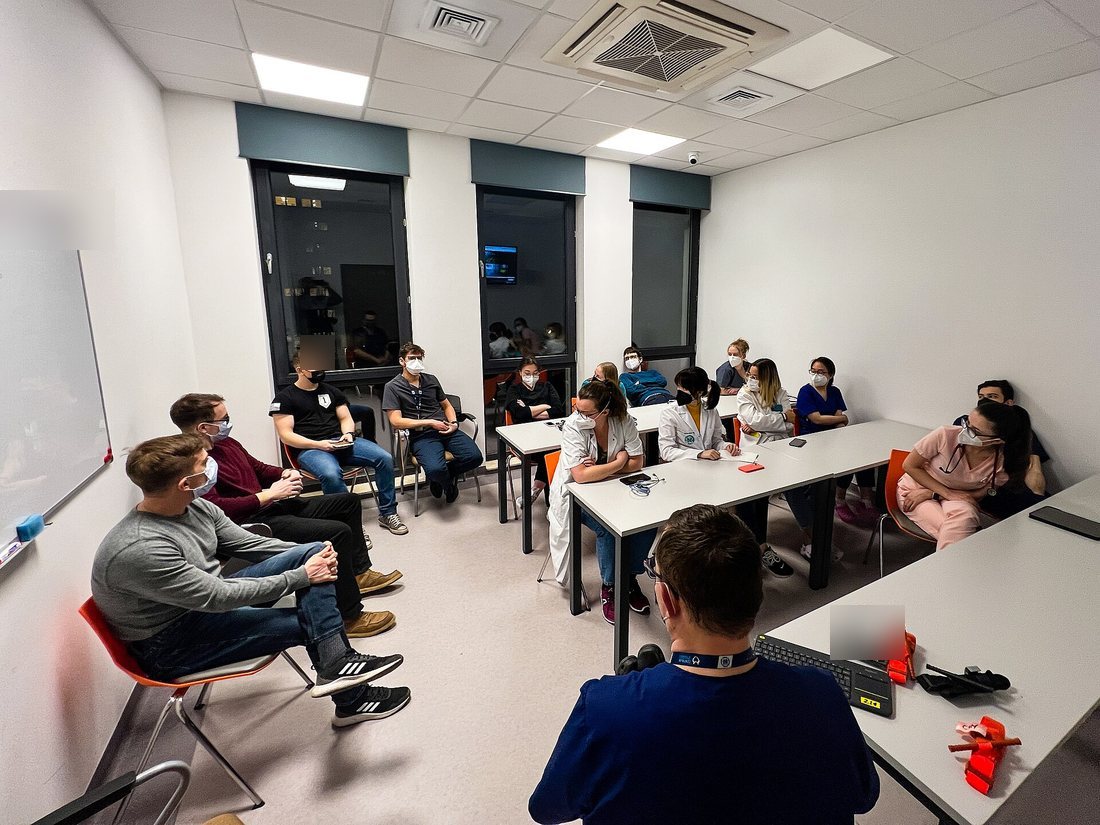
Fictional scene. During a joint exercise with the team, the front desk triggers the support planned for a critical situation. The call reaches a device with no defined owner. In the room, two people take on the same task, while nobody communicates that the flow needs to be reorganized. The problem is not a lack of goodwill. The service has not yet checked whether the written plan works under the conditions in which it will have to be used.
A simulation can be organized to learn a technique, assess a participant or investigate how a work system responds. This article addresses the third question: when a crisis arises, can the service recognize the need, trigger the resources and coordinate the people? The goal is to find correctable failures, not to stage a flawless performance or promise that training will eliminate aggression or human responses to stress.
The literature on workplace simulation describes opportunities to identify safety threats, but it brings together different designs, scenarios and measures. The review by Fent and colleagues included 18 studies, predominantly observational (Fent et al., 2015). This base helps plan the use of simulation as an improvement tool, without turning every exercise into an intervention with proven clinical effectiveness.
Key points
- Start with an operational question that the service can observe and answer.
- Prepare the activity with clear limits, protection for participants and priority on real care.
- Test the full support pathway, not just the act of starting a call.
- Describe failures in communication, resources and organization without reducing the analysis to individual blame.
- Turn the later discussion into actions with owners, deadlines and verification.
- Retest the changes and distinguish simulated performance from results in real care.
Summary
- Define what the service needs to test
- Prepare the exercise without creating another risk
- Triggering, roles and communication
- Observe processes, do not look for culprits
- From discussion to action plan
- Correct, retest and follow up
- How NEXO fits into the study
- Frequently asked questions
- Take-home messages
Define what the service needs to test
"Training for a crisis" is a broad intention. To guide a useful activity, it needs to become a concrete question. Who receives the request for help on that shift? How does the team know it was understood? Is the needed resource available where the plan indicates? The scenario may involve clinical deterioration, an urgent need for transfer or a threat during care, but the operational question must remain explicit.
Victoria Brazil proposes describing simulation also by its function: diagnosing system difficulties and supporting improvement interventions, in connection with the service's priorities. The setting matters when it allows these conditions to be tested, but it does not replace defining the purpose. An activity inside the unit can remain just a class if it does not observe the processes it intended to assess (Brazil, 2017).
This distinction avoids mixing incompatible objectives. If the question is to check the support flow, it makes no sense to repeatedly interrupt the scenario to teach an individual clinical technique and then interpret the observed time as the service's usual performance. The activity may have educational value, but the record must report the session lead's interventions and what they prevent concluding.
There are empirical examples of identifying failures. Patterson and colleagues studied a program in a pediatric emergency department, with 90 simulations and 218 professionals over one year (Patterson et al., 2013). A total of 73 latent threats were identified, including equipment and team response problems (Patterson et al., 2013). However, the assessment of non-technical behaviors showed no clear trend of improvement. Detecting problems and demonstrating improvement in every dimension are distinct results (Patterson et al., 2013).
When the topic is threat or aggression, caution needs to be specific. The Cochrane review by Geoffrion and colleagues found uncertain evidence on the effects of education and training on aggression against workers. Their programs and contexts do not automatically match the exercise proposed by a service. The local goal may be to check whether support arrives and whether roles are clear, without promising a reduction in episodes that has not been demonstrated (Geoffrion et al., 2020).
The article on simulation to train patient assessment discusses another focus. Here, the main unit of analysis is how the service works. A clinical question can be part of the scenario, but the discussion should show how people, information and resources come together, including when the first attempt at a response does not work.
Preparing the exercise without creating another risk
Preparation starts by deciding who needs to take part and who should remain responsible for real care. A simulation does not create extra capacity. If it takes from the service the same people and materials needed for a real emergency, it needs an operational assessment and criteria for being postponed or stopped. In the study by Patterson, these criteria were agreed with the unit leadership, considering patient demand and severity (Patterson et al., 2013).
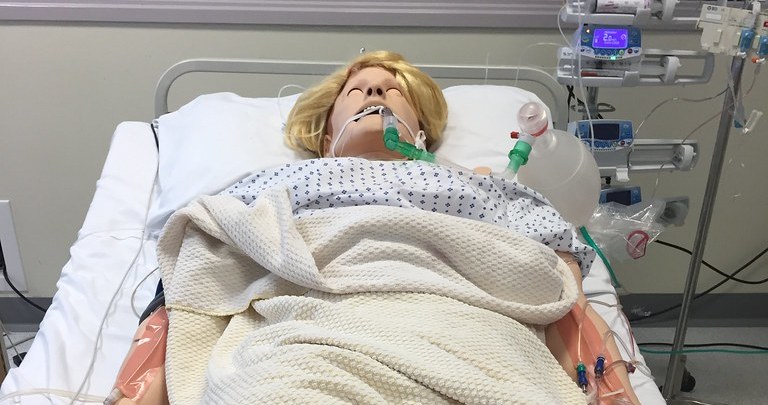
It is also necessary to explain what will be simulated. In a threat scenario, realism does not mean surprising someone with intimidation or unagreed physical contact. Participants need to know the limits of the portrayal, how to ask for a pause and who can end the activity. Difficult conversations can be planned without turning the exercise into personal exposure or a test of emotional endurance.
The official summary of the INACSL standards includes needs assessment, measurable objectives, choice of modality, preparation, prebriefing and planned debriefing. Preparation should consider the knowledge and experience of those taking part. This supports a coherent design: a person is not required to discover hidden rules only to conclude afterwards that they were not prepared (INACSL, 2025).
Rudolph, Raemer and Simon, in a conceptual article on prebriefing before simulation, gather practices for creating a psychologically safe learning context: clarifying expectations, agreeing with participants on the fiction, taking care of logistical details and stating and practicing the commitment to respect those who take part. The authors note that unrealistic elements, threats to professional identity and frank discussion of errors can drive people away from the activity. Announcing that the environment is safe is not enough; the running of the exercise must be consistent with that commitment (Rudolph et al., 2014).
- Define the objective, the people involved and the limits of the portrayal.
- Agree on the pause signal and the criteria for stopping because of a real need.
- Identify training materials and avoid confusing them with care resources.
- Explain how observations, records or images will be used and protected.
- Set aside adequate time and guidance to discuss what was observed.
The separation between training and care materials must be checked at the end. A piece of equipment that was moved must return to the condition intended for use; a training item must not remain mixed with clinical stock. These are organizational decisions to be defined with the teams responsible, not details that can be left for someone to sort out later.
The joint WHO and ILO guide on health and safety programs for health workers places training within an organizational approach to prevention, with worker participation and risk management. The exercise needs to be connected to that structure. The institution remains responsible for resources and working conditions, even when it identifies a training need (WHO and ILO, 2022).
Activation, roles and communication
In a written plan, "calling for support" looks like a single task. In practice, there is a sequence: recognizing the need, passing on the request, reaching the right recipient, confirming receipt and organizing the response. An exercise can test this whole sequence or just one part, as long as it does not confuse what was actually observed with what the scenario assumed was available.
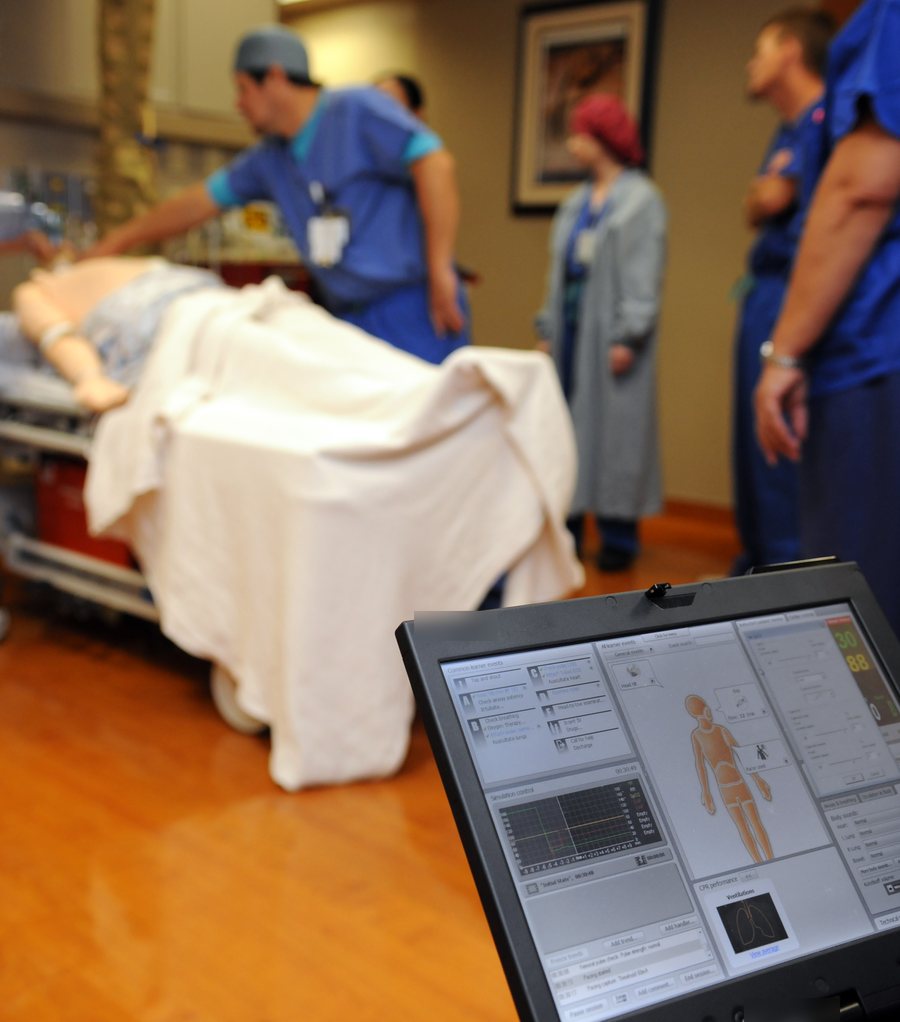

The TeamSTEPPS pocket guide, in the American Hospital Association adaptation, describes closed-loop communication: directing the request, repeating the information received, confirming understanding and reporting completion of the task. The value for simulation lies in making these steps observable. Hearing a general announcement does not prove that someone took on a responsibility (AHA, 2024).
Fictional example. The professional in charge of the room says: "I need the support defined in the plan. Can you make the call and confirm the response for me?" The colleague confirms the task and then reports whether contact was made and what guidance was received. If there was no response, the difficulty goes back to the team. The example does not define a universal protocol; it allows discussion of whether the service has a recipient, an alternative and the authority to change the plan.
The distribution of roles also needs to follow the situation. One person can lead the communication, another can seek the planned resource and another can organize care for the other people present. The composition depends on the size and duties of the team. There is no gain in creating a design that requires professionals or skills that will not be available on the actual shift.
- Note who identifies the need and who receives the request.
- Check whether receipt and responsibility are confirmed.
- Record how the team finds out that support is not available.
- Check who keeps the overall view while other people carry out tasks.
- Include the handover of information when another team takes over the situation.
The same guide distinguishes the brief planning meeting, the pause to update the plan and the later review of performance. In a scenario, the team may need to redistribute tasks when the expected resource does not arrive. This adaptation must be communicated, not assumed. The discussion of clinical leadership complements the analysis of responsibilities without making leadership an attribute of a single person (AHA, 2024).
Reception, administrative support, maintenance and other departments may know parts of the flow that the clinical team does not. Including them when relevant avoids testing only the treatment room and leaving out the path the request actually travels. The limit is the defined objective: each participation must have an understandable function in the activity, not serve only to increase its size.
Observe processes, do not look for someone to blame
A useful observation describes what happened and under what conditions. "The request was passed on, but there was no confirmation of receipt" is different from "the team communicated poorly." The first formulation allows the flow to be reconstructed. The second may be true as an impression, but it does not show what needs to change or which information was missing.
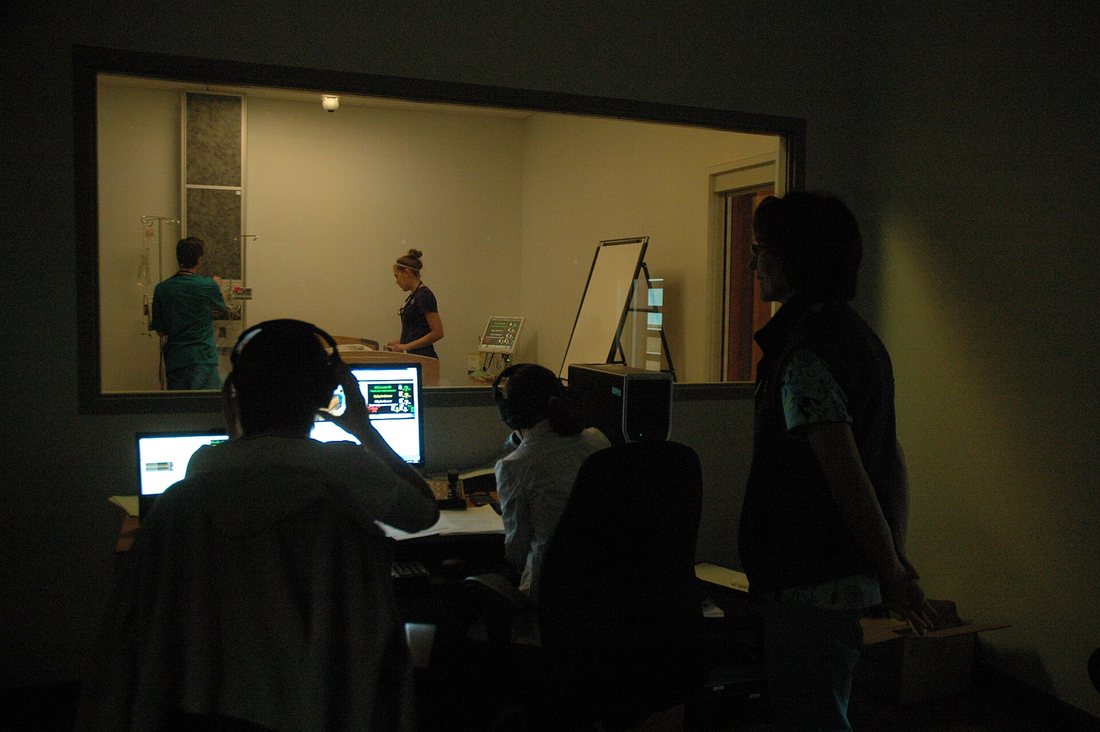

The distinction between looking only at the person and investigating working conditions is central to James Reason's text on models of error. The systemic perspective seeks to understand how the environment and the organization favor failures and which safeguards can prevent them or reduce their effects. This does not erase responsibilities; it prevents a moral explanation from replacing the analysis of the work (Reason, 2000).
Reason distinguishes active failures, committed by those in direct contact with the patient or with the system, from latent conditions, created by design, procedural or management decisions. Latent conditions can remain hidden for a long time, but, unlike active failures, they can be identified and corrected before an adverse event. This is exactly the kind of finding a service simulation looks for: a phone far from whoever needs it, a flow that depends on memory, a role nobody took on (Reason, 2000).
The observer needs to distinguish something that happened spontaneously from a difficulty introduced by the script. If the scenario foresaw that a device would be unavailable, the question is how the team recognized the unavailability and reacted. The record must not state that the service's real equipment failed just because the session lead represented a failure. The limitations of the scenario are part of the result.
A methodological chapter by Davis and colleagues describes the combination of in situ simulation with prospective failure mode analysis, in emergency cesarean sections at a maternity hospital. After ten simulations, process failures were classified by probability, severity and possibility of detection. The highest-priority failure was the absence of clear roles for team members; others involved requests for blood and tests and the lack of closed-loop communication between the operating room and the blood bank (Davis et al., 2008).
The principle worth taking away is to link each failure to the possible consequence and to an improvement action. The scores in that study were assigned by the analysis team and do not form a validated scale for predicting violence in a consultation. The example shows, however, how a failure observed in the scenario can reveal at the same time unfamiliarity with a procedure, a communication problem and an organizational defect (Davis et al., 2008).
The table below presents fictional examples of a record. The actions are proposals for discussion, not already tested solutions nor identical obligations for any service. Who will carry out the change, with which resource and within what timeframe must be defined by the responsible organization.
| Observation | Question for analysis | Referral to verify |
|---|---|---|
| The call reaches a device with no defined owner. | Who monitors this channel during the shift? | Define coverage and test receipt and an alternative. |
| Two people take on the same task. | Were the roles communicated and confirmed? | Review the distribution and observe confirmation in the retest. |
| The planned resource cannot be found. | Are location, availability and maintenance defined? | Fix the organization and check access in the real context. |
| The change of plan does not reach the reception. | Which departments need to receive the update? | Review the flow of information between departments. |
| The exercise uses a resource needed for care. | Did the pause criteria protect real care? | Replan coverage and the conditions for running it. |
It is also important to record what worked. A clear confirmation, an offer of help or the early identification of a missing resource can represent a protection worth preserving. The analysis is incomplete when it looks only for failures and stops showing which conditions allowed the team to notice them or work around them.
- Separate direct observation, participant account and session lead interpretation.
- Record the context that makes the difficulty understandable.
- Identify script interventions that changed the course.
- Describe protections that worked and need to be kept.
This way of recording is in line with the analysis of diagnostic error and teamwork, although the object here is the service in a crisis. The same attention to description, discussed in stigma and clinical language, helps prevent the team from describing people as problems instead of analyzing observable behaviors and conditions.
From discussion to action plan
The later conversation does not need to seek a single version immediately. People in different positions saw different parts of the scene. Whoever was on the phone may have noticed a failure that was not visible to whoever was watching the manikin. The session lead must allow this sequence to be reconstructed before deciding that the difficulty was a lack of attention or unfamiliarity.
The patterns summarized by INACSL recommend a planned and structured discussion, conducted in a way that supports analysis of the individual, the team and the system, with psychological safety and confidentiality. The goal of the meeting guides the depth of the analysis. It is not mandatory to discuss every clinical detail of a scenario when the main question was the path of the support (INACSL, 2025).
One possible opening is to ask participants to describe what they understood as the priority and what information they had at that moment. Then the session lead can present a concrete observation and ask how it was perceived. The wording supports inquiry: “I noticed that the request was repeated, but there was no confirmation. What could you hear at that point?”. It does not require assuming intent or exposing anyone to public judgment.
Fictional continuation of the opening scene. The reception desk reports that the destination device was moved to another room recently. The clinical team was unaware of the change. The problem is not solved merely by asking the receptionist to call more firmly. It is necessary to define channel coverage, update the information and check whether the recipient can respond during the shift.
A discussion can acknowledge both a learning need and an organizational failure. Perhaps someone does not know the flow, while the guidance document is also out of date. Choosing one of these explanations and discarding the other weakens the plan. The guidance must reach new team members, and the process must keep working when the person performing the task changes.
The feedback offered to participants must be specific and aimed at improvement. “You need to work better as a team” leaves almost everything open. “We will confirm receipt of the request and inform when there is no response” describes an observable change. The TeamSTEPPS guide recommends respectful feedback, related to behaviors and processes, timely and aimed at improvement (AHA, 2024).
The discussion about feedback in clinical cases helps distinguish a conclusion from a useful explanation. Formative assessment, in turn, clarifies why learning during an activity is not the same as receiving a certification of competence. In a service simulation, the report must state which of these functions was at stake.
At the close, each selected problem needs a follow-up path. Some actions fall to the local team; others depend on management, maintenance, technology or agreements with another service. If a change requires a decision that participants cannot make, the plan must identify that dependency. A task without authority, resources or an owner does not become feasible just because it was written on a list.
Correct, retest and monitor
Finding a difficulty is the start of the improvement work, not its end. Replacing a device, updating a contact or redistributing a role produces a hypothesis: this change may solve the observed problem. Retesting checks whether this happened under the relevant conditions and whether the solution did not introduce another difficulty. Fent's review describes considerable variation in how identified threats are recorded and resolved, which calls for care when comparing results (Fent et al., 2015).
Retesting must preserve the question. If the problem was the absence of a response on a given shift, checking the channel only during administrative hours may be insufficient. If the solution depends on a specific person, it is worth assessing what happens when someone else takes on the same role. The intent is to test the process, not to demonstrate that an experienced team member can compensate for its weaknesses.
To monitor the plan, distinguish planned change, executed change and verified change. “Update the flow” is a proposed action. “Document updated and communicated” indicates execution. “Team used the revised flow and confirmed the response in the exercise” adds an observation of how it works. These states must not appear as if they were equivalent in the report sent to management.
In Davis's study, simple changes came right after each simulation, such as moving the phone from the operating room to near the anesthesiologist. The more complex actions got owners and follow-up deadlines, and the effect of the changes was reassessed in the following simulations, observing the process and listening to the participants. It is a design that separates quick correction, long-term plan and verification (Davis et al., 2008).

- Choose the priority problems and describe the intended change.
- Define the owner, dependencies and a feasible deadline for execution.
- Record what was actually changed and communicated.
- Retest the relevant function, including alternatives when the resource fails.
- Track unwanted effects, pending items and the need for a new review.
The measures need to match the objective. It is possible to track whether a request was received, whether responsibility was clear or whether a material was accessible. Time can also be observed, but its interpretation depends on the defined start and end, the severity represented and the session lead's interventions. A number without context can encourage haste and hide failures of understanding.
It is also worth recording the operational cost of the activity itself: resources moved, need for coverage, interruptions and conditions that prevented it from taking place. In Patterson's study, the tension between real care and training was a relevant limitation. Systematically excluding the most difficult periods can leave precisely those contexts less evaluated; insisting on the exercise in the face of a real emergency, on the other hand, creates an unacceptable risk (Patterson et al., 2013).
A change that involves transferring responsibility must consider what reaches the next team. The text on failures in care transitions illustrates how information and responsibility can be lost between points in the system. In simulation, it is worth observing not only the sending of a request, but also its receipt and the continuity of the plan.
Finally, a favorable retest demonstrates something about that process and those conditions. To assess clinical outcomes or episodes of violence, appropriate records of real care are needed, along with interpretation that considers changes in context and in reporting. The article on violence against health professionals addresses the broader problem; simulation is one possible activity within the organizational response, it does not replace that response.
How NEXO fits into the study
Studying reasoning and testing how a service works are complementary activities, with different objects. In the individual study, one can review how a piece of information modifies hypotheses. In service simulation, the team observes how that information circulates, who receives the request and which resources allow the plan to be carried out. Neither task serves as an automatic measure of the other.
In NEXO, the case of the day is fictional, with a real clinical presentation and up to six progressive clues, and you propose the diagnosis by searching for the ICD-10 code. Discussing the case can help organize questions for studying a clinical situation, while simulation planning defines which aspects of collective work need to be observed.
For those who teach, this separation makes the objective clearer: an explanation about diagnosis requires clinical grounding; a conclusion about service preparedness requires observing the service. The educational resource is chosen according to the question, not used as proof of an outcome it did not assess.
Frequently asked questions
Is a sophisticated manikin necessary?
The modality must match what is meant to be tested. To check a communication flow, a simple representation may be enough; to observe interaction with a piece of equipment, its characteristics may be relevant. INACSL standards recommend aligning modality and objectives. More technology does not fix a poorly defined question nor replace team preparation (INACSL, 2025).
Does the exercise need to be a surprise?
It depends on the question. The authors of the Fent review argue for unannounced exercises, because advance notice allows the response to be prepared and may show better performance than a real emergency (Fent et al., 2015). Even so, surprise does not remove the need for preparation: limits, a pause signal and stopping criteria must be agreed with the team and with leadership, and the initial briefing remains necessary (Rudolph et al., 2014). Useful realism allows the process to be observed; it does not depend on causing fear or embarrassment.
Does finding many failures mean the team is bad?
No. The number observed depends on the scenario, on how problems are sought and on the willingness to report them. A team that identifies difficulties previously ignored may produce a longer record. Interpretation must consider context, severity and the possibility of correction, without turning the count into a ranking of professionals or services.
How should discomfort during simulation be handled?
Preparation must establish how to ask for a pause and support, without individual blame. The session lead must respect these agreements and consider previous experiences, roles and working conditions. The discussion of acute stress and clinical reasoning explores another aspect of the topic; isolated discomfort does not allow a trauma response to be diagnosed or competence to be assessed.
When can the plan be considered complete?
When the defined actions have been carried out and their verification has been documented within the established scope. Pending items and limits must remain visible. A favorable exercise does not remove the need for maintenance, orientation of new members or review after changes in team, environment and resources. Closing a task is different from the end of risk management.
Take-home messages
- Turn “preparing for crises” into an observable operational question.
- Protect real care and agree on the limits of the activity before starting.
- Test confirmation of support, roles and continuity of information.
- Analyze conditions and processes, including the protections that worked.
- Link each priority problem to an action, an owner and a verification.
- Distinguish what was observed in the simulation from outcomes in real care.
References
- Fent G, Blythe J, Farooq O, Purva M. In situ simulation as a tool for patient safety: a systematic review identifying how it is used and its effectiveness. BMJ Simul Technol Enhanc Learn. 2015;1(3):103-110. DOI: 10.1136/bmjstel-2015-000065.
- Brazil V. Translational simulation: not ‘where?’ but ‘why?’ A functional view of in situ simulation. Adv Simul. 2017;2:20. DOI: 10.1186/s41077-017-0052-3.
- Patterson MD, et al. In situ simulation: detection of safety threats and teamwork training in a high risk emergency department. BMJ Qual Saf. 2013;22(6):468-477. DOI: 10.1136/bmjqs-2012-000942.
- Geoffrion S, et al. Education and training for preventing and minimizing workplace aggression directed toward healthcare workers. Cochrane Database Syst Rev. 2020;CD011860. DOI: 10.1002/14651858.CD011860.pub2.
- International Nursing Association for Clinical Simulation and Learning. Healthcare Simulation Standards of Best Practice: Simfographic, 2025 update. 2025.
- Rudolph JW, Raemer DB, Simon R. Establishing a safe container for learning in simulation: the role of the presimulation briefing. Simul Healthc. 2014;9(6):339-349. DOI: 10.1097/SIH.0000000000000047.
- World Health Organization; International Labour Organization. Caring for those who care: guide for the development and implementation of occupational health and safety programmes for health workers. 2022.
- American Hospital Association, Team Training. TeamSTEPPS Pocket Guide. 2024.
- Reason J. Human error: models and management. BMJ. 2000;320(7237):768-770. DOI: 10.1136/bmj.320.7237.768.
- Davis S, Riley W, Gurses AP, Miller K, Hansen H. Failure Modes and Effects Analysis Based on In Situ Simulations: A Methodology to Improve Understanding of Risks and Failures. In: Henriksen K, Battles JB, Keyes MA, Grady ML, editors. Advances in Patient Safety: New Directions and Alternative Approaches (Vol. 3: Performance and Tools). Rockville (MD): Agency for Healthcare Research and Quality; 2008.