NephrologyPediatricsGlobal health
Pediatric CKD: causes, growth and transition



Table of contents
- Why CKD in children is another disease
- Causes: from the malformed kidney to the altered gene
- How to measure kidney function in children
- Growth: height as a vital sign
- Blood pressure, heart, anemia and brain
- Kidney replacement therapy worldwide: who has access
- Transition to adult care
- How NEXO helps train this reasoning
- Frequently asked questions
- Take-home messages
- References
In a fictional case, a 9-year-old boy comes to a routine visit because the school noticed he is the shortest in his class. His mother reports that he drinks a lot of water, wakes at night to urinate and tires before his classmates at recess. In the chart, there is a prenatal ultrasound showing both kidneys dilated that no one looked at again. Creatinine is high for his age, blood pressure is above the expected percentile and hemoglobin is low. The pediatrician needs to put the pieces together: short stature, thirst and the old exam tell the same story.
Chronic kidney disease (CKD) in children is rare, but it weighs heavily. It usually begins before birth, affects growth, school and the family, and follows the patient into adult life. In May 2025, the World Health Assembly approved the first World Health Organization (WHO) resolution on kidney health, which names children and pregnant women among the groups that deserve special attention (WHO, 2025).
This text covers the causes specific to childhood, the measurement of kidney function, growth, the complications that change the child's future, unequal access to treatment around the world and the transition to adult care.
Key points
- Congenital anomalies of the kidney and urinary tract (CAKUT) and hereditary diseases account for most pediatric CKD in registries from wealthy countries (Harambat et al., 2012).
- In low- and middle-income countries, glomerulonephritis appears more often and the diagnosis comes later (Pais and Wightman, 2022).
- Height is a vital sign in children with CKD: short stature is associated with fewer transplants and more deaths (Bonthuis et al., 2023).
- Growth hormone has defined criteria and is only started after correcting nutrition, acidosis and mineral disorder (Drube et al., 2019).
- Attention, working memory and executive functions can be affected, which calls for a look at school (Wijaya et al., 2022).
- Resolution WHA78.6 asks countries to include kidney care in universal coverage, with transplantation as the preferred option (WHO, 2025).
Summary
- Why CKD in children is another disease
- Causes: from malformed kidney to altered gene
- How to measure kidney function in children
- Growth: height as a vital sign
- Blood pressure, heart, anemia and brain
- Kidney therapy in the world: who has access
- Transition to adult care
- How NEXO helps train this reasoning
- Frequently asked questions
- Take-home messages
Why CKD in children is another disease
In adults, CKD is usually the late consequence of diabetes and hypertension, and staging by glomerular filtration rate (GFR) and albuminuria organizes risk, as shown in the text on KDIGO 2024 CKD staging. In children, the logic changes. The disease starts from a kidney that formed poorly, from an altered gene or from a glomerulopathy, and coexists with a body that still needs to grow, learn and mature.
The difference starts with staging itself. The GFR categories used in adults do not apply before age 2, because the baby's filtration is still maturing and is normally low by adult standards (Harambat et al., 2012). A healthy newborn has a GFR that looks insufficient by adult criteria and doubles in the first weeks.
Rare, but long-lasting
Pediatric CKD is uncommon. In European registries, the incidence of CKD stages 3 to 5 is around 11 to 12 per million children in the same age group per year (Harambat et al., 2012). Rarity is a trap. The primary care physician sees few such patients over a career and may attribute short stature to the family, thirst to heat and anemia to diet.
The weight comes from time. A child who starts dialysis at age 5 may live for decades with the disease. Mortality on kidney replacement therapy is around 30 times that of children of the same age, even in the best services (Bonthuis et al., 2021). The estimated life expectancy for an adolescent with a transplanted kidney is 63 years, versus 38 years for those who remain on dialysis (Harambat et al., 2012).
What the pediatrician needs to recognize
The initial signs are subtle: slow growth, excessive thirst and urination, repeated urinary infections, high blood pressure for age, fatigue and pallor. The clinical path to assess the child who is falling behind without obvious signs appears in the clinical reasoning exercises for pediatrics. In acute presentations, the rapid worsening of a child with CKD can be recognized by the pediatric warning scores.
Causes: from the malformed kidney to the altered gene
CAKUT and hereditary diseases
In the North American NAPRTCS registry, congenital anomalies of the kidney and urinary tract account for 48 percent of childhood CKD cases, hereditary diseases for 10 percent and glomerulonephritis for 14 percent (Harambat et al., 2012). The Italian and Belgian registries show similar proportions, with congenital anomalies around 58 percent (Harambat et al., 2012). The CAKUT group includes renal hypoplasia and dysplasia, posterior urethral valves, ureteropelvic junction obstruction and high-grade vesicoureteral reflux.
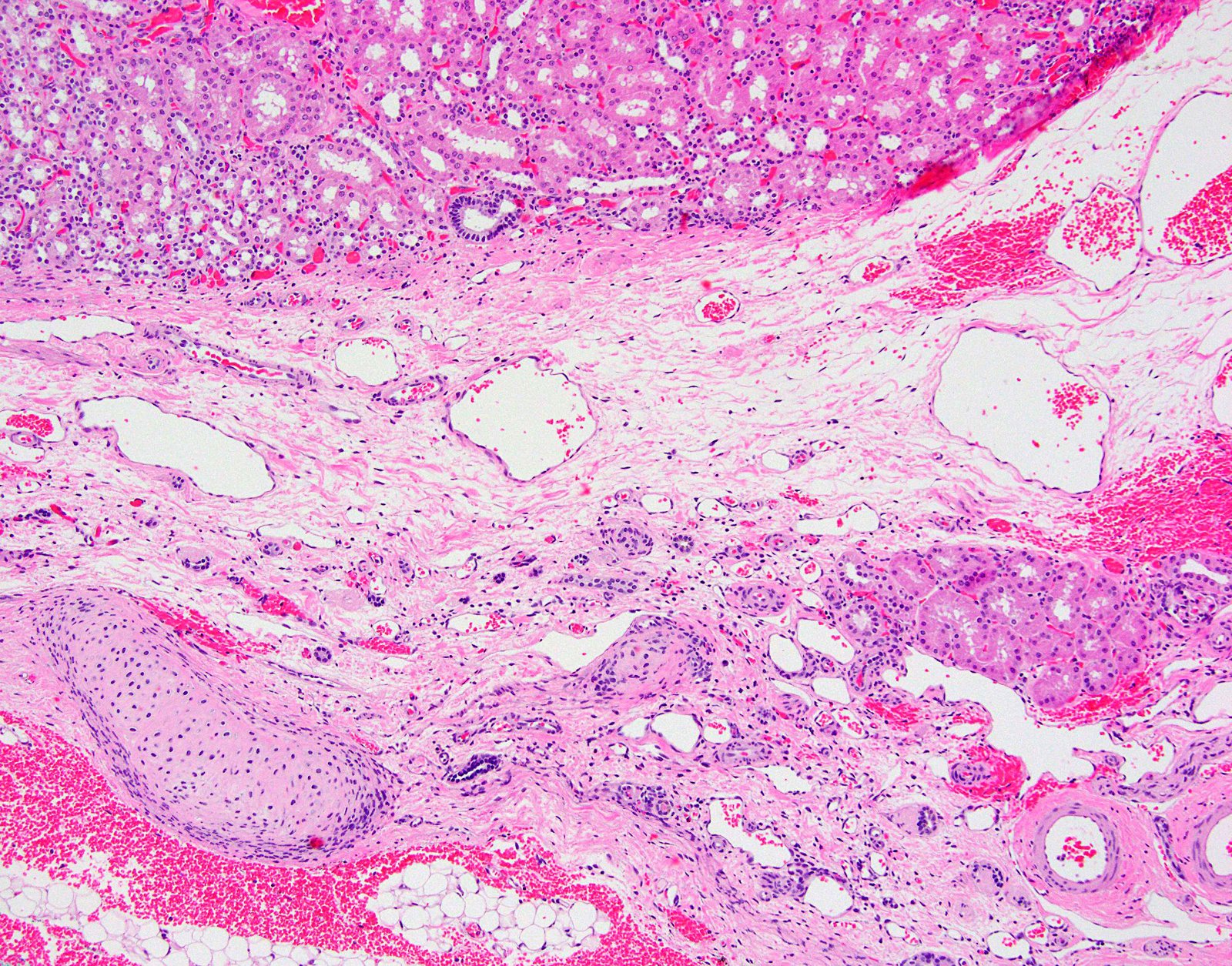
An Italian review gathered the most frequent causes: CAKUT, steroid-resistant nephrotic syndrome, glomerulonephritis and ciliopathies, which together account for more than 70 percent of cases (Becherucci et al., 2016). Renal dysplasia, shown in the image below, is the clearest example of a kidney that did not form the right way.
The weight of genetics
Genetics changed diagnosis. More than 600 genes have already been linked to kidney diseases, and a monogenic cause appears in 10 to 60 percent of patients, depending on the group studied (Cirillo et al., 2023). When the disease begins before age 25, about 20 percent of patients have an identifiable monogenic cause (Becherucci et al., 2016). Finding the gene changes family counseling, avoids biopsies and useless treatments, such as steroids in a genetic nephrotic syndrome, and guides the choice of a related living donor.
The kidney that forms before birth
Nephron formation ends between 34 and 36 weeks of gestation, and the baby does not gain new nephrons after that (Cirillo et al., 2023). Prematurity and low birth weight reduce the number of nephrons and leave a kidney with less reserve for life. The WHO resolution recognizes this link by recalling that hypertensive disorders of pregnancy lead to premature and low birth weight babies, who have a higher risk of kidney disease (WHO, 2025).
Acquired causes and differences between countries
Acute kidney injury is another gateway. It affects 10 to 35 percent of children in pediatric intensive care, and some of them are left with chronic sequelae (Cirillo et al., 2023). Nephrotoxic drugs also count: after ifosfamide used in childhood tumors, CKD appears in up to 30 percent of patients (Cirillo et al., 2023).
The map of causes changes with a country's income. In low- and middle-income countries, glomerulonephritis accounts for 30 percent to almost 60 percent of recorded causes (Harambat et al., 2012). Repeated infections, lack of sanitation and contaminated water favor glomerulopathies and episodes of acute injury, while the lack of prenatal care and primary care delays the detection of malformations (Pais and Wightman, 2022). The WHO resolution lists malaria, dengue, HIV, tuberculosis, hepatitis, sepsis and diarrheal diseases among the infections that can damage children's kidneys (WHO, 2025).
How to measure kidney function in children
Creatinine and the pediatric equations
Creatinine depends on muscle mass, and a child's muscle mass changes every year. That is why adult equations do not work. The bedside Schwartz equation, revised in 2009, uses height and creatinine, and the CKiD U25 equation, from 2021, combines creatinine and cystatin C, does not require height and is valid up to age 25 (Cirillo et al., 2023). The second has a practical advantage in transition, because it follows the patient without a change of formula when moving to the adult clinic.
The newborn is a case apart
In the first 72 hours of life, the baby's creatinine still reflects the mother's and is not useful for estimating kidney function (Cirillo et al., 2023). The GFR of a full-term newborn doubles in the first five days, approaches 60 mL/min/1.73 m² at one month, and only reaches the adult value between 18 and 24 months (Cirillo et al., 2023). A single value in the nursery says little; the trend says a lot.
To screen or not to screen
Screening with a urine dipstick in children without symptoms is controversial. The American Academy of Pediatrics dropped the routine dipstick in 2007 because screening did not prove advantageous, although countries such as Japan, Korea and Taiwan maintain school programs (Harambat et al., 2012). The safest path lies in attentive primary care: measure height and blood pressure at every visit and review prenatal imaging studies. Without continuous follow-up, these signs are lost, as discussed in the text about the four attributes of primary care.
Growth: height as a vital sign
How much height CKD steals
More than 35 percent of children with CKD fall below the 3rd percentile for height (Becherucci et al., 2016). About 40 percent of those who start renal replacement therapy in childhood reach adulthood with reduced final height (Drube et al., 2019). The greatest harm happens early. A third of all postnatal growth occurs in the first two years, and in this phase nutrition matters more than any hormone (Becherucci et al., 2016).
The causes add up: low calorie intake, vomiting, metabolic acidosis, loss of salt and water, mineral and bone disorder, anemia, resistance to growth hormone and delayed puberty. Each one calls for correction before considering hormone therapy.
The WHO ruler
To know whether a child is growing poorly, a common ruler is needed. The WHO child growth standards, released in 2006, describe how healthy children should grow from birth to 5 years and include length and height for age, weight, body mass index and motor milestones (WHO, 2006). In 2007, the WHO extended the height and body mass index curves to 19 years, with a smooth transition at 5 years and cutoffs aligned with those for adults (de Onis et al., 2007).
The European registry of children on renal therapy uses WHO criteria to assess weight below 2 years (Bonthuis et al., 2023). The practical point is simple: measure recumbent length below 2 years, standing height afterward, plot it on the curve and calculate growth velocity (Drube et al., 2019).
Height, transplant and survival
Height is not just aesthetic. In a European registry of 11,873 children on renal therapy, short stature was associated with a lower chance of transplant and with more than double the risk of death, with an adjusted hazard ratio of 2.30 (Bonthuis et al., 2023). Low weight and obesity also increased mortality, especially cardiovascular mortality, in the same study (Bonthuis et al., 2023). Short stature works as a marker of more severe disease and of insufficient nutrition.
When to use growth hormone
The 2019 European consensus defined when to indicate recombinant growth hormone (Drube et al., 2019):
- CKD in stages 3 to 5 or on dialysis, older than 6 months.
- Height below the 3rd percentile and growth velocity below the 25th percentile.
- Malnutrition, acidosis, sodium and water disorder and mineral disorder already corrected, with bicarbonate of at least 22 mmol/L.
- Parathyroid hormone controlled; very high values contraindicate starting.
- After transplant, wait 1 year before considering the hormone.
The recommended dose is 0.045 to 0.05 mg/kg per day, subcutaneously, at night (Drube et al., 2019). In the meta-analysis cited by the consensus, treatment added 3.88 cm per year in the first year compared with the control group (Drube et al., 2019). From age 8 to 10, many children learn to give themselves the injection, which is already a step in the transition.
Blood pressure, heart, anemia and brain
Hypertension and the heart
Hypertension appears in about half of children with CKD; in the North American CKiD cohort, 54 percent had hypertension and 38 percent had masked hypertension, seen only on ambulatory monitoring (Becherucci et al., 2016). The ESCAPE trial, with 385 children, showed that targeting blood pressure below the 50th percentile for age reduced the risk of disease progression by 35 percent (Becherucci et al., 2016).
The heart suffers early. Left ventricular hypertrophy and arterial stiffness already appear in childhood, and cardiovascular disease accounts for 30 to 40 percent of deaths among children on kidney replacement therapy (Harambat et al., 2012). In the European registry, cardiovascular disease was the most frequent cause of death, ahead of infections (Bonthuis et al., 2021).
Anemia
Anemia grows with loss of function: it appears in 73 percent of children at stage 3, 87 percent at stage 4 and 93 percent at stage 5 (Becherucci et al., 2016). It worsens fatigue, appetite, school performance and the heart. Infants often need proportionally higher doses of erythropoietin than older children. The general management of renal anemia is in the text on anemia in CKD and KDIGO 2026.
Cognition and school
The systematic review by Wijaya and colleagues found impairment in attention, visuospatial skills, working memory and executive functions in children with CKD (Wijaya et al., 2022). Associated factors included longer time on hemodialysis, hypertension, seizures, problems at birth and lower maternal education; transplantation was associated with better outcomes (Wijaya et al., 2022). For the family, this means talking to the school, requesting a neuropsychological assessment when performance drops and not attributing difficulties to laziness.
Progression and puberty
Progression tends to speed up during puberty. In the Italian ItalKid study, 68 percent of children with renal hypodysplasia reached end-stage disease by age 20 (Harambat et al., 2012). New drugs tested in adults, such as finerenone and SGLT2 inhibitors, still have little data in children; as of 2023, there was no registered pediatric trial with an SGLT2 inhibitor (Cirillo et al., 2023).
Kidney replacement therapy worldwide: who has access
What the registries say
In Europe, the incidence of children under 15 starting kidney replacement therapy stayed stable between 5.5 and 6.6 per million per year from 2007 to 2016 (Bonthuis et al., 2021). Four in five started on dialysis and one in five received a preemptive transplant, before any dialysis (Bonthuis et al., 2021). Five-year survival was around 94 percent, and five-year graft survival was 89 percent (Bonthuis et al., 2021).
The other side of the map
These numbers describe a minority of the world's children. About 80 percent of children on kidney replacement therapy live in Europe, Japan or North America (Harambat et al., 2012). In much of sub-Saharan Africa, pediatric maintenance dialysis is practically nonexistent, and fewer than 10 percent of children with kidney failure worldwide receive dialysis or a transplant (Pais and Wightman, 2022). Where treatment comes out of the family's own pocket, death or abandonment of treatment affects 50 to 80 percent of children in series from isolated centers (Pais and Wightman, 2022).
Peritoneal dialysis is the preferred modality in small children, but the supplies are expensive, and in many places parents do manual exchanges for 12 to 16 hours a day (Pais and Wightman, 2022). A child's illness becomes the impoverishment of the whole family. The pattern follows the inverse care law: those who need the most receive the least.
Resolution WHA78.6
The resolution approved in May 2025 estimates that about 674 million people live with CKD, 9 percent of the world population, and projects the disease as the fifth leading cause of death in 2050 (WHO, 2025). The text calls kidney disease the main cause of catastrophic health spending in many developing countries, where few cover dialysis and transplant (WHO, 2025).
The resolution asks countries to include kidney care in universal coverage packages, with peritoneal dialysis, hemodialysis, transplant and conservative care, and with special attention to pregnant women and children (WHO, 2025). It treats transplant as the preferred option for those with the clinical condition and calls for national kidney disease registries. The first progress reports are expected in 2027, 2029 and 2031. Alternatives to human transplant, such as pig kidney xenotransplantation, are still far from pediatric reality.
Table: the child with CKD on one page
| Topic | What changes in the child | Source |
|---|---|---|
| Main cause in rich countries | Congenital anomalies of the kidney and urinary tract and hereditary diseases | Harambat et al., 2012 |
| Frequent cause in low and middle income countries | Glomerulonephritis, with later diagnosis | Pais and Wightman, 2022 |
| Function estimate | Bedside Schwartz or CKiD U25; neonatal creatinine has no value in the first 72 hours | Cirillo et al., 2023 |
| Growth chart | WHO curves from birth to 19 years | de Onis et al., 2007 |
| Growth hormone | Height below the 3rd percentile and velocity below the 25th percentile, after correcting treatable factors | Drube et al., 2019 |
| Blood pressure target | Below the 50th percentile for age in the ESCAPE trial | Becherucci et al., 2016 |
| Cognition | Attention, working memory and executive functions | Wijaya et al., 2022 |
| Access to treatment | Universal coverage with transplant as the preferred option | WHO, 2025 |
| Transition | Start in early adolescence and transfer in a stable phase | Močnik et al., 2022 |
Transition to adult care
Why the handover fails
Pediatrics cares for the family; the adult clinic expects an autonomous patient. Between one and the other, the young person may miss appointments, abandon medications and, in the transplant recipient, lose the graft. Young people with mild CKD, malformations operated on in childhood or hypertension without medication are the most forgotten, because they do not have frequent appointments (Močnik et al., 2022).
In a Slovenian survey of 100 young people aged 17 or older followed in pediatric nephrology, 46 percent did not know who would care for them afterwards and about one third did not know how the disease affected their choice of profession and reproductive health (Močnik et al., 2022). Almost all lived with their parents, and many still came to appointments accompanied.
How to carry out the transition
The international consensus cited by the authors proposes starting preparation in early adolescence, between 12 and 14 years, gradually and suited to development, and making the transfer in a stable phase of the disease, after finishing school (Močnik et al., 2022). Preparation includes explaining the disease to the young person in their own words, teaching the name and effect of the medications, practicing coming to the appointment alone and talking about profession, sexuality, pregnancy, alcohol and drugs.
The method of checking whether the patient understood works for the adolescent. Asking them to explain, in their own words, why they take each medication reveals gaps that a nod hides. A joint appointment between the pediatric and adult nephrologist helps pass on the bond, and the family doctor holds continuity, as the text on longitudinality shows. The most common errors recall those of the transition from hospital discharge to primary care: information that does not arrive, a person in charge who is not defined and a patient who disappears.
Who follows whom
There is agreement that young people with CKD in stages 3 and 4 should be transferred to the adult nephrologist, while those with CKD in stages 1 and 2 can stay in primary care and return to the specialist if progression, hypertension or proteinuria appears (Močnik et al., 2022). The important thing is that someone has the young person's name on the list.
Back to the boy from the opening
The 9-year-old boy has the typical signs of CKD from an undetected urinary malformation: prenatal renal dilation, polyuria, short stature, anemia and high blood pressure. The next step is ultrasonography, urinalysis, estimation of GFR by pediatric equation and referral to a pediatric nephrologist. Before considering growth hormone, the team corrects nutrition, acidosis, anemia and mineral disorder, plots height on the WHO curve and measures growth velocity at every visit. The conversation about transition starts in three or four years, but autonomy can begin now, with him learning the names of his own medications.
How NEXO helps train this reasoning
In NEXO, the case of the day is fictional, with a real clinical presentation and up to six progressive clues, and you propose the diagnosis by searching for the ICD-10 code.
The limits on using the game are described on the NEXO Economy page. If you research the teaching of clinical reasoning, the page for Researchers explains how to get in touch. Professionals who write or review cases find information on Curator and on Creators, and institutions can learn about the proposal on the partnerships page. Searching for the right ICD-10 code completes this training.
Frequently asked questions
What is the most common cause of CKD in children?
In records from wealthy countries, congenital anomalies of the kidney and urinary tract, such as dysplasia, hypoplasia and posterior urethral valve, come first, followed by hereditary and glomerular diseases. In low- and middle-income countries, glomerulonephritis weighs more.
Can I use the adult equation to estimate a child's GFR?
In children, the bedside Schwartz equation or CKiD U25 is used, which combines creatinine and cystatin C and is valid up to age 25. In the newborn, creatinine in the first 72 hours reflects the mother's.
Should every short child with CKD receive growth hormone?
Hormone is started only when height is below the 3rd percentile, growth velocity is below the 25th percentile and treatable factors, such as nutrition, acidosis and mineral disorder, have already been corrected. After transplantation, 1 year is awaited.
Does CKD affect school performance?
It can affect attention, working memory and executive functions. Prolonged hemodialysis, hypertension and seizures worsen the picture, and transplantation is associated with better outcomes. The school should be part of the care.
What does the 2025 WHO resolution change for children?
It asks countries to include full kidney care in universal coverage, with special attention to children and pregnant women, treats transplantation as the preferred option and calls for national kidney disease registries.
At what age should transition to the adult nephrologist begin?
Preparation begins in early adolescence, between 12 and 14 years, gradually. Transfer happens at a stable phase of the disease, generally after the end of school, with a joint consultation whenever possible.
Take-home messages
- CKD in children arises, most of the time, from urinary malformations and genes, not from diabetes or hypertension.
- Prematurity and low birth weight leave fewer nephrons for life.
- A child's kidney function is estimated with pediatric equations; creatinine in the first days of life reflects the mother's.
- Height is a vital sign: measure at every visit, plot on the WHO curve and correct treatable factors before growth hormone.
- Blood pressure below the 50th percentile, anemia control and attention to school change the child's future.
- Access to pediatric dialysis and transplantation is deeply unequal around the world, and resolution WHA78.6 calls for universal coverage (WHO, 2025).
- Transition begins in early adolescence and ends only when someone takes over the care of the young adult.
Milestone inventory
- 2006: WHO launches child growth curves from birth to 5 years (WHO, 2006).
- 2007: WHO extends the height and body mass index curves to 19 years (de Onis et al., 2007).
- 2009: the ESCAPE trial shows benefit of intensive blood pressure control in children with CKD, and the Schwartz equation is revised.
- 2019: the European consensus defines criteria for growth hormone in pediatric CKD (Drube et al., 2019).
- 2021: the CKiD U25 equation starts estimating GFR from infancy to young adulthood, and the European registry publishes ten years of pediatric kidney replacement therapy data (Bonthuis et al., 2021).
- 2025: the World Health Assembly approves resolution WHA78.6, the first on kidney health (WHO, 2025).
Play the case of the day on NEXO.
References
- Harambat J, van Stralen KJ, Kim JJ, Tizard EJ. Epidemiology of chronic kidney disease in children. Pediatr Nephrol. 2012;27(3):363-373. PMID 21713524. DOI 10.1007/s00467-011-1939-1.
- Becherucci F, Roperto RM, Materassi M, Romagnani P. Chronic kidney disease in children. Clin Kidney J. 2016;9(4):583-591. PMID 27478602. DOI 10.1093/ckj/sfw047.
- Cirillo L, De Chiara L, Innocenti S, et al. Chronic kidney disease in children: an update. Clin Kidney J. 2023;16(10):1600-1611. PMID 37779846. DOI 10.1093/ckj/sfad097.
- Drube J, Wan M, Bonthuis M, et al. Clinical practice recommendations for growth hormone treatment in children with chronic kidney disease. Nat Rev Nephrol. 2019;15(9):577-589. PMID 31197263. DOI 10.1038/s41581-019-0161-4.
- Wijaya EA, Solek P, Hakim DDL, et al. Factors Affecting Neurocognitive Function in Children with Chronic Kidney Disease: A Systematic Review. Int J Nephrol Renovasc Dis. 2022;15:277-288. PMID 36329897. DOI 10.2147/IJNRD.S375242.
- Pais P, Wightman A. Addressing the Ethical Challenges of Providing Kidney Failure Care for Children: A Global Stance. Front Pediatr. 2022;10:842783. PMID 35359883. DOI 10.3389/fped.2022.842783.
- Bonthuis M, Vidal E, Bjerre A, et al. Ten-year trends in epidemiology and outcomes of pediatric kidney replacement therapy in Europe: data from the ESPN/ERA-EDTA Registry. Pediatr Nephrol. 2021;36(8):2337-2348. PMID 33483800. DOI 10.1007/s00467-021-04928-w.
- Bonthuis M, Bakkaloglu SA, Vidal E, et al. Associations of longitudinal height and weight with clinical outcomes in pediatric kidney replacement therapy: results from the ESPN/ERA Registry. Pediatr Nephrol. 2023;38(10):3435-3443. PMID 37154961. DOI 10.1007/s00467-023-05973-3.
- Močnik M, Golob Jančič S, Marčun Varda N. Transition of Chronic Pediatric Nephrological Patients to Adult Care Excluding Patients on Renal Replacement Therapy with Literature Review. Children (Basel). 2022;9(7):959. PMID 35883943. DOI 10.3390/children9070959.
- de Onis M, Onyango AW, Borghi E, et al. Development of a WHO growth reference for school-aged children and adolescents. Bull World Health Organ. 2007;85(9):660-667. PMID 18026621. DOI 10.2471/BLT.07.043497.
- World Health Organization. Resolution WHA78.6: Reducing the burden of noncommunicable diseases through promotion of kidney health and strengthening prevention and control of kidney disease. Seventy-eighth World Health Assembly, 27 May 2025. Official text.
- World Health Organization. Child growth standards. Geneva: WHO; 2006. Official page.