Adjuvant pembrolizumab in kidney cancer: KEYNOTE-564

Table of contents
- Why this is a reasoning scenario
- The risk of recurrence after nephrectomy
- The design of KEYNOTE-564
- What KEYNOTE-564 showed
- Immune-mediated toxicity
- Who has enough risk
- What other studies teach
- How to conduct the conversation
- How NEXO helps train this reasoning
- Frequently asked questions
- Final checklist
- References
A 52-year-old teacher underwent radical nephrectomy for a 9-centimeter kidney tumor. The report describes clear cell carcinoma, stage pT3a, nuclear grade 3, with no involved lymph nodes and free margins. The CT scan after surgery shows no disease. The team proposes pembrolizumab for one year to reduce the risk of recurrence. He asks whether it is worth receiving a year of immunotherapy when the tumor has already been removed, and what can happen to his body during that period. The scene is fictional and was written for teaching.
This text uses the case as a clinical reasoning scenario for students and health professionals. The topic is adjuvant pembrolizumab in kidney cancer based on the KEYNOTE-564 trial, and the question Dr. Alexei proposed for the series: which patients have enough risk to justify adjuvant treatment and exposure to immune-mediated toxicity? The text does not replace your country's guideline or your institution's protocol. If you play the case of the day on NEXO, you will recognize the challenge: deciding when to treat someone who, after surgery, has no visible disease.
Key points
- KEYNOTE-564 compared pembrolizumab for up to one year with placebo after nephrectomy in 994 patients at intermediate-high or high risk of recurrence.
- Pembrolizumab prolonged disease-free survival, with a hazard ratio of 0.68.
- The trial also showed a gain in overall survival, with a hazard ratio of 0.62 and 48-month survival of about 91 versus 86 per 100.
- Serious adverse events occurred in about 20 per 100 patients, and about 21 per 100 discontinued treatment due to an adverse effect.
- The trial criteria group together patients with very different risks, and selection requires looking beyond stage.
- Some immune-mediated effects, such as hypothyroidism, adrenal insufficiency and type 1 diabetes, may require hormone replacement or insulin.
Why this is a reasoning scenario
Adjuvant treatment is given to those who have no visible disease after surgery. The logic is to eliminate cells that may have remained in the body and that, without treatment, would give rise to a recurrence. The problem is that not every patient has these cells. Some of those operated on would never have a recurrence, and these patients receive the treatment and its effects with no possible benefit.
In kidney cancer, this question went unanswered for a long time. A 2020 review recalled that trials with chemotherapy, radiotherapy, cytokines, hormones, vaccines and tyrosine kinase inhibitors had given disappointing or conflicting results, and that there was no routinely used adjuvant therapy able to improve outcomes safely (Tacconi et al., 2020). KEYNOTE-564 changed this picture. The post on clinical decision-making helps to think about choices with benefit for few and risk for all.
The question has two halves
Dr. Alexei's question combines two assessments. The first is the risk of recurrence, which defines how much benefit is possible. The second is the risk of toxicity, which applies to everyone treated. Clinical reasoning consists of putting both on the same scale, patient by patient. The post on pretest probability works with the idea that the same relative effect produces different absolute gains depending on baseline risk.
The risk of recurrence after nephrectomy
A review of prognostic factors estimates that about 20 per 100 patients with kidney cancer already arrive with metastases, and that more than 30 per 100 of those with localized disease develop metastases after complete removal of the tumor (Mattila et al., 2022). Most recurrences occur in the first five years, but up to 10 per 100 appear after that.
The same review points out that simple pathology factors, such as tumor size, grade, vascular invasion and extension beyond the kidney, remain good predictors of recurrence risk (Mattila et al., 2022). These factors were combined into prognostic models, such as UISS, SSIGN and the Leibovich score, used at different centers to estimate individual risk.
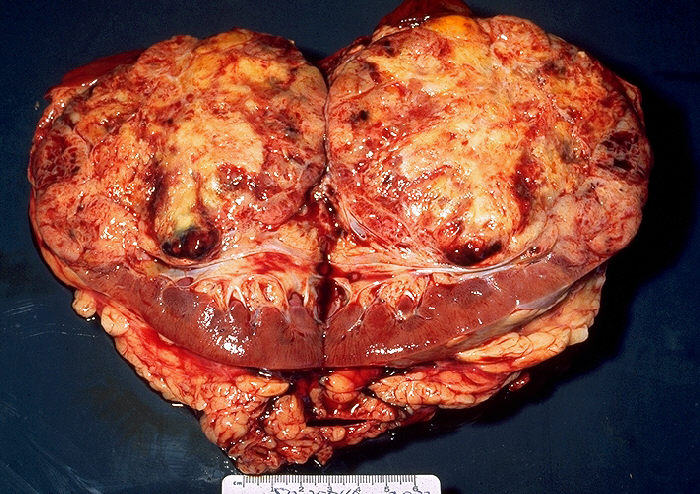


Factors that weigh on risk
- Tumor size and local extension, which define the T stage.
- Involvement of regional lymph nodes.
- Nuclear grade, especially grade 4.
- Sarcomatoid differentiation.
- Tumor necrosis and vascular invasion.
- Metastasis completely resected, when present.
The design of KEYNOTE-564
The US label for Keytruda describes KEYNOTE-564 as a multicenter, randomized, double-blind, placebo-controlled study with 994 patients who had intermediate-high or high risk of recurrence, or resected metastatic disease with no evidence of disease (Keytruda label). Patients had to have undergone partial or radical nephrectomy with negative margins at least 4 weeks before screening.
The study risk categories
- Intermediate-high risk: pT2 tumor with grade 4, or pT3 of any grade, without lymph nodes and without metastases.
- High risk: pT4 tumor of any grade, or any pT with involved lymph nodes, without metastases.
- Resected metastatic disease: complete removal of the primary tumor and the metastases.
According to the label, about 86 in 100 patients were in the intermediate-high category, 8 in 100 in the high category and 6 in 100 had resected metastasis. The median age was 60 years, and about 11 in 100 had a sarcomatoid component. Patients with active autoimmune disease or a condition requiring immunosuppression were excluded (Keytruda label).
The dose
In the study, patients received pembrolizumab 200 mg intravenously every 3 weeks or placebo for up to one year, until recurrence or unacceptable toxicity. The US label indicates, for adjuvant treatment of kidney cancer, 200 mg every 3 weeks or 400 mg every 6 weeks as a single agent (Keytruda label). The study quality-of-life analysis describes the same schedule as up to 17 cycles (Choueiri et al., 2024).
What KEYNOTE-564 showed
The primary endpoint was investigator-assessed disease-free survival, defined as the time to recurrence, metastasis or death. Overall survival was an additional endpoint. The US label records a statistically significant improvement in both endpoints, in planned interim analyses (Keytruda label).
| Result | Pembrolizumab | Placebo |
|---|---|---|
| Randomized patients | 496 | 498 |
| Recurrence, metastasis or death | About 22 in 100 | About 30 in 100 |
| Disease-free at 24 months | About 77 in 100 | About 68 in 100 |
| Hazard ratio for disease-free survival | 0.68, with confidence interval 0.53 to 0.87 | |
| Deaths | About 11 in 100 | About 17 in 100 |
| Alive at 48 months | About 91 in 100 | About 86 in 100 |
| Hazard ratio for overall survival | 0.62, with confidence interval 0.44 to 0.87 | |
Source of the table numbers: Keytruda label.
Why the overall survival gain matters
In adjuvant treatment, the gain in time without disease does not always translate into more years of life, because patients who recur can later be treated with effective drugs. That is why the demonstration of overall survival in KEYNOTE-564 is the central point of the study. A 2023 review, written before this result, still noted that the available data did not show an overall survival improvement with adjuvant immunotherapy, only a trend favoring pembrolizumab (Cosso et al., 2023). Reading the evidence requires considering the date of each source.
In absolute numbers, the difference in survival at 48 months was about 5 people in every 100 treated. It is a benefit that should be presented with the absolute number, alongside the hazard ratio, so that the patient understands the size of the gain. The post about diagnostic uncertainty helps communicate numbers without exaggerating or minimizing.
The East Asian subgroup
A later analysis of the 126 participants from Japan, South Korea and Taiwan, with a median follow-up of 62.1 months, found a hazard ratio of 0.70 for disease-free survival and 0.47 for overall survival, with wide confidence intervals that crossed 1 (Park and colleagues, 2026). Treatment-related adverse events occurred in about 71 of every 100 patients on pembrolizumab, with grade 3 or 4 in about 29 of every 100. Small subgroups serve to check consistency, not to decide on their own.
Immune-mediated toxicity
Pembrolizumab blocks the PD-1 receptor and releases the immune response. The US label explains that this mechanism can break peripheral tolerance and cause severe or fatal immune-mediated reactions in any organ, during treatment or after discontinuation (Keytruda label). The label calls for measuring liver enzymes, creatinine and thyroid function before starting and periodically.
In KEYNOTE-564, median exposure to pembrolizumab was 11.1 months. Serious adverse events occurred in about 20 of every 100 patients, among them acute kidney injury, adrenal insufficiency, pneumonia, colitis and diabetic ketoacidosis, each in about 1 of every 100. About 21 of every 100 stopped treatment because of an adverse effect, and there was one death from pneumonia (Keytruda label).
The most frequent effects
According to the label table, the differences from placebo appeared mainly in fatigue, about 40 versus 31 of every 100, rash, 30 versus 15, itching, 23 versus 13, and diarrhea, 27 versus 23 (Keytruda label). Hypothyroidism occurred in about 21 of every 100 patients on pembrolizumab, versus fewer than 4 of every 100 on placebo, and hyperthyroidism in about 12 of every 100.
Effects that require ongoing treatment
Some immune-mediated effects affect glands. The US label advises starting hormone replacement in hypothyroidism and adrenal insufficiency, and describes type 1 diabetes, which can present with ketoacidosis and requires insulin (Keytruda label). For those who would not have a recurrence, these effects are a cost without benefit. This is the core of the second half of Dr. Alexei's question.
There are also rare and little-known effects. One report describes a 37-year-old man with pathological humerus fractures during adjuvant pembrolizumab after nephrectomy, and the authors note that the effects of checkpoint inhibitors on bone are still poorly understood (Kang and colleagues, 2024).


And quality of life?
The analysis of patient-reported outcomes from KEYNOTE-564 found no clinically important difference between pembrolizumab and placebo at week 52 in global health, physical function and kidney cancer-related symptoms (Choueiri and colleagues, 2024). Most patients kept or improved their scores, though the proportion was slightly lower with pembrolizumab. A qualitative study with participants from another adjuvant immunotherapy trial showed that many gave more importance to the duration and chronicity of immune-mediated effects than to their severity (Merrick and colleagues, 2026).
Who has enough risk
Here is the heart of the question. The KEYNOTE-564 criteria define who can receive the treatment, but they do not guarantee that all eligible patients have the same risk. An analysis published after the study showed that, by the Leibovich score, the estimated 5-year metastasis-free survival among eligible patients can range from about 12 to 95 of every 100, and by the ASSURE study model, disease-free survival ranges from 8 to 79 of every 100 (Marchioni and colleagues, 2022).
In the series of 681 patients analyzed by these authors, about 26 out of every 100 would be eligible by the KEYNOTE-564 criteria, and most of them had pT3a stage without lymph nodes (Marchioni and colleagues, 2022). These patients fall in the intermediate-high category, but their risk of recurrence varies widely. The authors argue that the higher the risk of recurrence, the better the cost-benefit ratio of adjuvant pembrolizumab.
How to apply this to the teacher in the scene
The teacher has a pT3a tumor, grade 3, without lymph nodes. He meets the study criteria in the intermediate-high category, but the individual risk depends on other factors, such as necrosis, vascular invasion and the exact size of the tumor. A prognostic model helps estimate this risk and present the absolute benefit honestly. If the estimated risk is low, the possible gain is small against a year of exposure to toxicity.
Profiles that weigh for and against
- For: involved lymph nodes, pT4 tumor, grade 4 or sarcomatoid component.
- For: fully resected metastasis, the highest-risk category in the study.
- Against: active autoimmune disease or need for immunosuppression, the study's exclusion criteria.
- Against: low estimated risk of recurrence within the intermediate-high category.
- Against: strong preference to avoid effects that may require continuous treatment.
- Consider: histology other than clear cell, poorly represented in the study.
What other studies teach
The KEYNOTE-564 result was not repeated by other checkpoint inhibitors. In CheckMate 914, nivolumab for about 24 weeks did not improve disease-free survival compared with placebo, with a hazard ratio of 0.87 and a confidence interval that crossed 1 (Motzer and colleagues, 2025). The first part of the same study, with nivolumab and ipilimumab, also showed no benefit.
This contrast is a lesson in reasoning. Drugs of the same class, in similar populations, gave different results. Possible explanations include the duration of treatment, the population included and the way recurrence was assessed, but none of them has been proven. What can be stated is that the demonstrated benefit applies to pembrolizumab in the regimen and population of KEYNOTE-564. The post on heuristics in clinical reasoning helps avoid generalizations by drug class.


Data from practice
In the ARON-1 study, which gathered 311 patients treated with adjuvant pembrolizumab at 40 hospitals in 12 countries, 2-year overall survival was about 95 out of every 100 and disease-free survival about 69 out of every 100, with a median follow-up of 15.4 months (Kopp and colleagues, 2025). Recurrence occurred in about 20 out of every 100, mainly in the lungs and bones.
A single-center Japanese series shows how the decision happens in the office. Of 21 eligible patients operated after the drug was approved in Japan, 16 received pembrolizumab and 5 did not, due to patient preference, kidney function, age with dementia or priority to treat another cancer (Furubayashi and colleagues, 2026). Among those treated, the median duration was 7.3 months, and grade 3 or higher events occurred in 5 patients.
How to conduct the conversation
The teacher in the scene asked two questions. The honest answer to the first is that adjuvant pembrolizumab, in the study, reduced recurrences and increased survival, but the absolute gain depends on his individual risk, which should be estimated with the data from the report. The answer to the second is that many effects are mild, but about 20 out of every 100 patients had serious events, and some effects, such as hypothyroidism and adrenal insufficiency, require hormone replacement.
With this information, the decision comes to depend on values. Some people accept a year of treatment and the risk of effects that require continuous treatment to reduce the chance of recurrence. Others prefer follow-up with tests, knowing that recurrence, if it occurs, can be treated. Both paths are reasonable when the risk of recurrence is intermediate, and the choice should be recorded as a shared decision.
Common reasoning errors
- Treating every eligible patient as if they had the same risk of recurrence.
- Presenting only the hazard ratio, without the absolute benefit.
- Extending the pembrolizumab result to other checkpoint inhibitors.
- Omitting that some immune-mediated effects require hormone replacement or insulin.
- Prescribing the treatment to someone with active autoimmune disease without discussing the exclusion in the trial.
- Forgetting to measure thyroid, liver and kidney function before and during treatment.
How NEXO helps train this reasoning
In NEXO, the case of the day is fictional, with a real clinical presentation and up to six progressive clues, and you propose the diagnosis by searching for the ICD-10 code. Adjuvant treatment is a good exercise because it forces you to estimate an invisible risk and weigh a benefit that only some will have. The post about differential diagnosis recalls how each clue in the report changes the estimate.
Three exercises with cases
Change the report. Say how your recommendation changes if the tumor has involved lymph nodes.
Change the history. Say what you would do if the patient had rheumatoid arthritis and was taking an immunosuppressant.
Change the preference. Say how you would record the decision of a patient who prefers surveillance only.
The limits on using the game are described on the NEXO economy page. If you research the teaching of clinical reasoning, the page for researchers explains how to get in touch. Professionals who write or review cases find information under curation and creators, and institutions can learn about the proposal on the partnerships page.
Frequently asked questions
Does adjuvant pembrolizumab increase survival?
Yes. In KEYNOTE-564, the hazard ratio for overall survival was 0.62, and 48-month survival was about 91 versus 86 out of every 100 with placebo (Keytruda prescribing information).
For how long is the treatment given?
For up to one year, with 200 mg every 3 weeks or 400 mg every 6 weeks, according to the US prescribing information.
Should every patient operated on for kidney cancer receive it?
No. The trial included only patients at intermediate-high or high risk or with resected metastasis, and even among them the risk varies widely.
Do adverse effects go away after treatment ends?
Not always. Some, such as hypothyroidism and adrenal insufficiency, require hormone replacement, and the prescribing information warns that immune-mediated effects can also appear after discontinuation (Keytruda prescribing information).
Can another checkpoint inhibitor be used instead?
Nivolumab showed no benefit in CheckMate 914 (Motzer et al., 2025). The demonstrated benefit applies to pembrolizumab.
Does quality of life worsen during treatment?
The trial analysis found no clinically important difference at week 52 (Choueiri et al., 2024), but each patient experiences the effects in their own way.
Final checklist
- I confirmed that the patient meets the risk criteria of KEYNOTE-564.
- I estimated the individual risk of recurrence with a prognostic model and the data from the report.
- I presented the benefit in disease-free survival and in overall survival, with absolute numbers.
- I explained the immune-mediated effects, including those that require hormone replacement or insulin.
- I checked for autoimmune disease and use of immunosuppressants.
- I measured thyroid, liver and kidney function before starting.
- I agreed with the patient on how to report new symptoms during and after treatment.
- I recorded the decision as shared.
Want to practice reasoning with progressive clues? Play the case of the day.
References
- Choueiri TK, Tomczak P, Park SH, et al. Patient-Reported Outcomes in KEYNOTE-564: Adjuvant Pembrolizumab Versus Placebo for Renal Cell Carcinoma. Oncologist. 2024. PMID 37589219.
- Cosso F, Roviello G, Nesi G, et al. Adjuvant Therapy for Renal Cell Carcinoma: Hype or Hope? Int J Mol Sci. 2023. PMID 36835654.
- Furubayashi N, Kojima T, Nakano Y, et al. Real-world Implementation of Adjuvant Pembrolizumab for High-risk Clear-cell Renal Cell Carcinoma After Surgery. In Vivo. 2026. PMID 42379743.
- Kang JK, Lee EH, Lee JN, et al. Pathologic fractures of the humerus during adjuvant pembrolizumab in patients with renal cell carcinoma after radical nephrectomy: A case report. Int J Surg Case Rep. 2024. PMID 38245944.
- Kopp RM, Massari F, Grande E, et al. Real-world evidences on adjuvant Pembrolizumab for renal cell carcinoma: results from the multicenter real-world ARON-1 study. Cancer Immunol Immunother. 2025. PMID 41236632.
- Marchioni M, Amparore D, Marandino L, et al. Is Adjuvant Immunotherapy Worth for All Patients with Clear-cell Renal Cell Carcinoma at High Risk of Recurrence? Eur Urol Open Sci. 2022. PMID 36325369.
- Mattila KE, Vainio P, Jaakkola PM. Prognostic Factors for Localized Clear Cell Renal Cell Carcinoma and Their Application in Adjuvant Therapy. Cancers (Basel). 2022. PMID 35008402.
- Merck Sharp & Dohme LLC. KEYTRUDA (pembrolizumab) injection, for intravenous use. Prescribing information. DailyMed. 2026. DailyMed.
- Merrick S, South A, Frangou E, et al. Health-related quality of life with adjuvant immune checkpoint inhibition in renal cell carcinoma: A qualitative study of UK participants in the phase III RAMPART trial. PLoS One. 2026. PMID 42766600.
- Motzer RJ, Bex A, Russo P, et al. Adjuvant Nivolumab for Localized Renal Cell Carcinoma at High Risk of Recurrence After Nephrectomy: Part B of the Randomized, Placebo-Controlled, Phase III CheckMate 914 Trial. J Clin Oncol. 2025. PMID 39303200.
- Park SH, Chang YH, Lee JL, et al. Adjuvant Pembrolizumab Versus Placebo for Renal Cell Carcinoma in the East Asian Subgroup of the Phase 3 KEYNOTE-564 Study. Cancer Res Treat. 2026. PMID 40575946.
- Tacconi EMC, Tuthill M, Protheroe A. Review of Adjuvant Therapies in Renal Cell Carcinoma: Evidence to Date. Onco Targets Ther. 2020. PMID 33299326.