Hodgkin lymphoma: interim PET guides treatment
Table of contents
- Why this is a reasoning scenario
- What the interim PET measures
- The first clue: the stage changes the question
- What RATHL showed in advanced disease
- What HD16 showed in early-stage disease
- The second clue: the patient and the future
- Risks and reasoning errors
- How NEXO helps train this reasoning
- Frequently asked questions
- Final checklist
- References
A 24-year-old woman visits the clinician for a dry cough and a lump in her neck that has not gone away in two months. The X-ray shows mediastinal widening. The cervical lymph node biopsy confirms classic Hodgkin lymphoma. The staging PET with CT shows disease above the diaphragm, in two regions, without bulky mass and without B symptoms. She receives two cycles of ABVD. The interim PET, the reassessment PET, arrives with the report "Deauville 3". At the meeting, the radiation oncologist proposes completing the plan with 20 Gy radiotherapy, and the hematologist asks if it would not be possible to skip radiation, since the exam was negative. The patient wants to know what this number means and whether she will still be able to have children. The scene is fictional and was written for teaching.
This text uses the case as a scenario for clinical reasoning for students and health professionals. The central question is how the PET done in the middle of treatment, after two cycles, changes the plan in Hodgkin lymphoma, and when it should not change. The answer depends on three clues: the stage of the disease, the score on the Deauville scale and what is gained or lost by removing a component of the treatment. If you play the case of the day in NEXO, you will recognize the logic: a new clue changes the weight of the others.
Key points
- The interim PET, done after two cycles, measures the lymphoma's sensitivity to chemotherapy and guides the next step.
- The Deauville scale compares tumor uptake with the mediastinum and the liver; scores 1 to 3 are usually read as negative and 4 and 5 as positive.
- In advanced disease, the RATHL study showed that, with a negative PET, bleomycin can be removed with less pulmonary toxicity and similar efficacy.
- In early favorable disease, HD16 showed that removing radiotherapy with a negative PET increases relapses.
- A positive PET is not a sentence: it indicates intensifying and reassessing, and the report needs careful reading.
- Fertility, cardiac risk and the patient's preferences are part of the decision from the first day.
Why this is a reasoning scenario
Hodgkin lymphoma is one of the diseases in which treatment was designed to change along the way. The doctor starts with a plan, looks at the response after two cycles and decides whether to maintain, reduce or intensify. This seems simple, but it requires the team to read the exam in the same way, to know which study supports each path and not to apply to one stage the conclusion that came from another.
What the scene teaches
The scene shows a real meeting decision: the PET became negative and someone wants to remove radiotherapy. The reasoning requires asking in which group of patients this removal was tested, what was the price in relapses and what was the gain in late effects. It also requires separating what the PET predicts, the prognosis, from what it allows you to do, the change in treatment. An exam can predict the future well and still not authorize the removal of part of the therapy.
What is not at stake
The text does not discuss the treatment of relapse, transplants or cell therapies. It also does not compare in detail the newer regimens with antibody-drug conjugates or immunotherapy in the first line. The focus is the use of interim PET in classic regimens and the questions the team should ask before changing the plan. Each patient's management follows the service's protocols and the team's decision.
What the interim PET measures
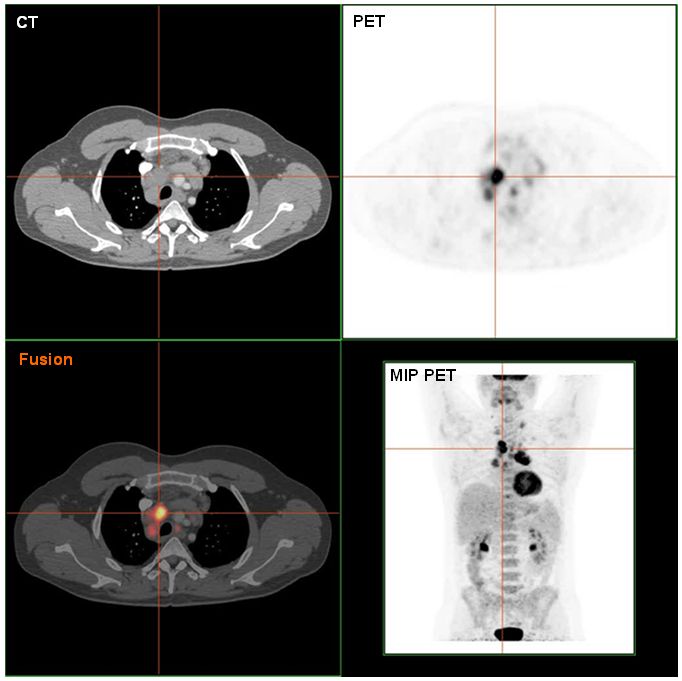
PET uses a molecule similar to glucose, labeled with radioactive fluorine, FDG. Hodgkin lymphoma cells and the inflammatory cells that surround them consume a lot of glucose and appear bright on the image. When chemotherapy works, this brightness falls before the lymph node size decreases. That is why the exam done after two cycles says a lot about the disease's sensitivity to treatment.

The Deauville scale
The reading uses a five-point scale. In the RATHL study, a score of 1 meant no uptake; a score of 2, mild uptake, lower than the blood pool in the mediastinum; a score of 3, uptake equal to or slightly above the mediastinum, but lower than the liver; a score of 4, uptake moderately higher than the liver; and a score of 5, uptake much higher than the liver. Scores 1 to 3 were treated as a negative exam and 4 and 5 as positive (Johnson et al., 2016). The scale is part of the 2014 Lugano Classification, which an international committee reaffirmed as the standard in 2025 (Organizing Committee of the Lugano Classification Workshop, 2025).
A threshold that changes with the question
A review on PET in lymphoma notes that the cutoff between negative and positive can be adjusted according to the goal. When the aim is to reduce treatment, some groups preferred to consider only an exam with a score up to 2 as negative, so as not to undertreat (Barrington and Kluge, 2017). In the scene, a score of 3 is exactly the zone where this difference matters. A report of "Deauville 3" is not automatically a license to remove something from the plan; it depends on the study being applied and the threshold it used.
The exam also measures inflammation
The same review explains that the positive predictive value of PET is lower than the negative one, because FDG also accumulates in inflammation caused by treatment. To reduce this effect, it recommends waiting at least 3 weeks, preferably 6 to 8, after chemotherapy at the end of treatment, 2 weeks after colony-stimulating factor and 3 months after radiotherapy (Barrington and Kluge, 2017). A positive exam deserves a second look before changing management; a negative exam, on the other hand, is generally more reliable.
The first clue: the stage changes the question
The same negative PET can lead to different decisions. In advanced disease, the question is usually whether a toxic drug can be removed. In early disease, the question is usually whether radiotherapy can be removed. These are different questions, tested in different studies, with different answers.
Advanced disease
In advanced stages, treatment is longer and radiotherapy is not a fixed part of the plan. The main risk of keeping the full regimen is bleomycin toxicity in the lung. Interim PET comes in to separate those who can receive less from those who need more.
Favorable early disease
In favorable early stages, the standard at many services is short: two cycles of ABVD followed by 20 Gy of radiotherapy to the involved site, as described by the German group of the HD16 study (Fuchs et al., 2024). The fear here is the late effect of radiation on the heart, the vessels and the risk of another cancer. Interim PET was tested as a way to choose who could forgo radiotherapy. The scene of the meeting is in this group.
What RATHL showed in advanced disease
RATHL included 1214 patients with advanced classic Hodgkin lymphoma. All had PET at the start, received two cycles of ABVD and repeated the PET. The images were read in a central network of laboratories (Johnson et al., 2016).
Removing bleomycin with a negative PET
Of the 1119 patients with an assessed interim PET, 937 had a negative exam and were randomized to continue ABVD or proceed without bleomycin, the AVD regimen, for four more cycles. Progression-free survival at 3 years was 85.7 percent with ABVD and 84.4 percent with AVD, a difference of 1.6 points, with overall survival near 97 percent in both groups (Johnson et al., 2016). The result fell slightly outside the non-inferiority margin defined at the start, but respiratory events were more frequent in the group that kept bleomycin. The authors concluded that removing bleomycin reduced pulmonary toxicity without an important loss of efficacy. Radiotherapy was not recommended for those with a negative interim PET.
Intensifying with a positive PET
The 172 patients with a positive interim PET switched to BEACOPP, a more intensive regimen. On the next PET, 74.4 percent became negative, and progression-free survival at 3 years was 67.5 percent, with overall survival of 87.8 percent (Johnson et al., 2016). The data show two things: a positive PET identifies a higher-risk group, and intensification recovers a good part of these patients, but not all of them.
Are the results repeated outside the study?
An analysis of 221 patients treated outside trials in eastern England compared outcomes with those of RATHL. The 177 who received ABVD had 5-year progression-free survival of 79.2 percent, versus 81.4 percent in the trial (Russell et al., 2021). A Turkish series of 379 patients who dropped bleomycin after a negative interim PET reported 3-year progression-free survival of 86.0 percent and overall survival of 96.1 percent (Isleyen et al., 2025). A tertiary center in Pakistan, with 169 patients, reported 3-year overall survival of 92.3 percent and progression-free survival of 76.9 percent, falling to 57.1 percent in patients with a positive interim PET (Iftikhar et al., 2025). The real-world numbers come close to those of the trial, which gives confidence in the strategy, provided the scan is done well and read well.
What HD16 showed in early-stage disease
HD16 is the clue that weighs on the scene. The trial included 1150 patients with favorable early-stage Hodgkin lymphoma. The standard group received two cycles of ABVD and 20 Gy of radiotherapy. In the experimental group, those with an interim PET scored below 3 skipped radiotherapy (Fuchs et al., 2024).
The price of dropping radiotherapy
In long-term follow-up, 5-year progression-free survival was 94.2 percent with combined treatment and 86.7 percent with chemotherapy alone, with a hazard ratio of 2.05. Overall survival was similar, 98.3 and 98.8 percent. Of the 12 deaths, 4 were from second cancers and only 1 from lymphoma (Fuchs et al., 2024). In other words, dropping radiation doubled the risk of relapse, but the patients who relapsed were largely salvaged, and survival did not change in the period observed.
PET also predicts the outcome of combined treatment
Among patients who received combined treatment, progression-free survival was 94.0 percent with an interim PET score of 1 to 3 and 83.6 percent with a score of 4 or higher (Fuchs et al., 2024). The authors concluded that combined treatment should be considered standard in favorable early-stage disease, whatever the PET result. In the scene, this is the answer to the hematologist: a negative PET predicts a good outcome, but HD16 did not show that radiotherapy can be dropped at no cost.
The other side: the risk of radiation
The argument for skipping radiotherapy is not weak. A British study estimated the cardiovascular risk of radiotherapy in patients from the RAPID trial, with a mean dose of 4.0 Gy to the heart and 21.5 Gy to the carotids. The predicted excess cardiovascular mortality over 30 years was 0.56 percent on average, but ranged from 0.01 to 6.79 percent, and was higher when the mediastinum was involved (Cutter et al., 2021). The authors concluded that, for most, radiotherapy brings a net benefit, but that, for a minority with high doses to the heart and vessels, it may be better to use more modern techniques or skip radiation and accept the higher risk of relapse.


Table: what interim PET allows in each scenario
| Scenario | Negative interim PET | Positive interim PET | Main trial |
|---|---|---|---|
| Advanced disease | Drop bleomycin and continue with AVD, without radiotherapy | Intensify to BEACOPP and reassess | RATHL |
| Favorable early-stage disease | Keep radiotherapy as standard; skip it only after a conversation about relapse risk | Keep combined treatment; higher risk of relapse | HD16 |
| Score 5 after two cycles | Not applicable | High-risk group; review the report and consider a new biopsy | Viviani pooled analysis |
| Scan with recent inflammation | Reading generally reliable | Confirm before changing management | Barrington and Kluge review |
When PET comes back strongly positive
A score of 5 after two cycles is an alarm signal. An analysis pooling three trials found 136 patients with a score of 5, about 6 percent of the 2321 with an available interim PET. Even with intensification, 3-year progression-free survival was 32 percent and overall survival 82 percent. A low lymphocyte count at diagnosis, below 600 per mm³, was associated with a worse outcome (Viviani et al., 2025).
Review the report before changing everything
The pediatric study AHOD1331 compared the interim PET reading done at each hospital with a central review in 573 children and adolescents. Agreement was 89.7 percent. Among the 126 patients considered positive by the hospital, 38 were reclassified as negative by the central review, which avoided unnecessary radiotherapy. Among the 447 considered negative by the hospital, 21 were reclassified as positive and would have gone without radiotherapy (Hoppe et al., 2023). The lesson holds for adults: when the report changes the treatment, it is worth asking for a second reading by someone with experience in the scale.
How to monitor the response
- Confirm the stage and the risk group before the first cycle.
- Do the staging PET at the start, to serve as a baseline.
- Repeat the PET after two cycles, away from colony-stimulating factor.
- Record the Deauville score and the threshold used by the protocol.
- Ask for a review of the report when it changes the management.
- Consider a new biopsy when the score of 5 does not match the clinical picture.
The second clue: the patient and the future
In the scene, the patient asks whether she will be able to have children. That question should have come up before the first cycle. A systematic review with more than 7000 patients estimated presumed infertility of about 21 percent in adult women and 45 percent in adult men after treatment. The risk varied widely by regimen: it was 6 percent in women and men after ABVD, and 38 percent in women and 81 percent in men after BEACOPP (Roth-Hochreutener et al., 2026).
Why this enters the PET decision
A positive interim PET, in advanced disease, leads to intensification with BEACOPP. That means the chance of needing a regimen more toxic to fertility exists from the start, even when the plan begins with ABVD. The conversation about fertility preservation cannot wait for the PET result, because after it the time to act is short. The authors of the review point out that these numbers help decide when preservation before treatment is essential.
Each person's preferences and risks
In the favorable early stage, the choice between keeping or dropping radiotherapy trades one risk for another. On one side, more relapses without radiation. On the other, late effects on the heart and vessels and the risk of a second cancer with it. The cardiovascular risk study shows that this risk is not the same for everyone and depends on the dose to the organs (Cutter et al., 2021). Showing the patient the radiotherapy plan, with the estimated doses, helps the patient make an informed choice, with concrete numbers. Shared decision-making here is not a courtesy: it is part of the method.
Risks and reasoning errors
The interim PET is a powerful tool, and for that reason easy to use badly. The most common errors are not of technique, but of reasoning. They resemble those that appear in other areas of medicine, as the text on clinical decision-making shows.
Applying a study to the wrong stage
The most frequent error is to use the RATHL reasoning in early disease. In advanced disease, the negative PET authorized dropping bleomycin without important loss. In early disease, HD16 showed that dropping radiotherapy increased relapses. Both conclusions are true, but they apply to different patients.
Confusing prognosis with indication
A negative PET predicts a good outcome. That does not mean the treatment one wants to drop is useless. In HD16, the patients with a negative PET and combined treatment were the ones with the best outcome. Separating what the test predicts from what it authorizes is a useful pause, like the one described in the text on the diagnostic pause.
Trusting the report too much
The Deauville score is a visual reading, and different readers may disagree, as the central review of AHOD1331 showed (Hoppe et al., 2023). Inflammation after chemotherapy, infection or colony-stimulating factor can mimic disease. When the report changes the plan, the reasoning calls for a second reading and, sometimes, a biopsy. Dealing with this margin of doubt is trainable, as the text on diagnostic uncertainty discusses.
Forgetting the new measures that are not yet standard
The Lugano committee discussed tumor metabolic volume and circulating tumor DNA, but these are not yet part of the classification (Organizing Committee of the Lugano Classification Workshop, 2025). They are promising tools, but using them alone to withdraw treatment outside a trial is a step ahead of the evidence.
How NEXO helps train this reasoning
Interim PET is a good example of a clue that arrives mid-story and changes the weight of everything that came before. In NEXO, the case of the day works like this: each new clue asks you to revisit the hypothesis, not just confirm it. Training this move on short cases helps you do the same in the oncology meeting, where time is short and opinions are many. The method relies on case-based learning and interprofessional clinical reasoning, because the decision involves the hematologist, the radiation oncologist, the nuclear medicine physician and the patient herself.
Three exercises with cases
- Take the scene and change the stage to advanced with the same negative PET. Write what changes in the plan and which study supports the change.
- Change the score from 3 to 5 and list the first three actions, starting with reviewing the report.
- Write the explanation for the patient about keeping or omitting radiotherapy in five sentences, with the risk of relapse and the late risk.
You can also train hypothesis building with the text on differential diagnosis with clues. Those who create cases can contribute through the Creators page.
Frequently asked questions
What is interim PET?
It is PET with CT done during treatment, usually after two cycles of chemotherapy. It shows whether the lymphoma is responding and guides whether the plan should be maintained, reduced or intensified.
What does Deauville 3 mean?
It means uptake equal to or slightly above that of the mediastinum, but lower than that of the liver. In RATHL, it was considered a negative scan (Johnson et al., 2016). Some protocols that seek to reduce treatment use a stricter threshold.
Does a negative PET allow omitting radiotherapy?
In early-stage favorable disease, HD16 showed more relapses when radiotherapy was omitted, with similar overall survival (Fuchs et al., 2024). The decision must weigh this increase in relapses against the late risk of radiation.
Does a positive PET mean the treatment failed?
No. It indicates a higher-risk group, which in RATHL was intensified, and most ended up with a negative PET afterward. Before changing management, it is worth confirming the reading, because inflammation can mimic disease.
When should fertility be discussed?
Before the first cycle. The risk depends on the regimen and can increase greatly if PET leads to intensification (Roth-Hochreutener et al., 2026).
Final checklist
- I confirmed the stage and risk group before starting.
- I discussed fertility and offered preservation before the first cycle.
- I did the staging PET as a baseline.
- I repeated PET after two cycles, at the appropriate time.
- I recorded the Deauville score and the threshold used by the protocol.
- I checked which study supports the management at the patient's stage.
- I requested a second reading when the report changed the plan.
- I weighed the risk of relapse and the late risk with the patient.
Want to practice reasoning with progressive clues? Play the case of the day.
References
- Barrington SF, Kluge R. FDG PET for therapy monitoring in Hodgkin and non-Hodgkin lymphomas. Eur J Nucl Med Mol Imaging. 2017. PMID 28411336.
- Cutter DJ, Ramroth J, Diez P, et al. Predicted Risks of Cardiovascular Disease Following Chemotherapy and Radiotherapy in the UK NCRI RAPID Trial of Positron Emission Tomography-Directed Therapy for Early-Stage Hodgkin Lymphoma. J Clin Oncol. 2021. PMID 34388007.
- Fuchs M, Jacob AS, Kaul H, et al. Follow-up of the GHSG HD16 trial of PET-guided treatment in early-stage favorable Hodgkin lymphoma. Leukemia. 2024. PMID 37845285.
- Hoppe BS, McCarten KM, Pei Q, et al. Importance of Central Imaging Review in a Pediatric Hodgkin Lymphoma Trial Using Positron Emission Tomography Response Adapted Radiation Therapy. Int J Radiat Oncol Biol Phys. 2023. PMID 36868525.
- Iftikhar I, Abbas M, Afzal M, et al. Real-World Outcomes of PET-Adapted Treatment for Classic Hodgkin's Lymphoma: A Study From a Single Tertiary Care Center. Cureus. 2025. PMID 40491613.
- Isleyen E, Alhan N, Terzi Demirsoy E, et al. Real-Life Retrospective Turkiye Data of the De-Escalation of ABVD to AVD in Hodgkin Lymphoma: On Behalf of the TSH Turkish Lymphoma Study Group. J Clin Med. 2025. PMID 41095893.
- Johnson P, Federico M, Kirkwood A, et al. Adapted Treatment Guided by Interim PET-CT Scan in Advanced Hodgkin's Lymphoma. N Engl J Med. 2016. PMID 27332902.
- Organizing Committee of the Lugano Classification Workshop. Current Status of Revisions to the Lugano Classification in Lymphoma. Hematol Oncol. 2025. PMID 40525613.
- Roth-Hochreutener M, Karakitsiou M, Vidal A, et al. Hodgkin Lymphoma-The Effect of Chemotherapy on Gonadal Function and Fertility Is Strongly Related to the Treatment Regimen, Age, and Sex: A Systematic Review and Meta-Analysis. Cancers (Basel). 2026. PMID 41681897.
- Russell J, Collins A, Fowler A, et al. Advanced Hodgkin lymphoma in the East of England: a 10-year comparative analysis of outcomes for real-world patients treated with ABVD or escalated-BEACOPP, aged less than 60 years, compared with 5-year extended follow-up from the RATHL trial. Ann Hematol. 2021. PMID 33641019.
- Viviani S, Pavoni C, Barrington SF, et al. Advanced stage classical Hodgkin lymphoma patients with a positive interim-PET (PET-2) Deauville score 5 after 2 ABVD cycles: a pooled analysis of three multicenter trials. Blood Cancer J. 2025. PMID 41102172.