How to present at a medical congress


 Alexei Peter dos Santos, Thiago Longo Moraes, and Caroline Wilhelmsen Martins
Table of contents
- Why present at a conference
- What happens to abstracts after the conference
- How to put the poster together
- How to prepare the oral presentation
- How to handle questions
- After the conference: turning it into an article
- Clinical reasoning with NEXO
- Frequently asked questions
- Checklist for presenting at a conference
- References
The email arrived on a Tuesday: "Your abstract has been accepted for presentation". The joy lasts until the second line, which gives the format, the poster size and the speaking time. You have never presented at a conference, your supervisor is on vacation and the date is five weeks away.
Presenting a paper at a conference is often the medical student's first contact with scientific communication. This guide shows what happens to abstracts after the conference, why it is worth presenting, how to put together the poster and the oral presentation, how to handle questions and what to do afterwards so that the work does not end at the badge. At the end, there is a preparation table and a checklist.
Key points
- In a Cochrane review with more than 300,000 abstracts, only 37.3% of the papers presented at conferences became full articles (Scherer et al., 2018).
- At national medical student conferences in Peru, only 9.8% of abstracts were later published in a scientific journal (Toro-Polo et al., 2012).
- Among first-year medical students in the United States, having presented at a conference before the course was associated with the intention to pursue a research career (Hajduk et al., 2026).
- Poster and oral presentation had a similar chance of becoming a publication at an orthopedics conference (Balhatchet et al., 2022).
- Lack of time, mentorship and methodological skill were the most cited barriers to carrying the work forward (Smith et al., 2014).
- Peer feedback improved oral case presentations in a clinical medicine rotation (Qaiser et al., 2022).
Why present at a conference
The first showcase for your work
The conference is where the work leaves the research group and meets other people. You get questions your supervisor did not ask, you find out who studies similar topics and you practice explaining what you did in a few minutes. For those starting out in research, the guide on research in the Medicine undergraduate course shows how to get this far.
Presenting is associated with staying in research
A study with 1,136 first-year medical students from 134 American schools found 26.9% with the intention to pursue a research career (Hajduk et al., 2026). Among the factors prior to the course associated with this intention were taking part in research, presenting at a conference and being an author of an article (Hajduk et al., 2026). The design is cross-sectional, so it is not possible to say that presenting causes the desire to do research, but the two things go together.
Student conferences have a role of their own
Conferences made for students offer a lower-pressure environment. At a national neurosurgery conference for students in the United States, participants valued the "less stressful environment" and the "chance to receive feedback on the research" (Barrios-Anderson et al., 2021). The majority (54.5%) went mainly to present, and 97.6% said the event strengthened their interest in the field (Barrios-Anderson et al., 2021).
At a student conference in the United Kingdom, also in neurosurgery, the 47 study participants came away with a better understanding of the career and of opportunities for research, electives and projects (Ashraf et al., 2023). At a urology symposium for students, participation increased knowledge about residency selection, mainly among those studying at schools without a rotation in the field (Kim et al., 2025).

Before submitting: the abstract
It all starts with the abstract. It is what the committee evaluates, and it is what stays in the event proceedings, sometimes as the only public record of the work. A good abstract answers, in a few lines, why the question matters, what was done, what was found and what that means. The most common mistakes are long introductory sentences, vague methods and conclusions that go beyond the data.
Before sending, check these points:
- The objective is written in a single sentence, at the beginning.
- The method states who the participants were, where and when.
- The results bring numbers, and not just "there was improvement".
- The conclusion does not claim more than the results show.
- The text respects the word limit and the event template.
- All authors read and approved the final version.
Agree on the authorship order before submitting. Discussions about who is included and in what position tend to be harder after acceptance, when the work already has visibility. If patients took part or medical records were used, confirm that the project went through the ethics committee, because many events ask for the approval number.
How to choose the conference
Not every conference suits every piece of work. Student conferences offer a friendlier environment and feedback from peers and professors (Barrios-Anderson et al., 2021). Specialty conferences give you contact with people who work in the field you are considering pursuing, as the neurosurgery and urology student events showed (Ashraf et al., 2023; Kim et al., 2025). Before choosing, look at who usually presents at the event, the cost of registration and travel, and whether there is support from your school or student league.
What you take from the conference beyond the presentation
The conference is also a chance to attend other sessions, meet professors from other schools and understand how a field works outside your own school. Plan the schedule before you arrive, pick two or three talks related to your work and set aside time to talk with people who presented similar topics. These conversations often lead to invitations for projects, elective placements and sometimes co-authorship. Write down names and contacts the same day, while you still remember who said what.
What happens to abstracts after the conference
Most do not become articles
The Cochrane review by Scherer and colleagues combined 425 reports and 307,028 abstracts and found a full publication rate of 37.3% (Scherer et al., 2018). The estimated rate at ten years reached 46.4%, and was higher for randomized controlled trials (68.7%) (Scherer et al., 2018). "Positive" results were more likely to be published (Scherer et al., 2018), which shows how the fate of abstracts can distort the literature.
An earlier review by von Elm and colleagues estimated that 27% of presented abstracts had been published after two years, 41% after four and 44% after six (von Elm et al., 2003). Oral presentation, smaller conferences and conferences in the United States were associated with more publication (von Elm et al., 2003). Even rejected abstracts were published in 27% of cases (von Elm et al., 2003).
At student conferences, the rate is even lower
A study of 532 abstracts presented at national medical student conferences in Peru between 2002 and 2009 found only 52 published in a scientific journal, or 9.8% (Toro-Polo et al., 2012). The median time to publication was 13 months (Toro-Polo et al., 2012). Work written in collaboration between students from two universities was more likely to be published (Toro-Polo et al., 2012).
Does poster or oral make a difference?
At an Australian orthopedics conference, 51% of the 1,130 abstracts became articles, and there was no difference between oral presentations and posters (Balhatchet et al., 2022). Most publications (73%) came out within two years (Balhatchet et al., 2022). At an anesthesia education conference, the rate was only 15%, and research abstracts were published more often than curriculum innovation ones (24.2% versus 9.4%) (Cerza et al., 2023). At a pediatrics education conference, there was also no difference by format (Smith et al., 2014).
What this means for you
The poster is not a consolation prize. The chance of the work becoming an article depends more on what you do after the conference than on the format in which it was accepted. Treat the presentation as a step, not as the end of the project.
Case report, research or teaching experience
The type of work changes what the audience expects. In a case report, the interest lies in the reasoning: what made the case difficult, which hypotheses were considered and what it teaches for practice. In a research paper, the audience wants to know whether the method supports the result. In a teaching experience, the question is whether the idea would work elsewhere and how it was evaluated. At the congress on education in anesthesiology, for example, abstracts on curricular innovation were published less often than research abstracts (9.4% versus 24.2%) (Cerza et al., 2023), which suggests it is worth planning early how the experience will be evaluated.
Honesty in the data
The rush to have a presentable result can lead to bad choices: showing only the analysis that worked, rounding numbers in favor of the hypothesis or omitting excluded patients. Positive results are already more likely to be published (Scherer et al., 2018), and every selective choice increases that distortion. Present what you found, including when the result is null, and make clear what is preliminary. A well-done negative result is a contribution, and audiences tend to respect those who show the limits of their own work.
How to put the poster together
Start with the event rules
Read the call before opening any program: size, orientation, file format, whether the poster is printed or digital, whether there is speaking time and where it will be displayed. Many students redo the poster the night before because they designed it in landscape when the event asked for portrait.
One message, not the whole article
People walking past the poster read the title and decide in seconds whether to stop. Write a title that states the main result, not just the topic. Reduce the text to the essentials: question, method in a few lines, two or three results with a chart and a conclusion that fits in one sentence. Leave empty space; a poster packed with text drives readers away.
Charts that can be read from a distance
Prefer simple charts, with legible axes and few colors. A large table with ten columns is rarely read in a congress hallway. If the main result is a number, make that number large.
Bring a short version to talk about
Even when there is no formal presentation, someone will stop and ask "tell me about your work". Prepare a one-minute talk and a three-minute talk. The one-minute talk states the problem, what you did and what you found. The three-minute one adds the method and the limitations.

On the day: how to receive visitors at the poster
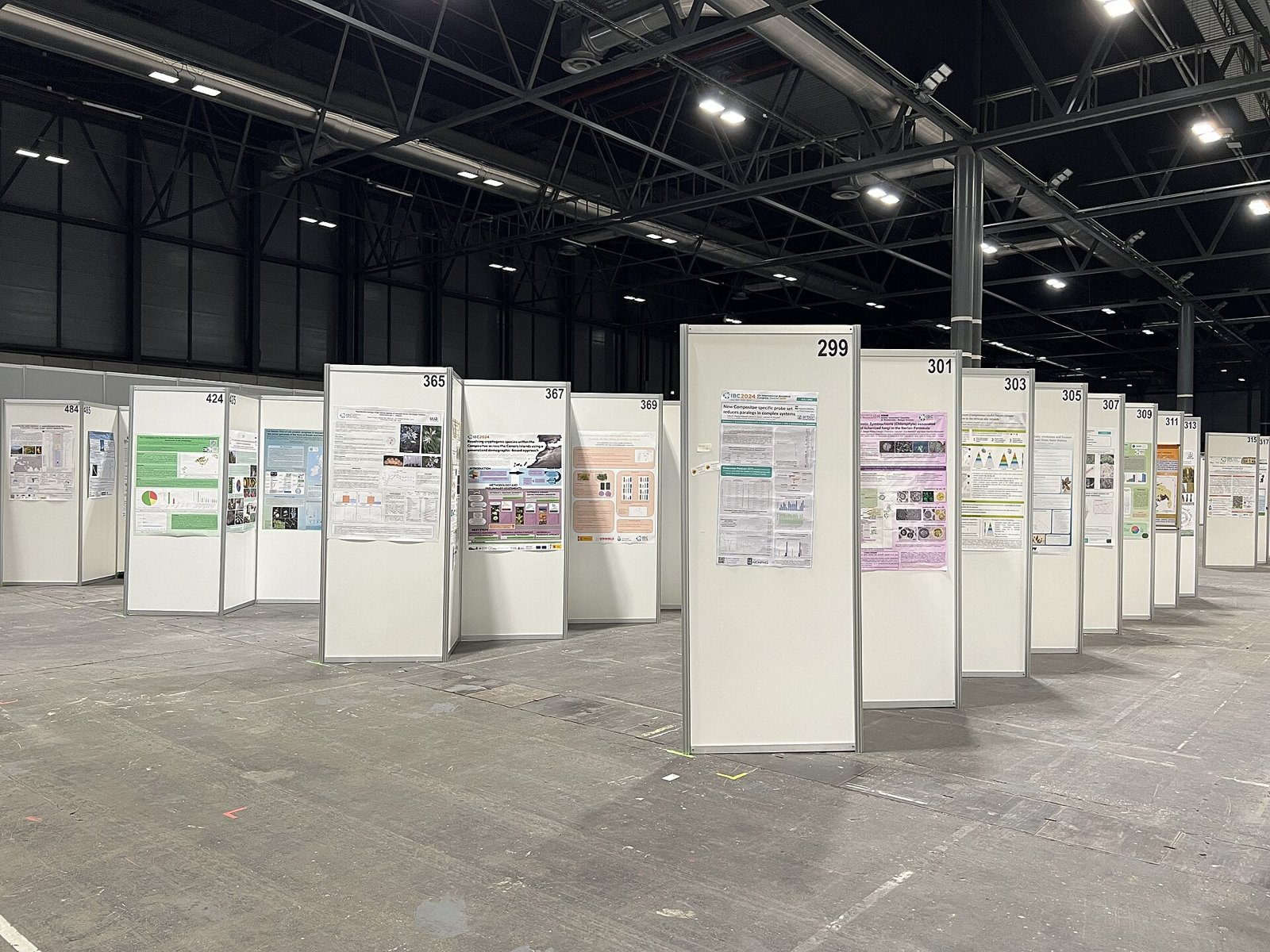
At poster sessions, those who stand next to the board looking at their phone miss the chance to talk. Face the hallway, greet those who stop and ask whether the person wants a quick summary. If they prefer to read, wait in silence and stay available for questions. Bring a card or a code with your contact details, in case someone wants to continue the conversation later.
Also take the time to visit other posters. Seeing how colleagues solved the same problem of space, chart or title teaches more than any ready-made template, and talking with other authors is a way to start partnerships.
How to prepare the oral presentation
Respect the time
Speaking time at congresses is usually short, and the moderator cuts off those who run over. Allow about one slide per minute and rehearse with a timer. If there is time left in the rehearsal, great: on the day, nerves usually speed up or stall the talk.
Simple structure
Use the same order as an article, well summarized: why the question matters, what you did, what you found, what it means and what the limitations are. One clear conclusion slide is worth more than three slides of secondary results. For those presenting a clinical case, the guide on how to write a clinical case for teaching helps organize the story.
Rehearse with those who will ask hard questions
In a medical clerkship, students who evaluated each other's oral presentations with a standardized form and gave verbal feedback improved their scores between the first and second half of the clerkship (Qaiser et al., 2022). The same applies to the congress: rehearse in front of colleagues and ask them to ask what an evaluator would ask.
Preparation table
| When | Poster | Oral presentation |
|---|---|---|
| When you receive the acceptance | Read the rules on size, orientation and printing | Check your speaking time and slide format |
| Four weeks before | Draft with title, message and main charts | Outline in bullet points and slide draft |
| Three weeks before | Review with your advisor | First timed rehearsal |
| Two weeks before | Final version and printing | Rehearsal with colleagues and tough questions |
| The day before | One-minute and three-minute talk rehearsed | Last rehearsal and a copy of the slides in two places |
| After the conference | Write down the questions and suggestions you received | Write down the questions and suggestions you received |
Managing nerves
Almost everyone gets nervous at a first presentation. A few simple steps help reduce the impact:
- arrive at the room early and test the computer, the projector and the slide clicker;
- memorize the first sentence of the presentation, which is the hardest to say;
- speak a little more slowly than in rehearsal;
- look at different people in the audience, not at the screen;
- keep water nearby and a copy of the slides in a second place.
If you freeze, stop, breathe and go back to the last slide you remember. The audience usually notices nerves less than the presenter does, and almost everyone there has been through the same situation.
How to handle questions
Listen to the whole question
Some questions are actually long comments. In that case, thank the person, answer the main point in one or two sentences and hand the floor back to the moderator.
Wait for the person to finish before answering. Repeat the question out loud when the room is large, so everyone hears it and to gain a few seconds.
Admitting limitations is strength
If the question points to a real limitation, agree and explain how it affects the interpretation. "That is a good point, and it is a limitation of our design" is a better answer than a forced defense. If you do not know, say you do not know and offer to talk later.
Write down what you hear
Conference questions are a free review. Write them all down: they show what needs to be clearer in the article.
Costs and support
Registration, poster printing, travel and lodging weigh on the budget of anyone in undergraduate school. Before submitting, ask your school, your academic league and your research group whether there is financial support for presenters. Many events offer student discounts, reduced registration for presenters or travel grants. Regional conferences and online events can also be a cheaper entry point for a first presentation.
After the conference: turning it into an article
The barriers are well known
In a study of papers presented at a pediatric education conference between 1998 and 2008, 67% were shared in some other form and 34% became publications (Smith et al., 2014). The barriers cited were lack of time, mentorship and methodological skill (Smith et al., 2014). The authors concluded that mentorship and protected time would help move the work forward (Smith et al., 2014).
Make a plan before going home
In the week after the conference, schedule a meeting with your advisor and define who writes each part, which journal the article goes to and what the deadline is. Use the questions you wrote down to strengthen the discussion. The guide to critical reading of articles helps you review similar articles and understand what journals expect.
Choosing the journal
After the conference, look for journals that publish work similar to yours. Read the instructions for authors before you start rewriting, because the format, the word limit and the article type vary a lot. Be wary of e-mail invitations from unknown journals that promise fast publication for a fee: check whether the journal is indexed in known databases and talk to your advisor before submitting. If the article is rejected, use the reviews to improve the text and try another journal. Rejection is part of the process, and even abstracts rejected at conferences end up published in some cases (von Elm et al., 2003).
Work through networks
In the Peruvian study, abstracts written by students from two universities were more likely to be published (Toro-Polo et al., 2012). The conference is a good place to meet these partners. Having a research mentor was also associated with the intention to stay in research among American freshmen (Hajduk et al., 2026).


Common mistakes
- Poster with too much text. Copying the whole abstract onto the poster drives readers away. Cut it down and keep the main result in evidence.
- Running over time. Going over time is the most visible mistake in an oral presentation. Rehearse with a timer and cut what is not essential.
- Hiding limitations. Anyone who hides limitations is taken apart at the first question. Show them on the discussion slide.
- Thinking the work is done. With publication rates between 9.8% and 51% depending on the conference (Toro-Polo et al., 2012; Balhatchet et al., 2022), most work stops at the abstract. Set the next step before leaving the event.
Clinical reasoning with NEXO
Presenting a case means telling a clinical story clearly and arriving at a hypothesis. NEXO offers one fictional clinical case per day, with a real clinical presentation, solved in up to six clues, with feedback by proximity in ICD-10. Solving one case per day is a short workout for organizing signs and symptoms into reasoning. To understand the whole game, see what NEXO is.
If you coordinate an academic league or a residency program and want cases to discuss, meet NEXO Closer. Researchers in medical education can propose studies through NEXO Researcher, physicians who review cases take part through NEXO Curator, and those who create health content on social media can take part through NEXO Creators.
Frequently asked questions
Is a poster worth less than an oral presentation?
Not necessarily. At an orthopedics conference, posters and oral presentations had a similar chance of becoming an article (Balhatchet et al., 2022).
How many conference papers become articles?
In a Cochrane review, 37.3% (Scherer et al., 2018). At medical student conferences in Peru, 9.8% (Toro-Polo et al., 2012).
Is it worth presenting at a student conference?
Yes. These events offer a lower-pressure environment and feedback on the research, according to the participants themselves (Barrios-Anderson et al., 2021).
What should I do if I do not know how to answer a question?
Say you do not know, thank the person and offer to talk later. Write down the question for the article.
How long after the conference should I publish?
At an orthopedics conference, 73% of publications came out within two years (Balhatchet et al., 2022). The sooner you start writing, the lower the risk of the project going cold.
Do I need a supervisor to present?
In general, yes. Lack of mentoring was one of the most cited barriers to moving work forward (Smith et al., 2014).
Checklist for presenting at a conference
- I read the event's format rules.
- I wrote a title that states the main result.
- I cut the text to the essentials and kept the charts legible.
- I rehearsed the one-minute and the three-minute talk.
- I rehearsed the oral presentation with a timer.
- I asked colleagues to pose difficult questions.
- I put the limitations in the presentation.
- I wrote down the questions and scheduled the meeting to write the article.
Want to practice organizing a clinical story? Play the case of the day on NEXO.
References
- Scherer RW, Meerpohl JJ, Pfeifer N, et al. Full publication of results initially presented in abstracts. Cochrane Database Syst Rev. 2018. https://pubmed.ncbi.nlm.nih.gov/30480762/
- von Elm E, Costanza MC, Walder B, et al. More insight into the fate of biomedical meeting abstracts: a systematic review. BMC Med Res Methodol. 2003. https://pubmed.ncbi.nlm.nih.gov/12854973/
- Toro-Polo M, Pereyra-Elías R, Nizama-Vía A, et al. [Publication of summaries presented at the scientific congresses of medical students, Peru 2002-2009: characteristics and related factors]. Rev Peru Med Exp Salud Publica. 2012. https://pubmed.ncbi.nlm.nih.gov/23338630/
- Balhatchet B, Schütze H, Awais A, et al. Publication rate of abstracts presented at the Australian Orthopaedic Association Annual Scientific Meeting. ANZ J Surg. 2022. https://pubmed.ncbi.nlm.nih.gov/35119773/
- Cerza DA, Battista CF, Sharma G, et al. Publication Rate of Abstracts Presented at the 2011-2019 Society for Education in Anesthesia Meetings. J Educ Perioper Med. 2023. https://pubmed.ncbi.nlm.nih.gov/37720367/
- Smith S, Kind T, Beck G, et al. Further dissemination of medical education projects after presentation at a pediatric national meeting (1998-2008). Teach Learn Med. 2014. https://pubmed.ncbi.nlm.nih.gov/24405340/
- Hajduk AM, O'Connell M, Aviles A, et al. Longitudinal Evaluation of Research Career Intentions Among US Medical Students. JAMA Netw Open. 2026. https://pubmed.ncbi.nlm.nih.gov/42118538/
- Barrios-Anderson A, Liu DD, Snead J, et al. The National Student Neurosurgical Research Conference: A Research Conference for Medical Students. World Neurosurg. 2021. https://pubmed.ncbi.nlm.nih.gov/33130142/
- Ashraf M, Ismahel H, Lub S, et al. Role of a medical student neuro-society organized neurosurgical conference: The Glasgow neuro experience. Surg Neurol Int. 2023. https://pubmed.ncbi.nlm.nih.gov/36895225/
- Kim IE, Allu S, Whittelsey M, et al. Student Urology Conference Increases Participant Knowledge of Urology Match and Confidence in Research. Urology. 2025. https://pubmed.ncbi.nlm.nih.gov/39547277/
- Qaiser R, Fadden P, Rustom S, et al. Real-Time Peer-to-Peer Observation and Feedback Lead to Improvement in Oral Presentation Skills. Cureus. 2022. https://pubmed.ncbi.nlm.nih.gov/35282526/