Ear and sinus barotrauma in flight
Table of contents
- Why barotrauma is a reasoning scenario
- Pathophysiology: why it hurts on descent
- The clinical picture and the Teed scale
- The differential diagnosis: do not confuse it with otitis
- Exams: otoscopy, tympanometry and nose
- Management during the flight and after landing
- Prevention: what the evidence shows, with the doses tested
- Special situations: children, crew members and those who fly again
- Reasoning: the same membrane, two stories
- How NEXO helps train this reasoning
- Frequently asked questions
- Final checklist
- References
A 34-year-old female passenger travels with a cold and a stuffy nose for three days. On the way up she feels nothing. On the way down, she starts with a feeling of a blocked right ear, which becomes severe pain, and she cannot "unblock" the ear by swallowing. After landing, the pain improves, but hearing on that side remains muffled. The next day, she seeks care thinking she has an ear infection. She has no fever. On otoscopy, the right tympanic membrane is retracted, reddened, with small areas of bleeding within the membrane itself. The scene is fictional and was written for teaching. This text uses this picture as a clinical reasoning scenario: why the pain appears on descent, how to grade the finding, what distinguishes barotrauma from otitis media, when to suspect inner ear injury and what the evidence says about prevention, with the doses tested.
The text does not replace an otolaryngology assessment or the guidance of each country's health service. The doses cited come from clinical trials and serve to discuss the evidence, not as a prescription. The interest here is reasoning: the same reddened membrane has different meanings depending on the history. If you play the case of the day on NEXO, you will recognize the move: the moment the symptom began may matter more than the exam finding.
Key points
- Middle ear barotrauma happens mainly on descent, when the Eustachian tube cannot equalize pressure.
- A cold, rhinitis and sinusitis increase the risk, because they swell the mucosa of the tube and the sinus ostia.
- The Teed classification, described in 1944 and modified since then, grades the otoscopy finding, from a normal membrane to perforation.
- The absence of fever and the clear link to descent help distinguish barotrauma from acute otitis media.
- In adults with recurrent pain, pseudoephedrine 120 mg 30 minutes before the flight reduced discomfort in one trial; in young children, 1 mg/kg did not reduce pain.
Why barotrauma is a reasoning scenario
Barotrauma is the injury caused by a pressure difference between an air-filled space inside the body and the environment. In flight, the most affected spaces are the middle ear and the sinuses. The ICD-10 from the World Health Organization has its own codes: T70.0 for otic barotrauma, which includes aerotitis media, and T70.1 for sinus barotrauma, which includes aerosinusitis.
The scenario is useful because the most visible finding, a red tympanic membrane, also appears in acute otitis media, and the management is different. Wright, in a systematic review for BMJ Clinical Evidence, estimated that 10 in every 100 adults and 22 in every 100 children may have tympanic membrane changes after a flight, although perforation is rare and symptoms usually improve on their own (Wright, 2015).
What the scene teaches
The scene has five clues. The first is the cold with a stuffy nose. The second is the pain that began on descent, not on ascent. The third is the difficulty equalizing pressure by swallowing. The fourth is the absence of fever. The fifth is the finding of retraction with bleeding inside the membrane. Together, they tell the story of an ear that could not receive air while the cabin pressure rose.
The post on signs, symptoms and history shows how the chronology of symptoms often guides the diagnosis before the exam.
Pathophysiology: why it hurts on descent
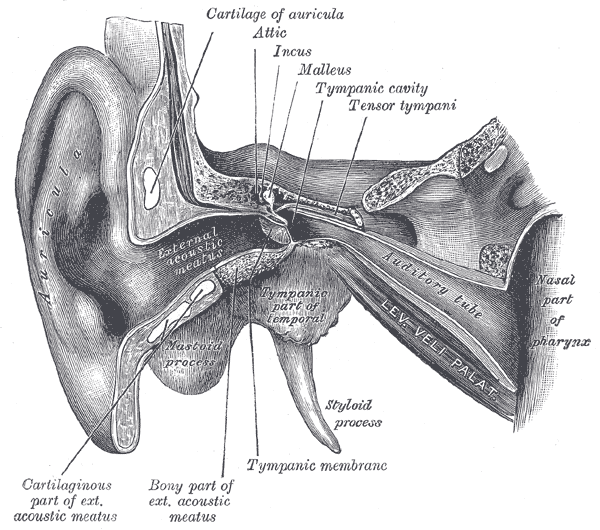
The middle ear is an air-filled cavity, separated from the external canal by the tympanic membrane and connected to the nasopharynx by the Eustachian tube. The tube stays closed most of the time and opens when swallowing and yawning.

A one-way valve
FAA Advisory Circular AC 61-107B explains the asymmetry between ascent and descent (Federal Aviation Administration, 2015). On ascent, the air in the middle ear expands and leaves easily through the tube. The base of the tube is collapsed and works as a one-way valve, which lets air out but makes it hard for air to enter. On descent, the cabin pressure rises, the air gets trapped and must be equalized actively. If that does not happen, ear block occurs.
Mirza and Richardson describe otic barotrauma as a traumatic inflammation of the middle ear caused by the pressure difference between the air in the middle ear and the environment, which arises after ascent or, more commonly, after descent, when the Eustachian tube fails to equalize the pressures. In severe cases, there may be perforation of the tympanic membrane and even rupture of the round window membrane (Mirza and Richardson, 2005).
The paranasal sinuses
The maxillary and frontal sinuses have openings that normally let air in and out. AC 61-107B notes that, in an upper airway infection, these openings can swell and close, and the pressure stops equalizing, which causes sinus block, almost always on descent and rarely on ascent. The pain sits under the cheekbones and in the upper teeth, in the maxillary sinus, or above the eyes, in the frontal sinus.
Lindfors and colleagues, in a study with crews of commercial airlines, found reports of sinus barotrauma in 61 of every 100 respondents, with female sex and frequent upper airway infections as possible risk factors (Lindfors and colleagues, 2021). Park and colleagues reported a case of frontal sinus barotrauma in a passenger with undiagnosed allergic rhinitis, which reinforces the role of the nasal mucosa (Park and colleagues, 2025).
The clinical picture and the Teed scale
Mirza and Richardson describe the presentation with ear fullness, pain and hearing loss. Wright's review adds that pressure changes can cause vertigo (Wright, 2015). AC 61-107B describes ear block as a sensation of fullness that progresses to pain, increases on descent and can cause vertigo.
The Teed scale
The Teed classification was first described in 1944 and has been modified over the years. O'Neill and Weitzner note that it was not created to guide management or treatment of the injury (O'Neill and Weitzner, 2015). In the version used in studies with divers, the scale goes from 0, normal tympanic membrane, to 4, perforation (Jansen and colleagues, 2016). Other modified versions use more grades, so it is worth recording which version was used. The StatPearls chapter on ear barotrauma provides a table for reference.
The passenger in the scene has a retracted membrane with small hemorrhages, an intermediate finding on the scale. Sohn and Cho, studying middle ear barotrauma in student pilots, found a predominance of grade 0 and grade III cases, an association of grade with turbinate hypertrophy and with nasal secretion, and a mean duration of 6.8 days, with most resolving within a week (Sohn and Cho, 2017).
Who is at higher risk
The studies cited point to the nose. In Sohn and Cho's student pilots, stuffy nose and nasal secretion were common, and turbinate hypertrophy appeared in almost all cases. In Lindfors's survey with crew members, frequent upper airway infections and female sex emerged as possible risk factors for sinus barotrauma. Park and colleagues described the case linked to undiagnosed allergic rhinitis. In young children, however, Buchanan and colleagues found no association between pain and a history of otitis or recent respiratory symptoms.
The differential diagnosis: do not confuse it with otitis
The main differential for middle ear barotrauma is acute otitis media, because both cause ear pain and a change in the membrane. The American Academy of Pediatrics guideline recommends diagnosing acute otitis media in children with moderate or intense bulging of the tympanic membrane or with new otorrhea that does not come from otitis externa (Lieberthal et al., 2013). Acute otitis externa is defined by the American Academy of Otolaryngology-Head and Neck Surgery guideline as diffuse inflammation of the external auditory canal, which may also involve the pinna or the tympanic membrane (Rosenfeld et al., 2014). The sinus and tooth clues come from the AC 61-107B blockage table.


| Condition | Clues in favor | What brings it close to barotrauma |
|---|---|---|
| Middle ear barotrauma | Pain that starts on descent, fullness, absence of fever, retraction and hemorrhage in the membrane | Pain, hearing loss, red membrane |
| Acute otitis media | In children, moderate or intense bulging of the membrane or new otorrhea without otitis externa | Ear pain and altered membrane |
| Acute otitis externa | Diffuse inflammation of the external auditory canal, which may involve the pinna or the membrane | Ear pain |
| Perilymphatic fistula | Abnormal communication between the inner ear and the middle ear, which may appear after barotrauma | Onset linked to pressure |
| Sinus barotrauma | Intense pain under the cheekbones and in the upper teeth or under the eyebrows | Relation to descent and a cold |
| Dental block | Pain in a single tooth, which increases with altitude | Facial pain linked to altitude |
The detail that changes management
The most important differential is not with otitis, but with inner ear injury. Deveze et al. define perilymphatic fistula as an abnormal communication between the inner ear space, filled with perilymph, and the air-filled space of the middle ear, located at the round or oval windows, among other sites, and note that it may appear after barotrauma. Diagnosis is difficult and has been controversial for decades. The authors also record that the fistula can be corrected by surgery and that recognizing and treating it can improve hearing and balance (Deveze et al., 2018). It is therefore worth referring to the otolaryngologist anyone with inner ear complaints after a flight.
The post about differential diagnosis shows how a clue that does not fit, such as persistent vertigo in a barotrauma that seemed simple, should make room for another hypothesis.
Exams: otoscopy, tympanometry and nose
The central exam is otoscopy, which allows grading the membrane on the Teed scale. That is how Sohn and Cho classified the cases of the pilot students, and it is also the exam that separates the criteria for otitis media and otitis externa described in the guidelines.
Tympanometry and the nine-step test
Sohn studied pilot students with middle ear barotrauma and performed tympanometry and the nine-step inflation and deflation test at the first visit and after improvement. At the initial visit, most failed the full test. After the pilots returned to flying, all those who had a recurrence had failed the control test, and the test showed high sensitivity and specificity for predicting recurrence (Sohn, 2019). The author concludes that the test gives useful information about eustachian tube function.
Nose exam
Sohn and Cho included endoscopy of the nasal cavity and found a relation between the degree of barotrauma and the severity of turbinate hypertrophy and nasal secretion (Sohn and Cho, 2017). Examining the nose is therefore part of the ear exam. In the case of Park et al., it was the nasal investigation that revealed the allergic rhinitis behind the frontal sinus barotrauma.
Management during the flight and after landing
During the flight, the goal is to equalize the pressure before the pain appears. For crew members, AC 61-107B recommends, when an ear block occurs, leveling the plane, trying clearing maneuvers such as the Valsalva maneuver, jutting the jaw forward, yawning or swallowing, climbing again and repeating the maneuvers and, if there is no relief, landing as soon as possible (Federal Aviation Administration, 2015). For sinus block, the sequence is similar, with Valsalva and a new climb before the next attempt. Passengers do not control the altitude, but they can swallow, yawn and perform the Valsalva maneuver gently throughout the descent.
After landing
Most cases improve on their own. Wright's review notes that symptoms usually resolve spontaneously and that perforation is rare. In student pilots, the mean duration was 6.8 days and most resolved within a week, but there was persistence or recurrence in some cases (Sohn and Cho, 2017). The sources for this text do not define a fixed time before flying or diving again, nor a specific protocol for follow-up of perforation; those decisions rest with the otolaryngologist and, for pilots, with the aviation authority.
The passenger in the scene
The passenger has no bulging and no otorrhea, which are the guideline criteria for acute otitis media in children, and the pain began during descent. The explanation of the mechanism, care of the nose, which Sohn and Cho associated with the degree and duration of barotrauma, and reassessment if hearing does not improve are the steps this text can support from the sources. Mirza and Richardson describe the condition as traumatic inflammation, and none of the trials cited here tested antibiotics.
Prevention: what the evidence shows, with the doses tested
Prevention starts with the maneuvers AC 61-107B lists for clearing the ear: Valsalva, jutting the jaw, yawning and swallowing. Mitchell-Innes and colleagues showed that many passengers do not know that barotrauma can be prevented (Mitchell-Innes and colleagues, 2014).
Pseudoephedrine in adults
The most cited trial is the one by Csortan and colleagues, randomized, double-blind and placebo-controlled, in volunteers with a history of recurrent ear discomfort on flights. Each participant received pseudoephedrine 120 mg orally, 30 minutes before flight departure, or placebo. Ear discomfort occurred in 32 of every 100 participants taking pseudoephedrine and in 62 of every 100 taking placebo, and seven participants reported drowsiness (Csortan and colleagues, 1994).
This result applies to adults with recurrent pain, not to every passenger. The over-the-counter label for pseudoephedrine on DailyMed, from the United States National Library of Medicine, says not to use the product with a monoamine oxidase inhibitor or within the 2 weeks after stopping one, and to ask a doctor before use in people with heart disease, high blood pressure, thyroid disease, diabetes or difficulty urinating due to an enlarged prostate (DailyMed, pseudoephedrine label). The decision must consider the patient. For pilots, medication use follows the rules of the aviation authority.
Pseudoephedrine in children
Buchanan and colleagues tested pseudoephedrine 1 mg/kg of body weight, 30 to 60 minutes before departure, against placebo, in children aged 6 months to 6 years. The medication did not reduce pain on ascent or descent and increased drowsiness at takeoff, present in 60 of every 100 flights with pseudoephedrine versus 27 of every 100 with placebo (Buchanan and colleagues, 1999). The dose is cited here as the dose tested, not as a recommendation.
Nasal decongestant and other measures
Mirza and Richardson summarize a third trial: oxymetazoline nasal spray, used 30 minutes before descent, did not reduce symptoms in adults with recurrent pain in a statistically significant way (Mirza and Richardson, 2005). Wright's review also included nasal balloon inflation among the interventions assessed. Klokker and colleagues tested pressure-equalizing earplugs sold at airports and pharmacies and found no prevention of barotrauma during descent (Klokker and colleagues, 2005).
Training chambers and travelers
Barotrauma is also the most common adverse effect of hypobaric chamber training, according to the review by Nakdimon and Ben-Ari (Nakdimon and Ben-Ari, 2022).
Special situations: children, crew members and those who fly again
Some groups deserve particular attention, because the risk, the way it presents or the consequences of barotrauma are different.
Young children
In young children, ear pain during flight has been studied directly. The trial by Buchanan and colleagues showed that pain occurred on a small share of the flights studied and was not associated with a history of pain on previous flights, recent otitis or recent airway symptoms (Buchanan and colleagues, 1999). Wright estimates that membrane changes after flight are more frequent in children than in adults. Since pseudoephedrine did not help in this age group in the Buchanan trial, there is no basis in the sources for this text to use it in young children before flight.
Crew members and student pilots
For those who fly as a profession, barotrauma has an occupational consequence. Lindfors and colleagues note that sinus barotrauma can compromise flight safety and even keep crew members grounded permanently (Lindfors and colleagues, 2021). Sohn and Cho observed persistence or recurrence in some of the student pilots, which reinforces the importance of treating the underlying nasal disease. The decision about returning to flying follows each country's aviation authority.
Those who need to fly again within a few days
Sohn's study helps in thinking about this return. The student pilots were followed for 2 weeks after returning to flying, and about 1 in 5 had a recurrence. All of those who recurred had failed the nine-step test done after improvement (Sohn, 2019). Improvement of symptoms, therefore, may not be enough to indicate that the tube is working again. The sources for this text do not define a time frame for returning to flying after a perforation.
Calibrating the guidance
The post on calibrating confidence shows how to adjust the certainty of guidance to what is known. In barotrauma, the evidence for preventive medications is limited and comes from few trials, and patient guidance should make that clear.
Reasoning: the same membrane, two stories
The scene shows an easy mistake: seeing a red tympanic membrane and concluding that it is otitis. Croskerry described this kind of shortcut, in which rapid recognition of a pattern ends the search before the history has been heard in full (Croskerry, 2003).
The question that changes the diagnosis is simple: when did the pain start? If it started during the descent of a flight, in someone with a blocked nose and no fever, the hypothesis of barotrauma becomes much more likely. The post on pretest probability helps to understand why the same finding carries different weight in different contexts.
Tests and approaches that do not help
The post on clinical decision making shows how to choose tests and approaches by what they change in care. In ear barotrauma, the nine-step test described by Sohn is an example of a test that changes the decision, because it helps predict who will recur when returning to flying. The post on examples of heuristics discusses useful shortcuts that sometimes mislead, and the one on diagnostic pause proposes a final question before closing the case.
How NEXO helps train this reasoning
To use the case of the day as training, try three habits. Before each guess, ask when and in what situation the symptom started. When the examination finding is common to several diseases, look for the clue in the history that separates the hypotheses. After the result, note which question would have anticipated the diagnosis.
Three exercises with cases
Ask about the timeline. Identify the exact moment it started and what the person was doing.
Separate mechanism from infection. When faced with an inflammatory finding, ask whether the cause could be mechanical.
Look for the red flag. In each apparently simple picture, list the finding that would change the urgency, such as sensorineural hearing loss.
The post about learning based on clinical cases shows how cases help fix these clues.
The limits on using the game are described on the Economy page of NEXO. If you research the teaching of clinical reasoning, the page for Researcher explains how to get in touch. Professionals who write or review cases find information on Curator and on Creators, and institutions can learn about the proposal on the partnerships page.
Frequently asked questions
Does ear barotrauma usually appear on descent?
Yes. On descent, cabin pressure rises and the Eustachian tube must open to let air into the middle ear.
Does a cold increase the risk of barotrauma?
Yes. Swelling of the mucosa makes it harder for the Eustachian tube and the sinus openings to open.
Does the Teed scale help grade barotrauma?
Yes. In the version used in studies with divers, it ranges from 0, normal membrane, to 4, perforation.
Do most cases improve on their own?
Yes. Symptoms usually resolve spontaneously, and among student pilots most resolved within a week.
Did pseudoephedrine reduce discomfort in adults with recurrent pain?
Yes. In a controlled trial, 120 mg by mouth 30 minutes before the flight reduced discomfort compared with placebo.
Do persistent vertigo and hearing loss require specialist assessment?
Yes. A perilymphatic fistula can appear after barotrauma, and recognizing and treating it can improve hearing and balance.
Final checklist
- I asked whether the pain started on ascent or descent.
- I asked about colds, rhinitis and sinusitis.
- I checked for fever and signs of infection before the flight.
- I graded the otoscopy finding using the Teed scale.
- I considered tympanometry and the nine-step test before the return to flying.
- I thought of perilymphatic fistula when the complaint suggested the inner ear.
- I examined the nose and the sinuses.
- I explained that the sources do not set a time frame for returning to flying or diving.
- I discussed prevention based on the evidence and on the pseudoephedrine label.
- I referred to the otolaryngologist when I suspected inner ear injury.
Want to practice reasoning with progressive clues? Play the case of the day.
References
- Buchanan BJ, Hoagland J, Fischer PR. Pseudoephedrine and air travel-associated ear pain in children. Arch Pediatr Adolesc Med. 1999. PMID 10323625.
- Croskerry P. The importance of cognitive errors in diagnosis and strategies to minimize them. Acad Med. 2003. PMID 12915363.
- Csortan E, Jones J, Haan M, et al. Efficacy of pseudoephedrine for the prevention of barotrauma during air travel. Ann Emerg Med. 1994. PMID 8198308.
- Deveze A, Matsuda H, Elziere M, et al. Diagnosis and Treatment of Perilymphatic Fistula. Adv Otorhinolaryngol. 2018. PMID 29794455.
- Federal Aviation Administration. Advisory Circular 61-107B CHG 1: Aircraft Operations at Altitudes Above 25,000 Feet Mean Sea Level or Mach Numbers Greater Than .75. 2015. Document.
- Jansen S, Meyer MF, Boor M, et al. Prevalence of Barotrauma in Recreational Scuba Divers After Repetitive Saltwater Dives. Otol Neurotol. 2016. PMID 27636390.
- Klokker M, Vesterhauge S, Jansen EC. Pressure-equalizing earplugs do not prevent barotrauma on descent from 8000 ft cabin altitude. Aviat Space Environ Med. 2005. PMID 16313146.
- Lieberthal AS, Carroll AE, Chonmaitree T, et al. The diagnosis and management of acute otitis media. Pediatrics. 2013. PMID 23439909.
- Lindfors OH, Ketola KS, Klockars TK, et al. Sinus Barotraumas in Commercial Aircrew. Aerosp Med Hum Perform. 2021. PMID 34819211.
- Mirza S, Richardson H. Otic barotrauma from air travel. J Laryngol Otol. 2005. PMID 15949100.
- Mitchell-Innes A, Young E, Vasiljevic A, et al. Air travellers' awareness of the preventability of otic barotrauma. J Laryngol Otol. 2014. PMID 24896105.
- Nakdimon I, Ben-Ari O. Mitigating Risks of Altitude Chamber Training. Aerosp Med Hum Perform. 2022. PMID 36309795.
- O'Neill OJ, Weitzner ED. The O'Neill grading system for evaluation of the tympanic membrane: A practical approach for clinical hyperbaric patients. Undersea Hyperb Med. 2015. PMID 26152108.
- World Health Organization. International Statistical Classification of Diseases and Related Health Problems, 10th revision (ICD-10), 2019 version. Chapter XIX, T70. Document.
- Park MJ, Kang SJ, Kim GT, et al. Frontal Sinus Barotrauma in an Airliner Passenger with Undiagnosed Allergic Rhinitis. Aerosp Med Hum Perform. 2025. PMID 40675604.
- Rosenfeld RM, Schwartz SR, Cannon CR, et al. Clinical practice guideline: acute otitis externa. Otolaryngol Head Neck Surg. 2014. PMID 24491310.
- Sohn JH, Cho KR. Middle Ear Barotrauma in Student Pilots. Aerosp Med Hum Perform. 2017. PMID 28518004.
- Sohn JH. Recurrent Middle Ear Barotrauma in Student Pilots. Aerosp Med Hum Perform. 2019. PMID 31331417.
- U.S. National Library of Medicine. DailyMed: Pseudoephedrine hydrochloride tablet, over-the-counter label. 2026. Document.
- Wright T. Middle-ear pain and trauma during air travel. BMJ Clin Evid. 2015. PMID 25599243.