Chemical agents and organophosphates: cholinergic syndrome

Table of contents
- Why cholinergic syndrome is a reasoning setting
- Recognizing the pattern
- Protecting the team and the hospital
- Treat before decontaminating
- Atropine: titrate by the chest, not the eyes
- Oximes: an open controversy
- Cholinergic syndrome: a table for care
- After improvement
- The biases that get in the way of care
- How NEXO helps train this reasoning
- Frequently asked questions
- Final checklist
- References
A small hospital receives, within a few minutes, several people brought from the same place. Their eyes are tearing, their pupils are very small, they have heavy salivation, wheezing in the chest and muscle tremors. Some vomit and one is confused, with weak breathing. The people who brought them also complain of headache and chest tightness. Nobody knows exactly what happened. The team's first reaction is to bring everyone inside and start examining them. The scene is fictional and was written for teaching. This text uses that picture as a setting for clinical reasoning: how to recognize cholinergic syndrome, why protecting the team and decontamination come together with treatment, how to titrate atropine and what to watch for after the patient improves.
NEXO is a daily medical diagnosis game: one clinical case a day, up to six progressive clues, and ICD-10 proximity feedback across five levels.
This text is not a protocol for responding to chemical incidents. Decontamination, protective equipment, antidotes and doses follow their own guidelines, local plans and practical training. The interest here is the reasoning: how to put together signs that seem disconnected into a single pattern and act before the laboratory confirms. If you play the case of the day on NEXO, you will recognize the move: sometimes several small clues only make sense when seen together.
Key points
- Small pupils, abundant secretions, wheezing, sweating, vomiting, muscle tremors and weakness suggest cholinergic syndrome, from nerve agents or from organophosphate pesticides.
- Treatment of immediate threats to life comes first, as soon as it is safe, even before decontamination.
- Atropine is titrated until the chest is clear, the heart rate is above eighty and the armpits are dry, not by the size of the pupils.
- The role of oximes remains controversial, especially in pesticide poisoning.
- After the initial improvement, respiratory weakness can return days later, in what is called intermediate syndrome.
Why cholinergic syndrome is a reasoning setting
Cholinergic syndrome can appear in very different contexts: in an incident with chemical agents, in a work accident in the countryside or in a suicide attempt with pesticide. The World Health Organization published, in 2026, a provisional guidance for the initial care of patients exposed to chemicals used as weapons (World Health Organization, 2026). Eddleston and colleagues reviewed the treatment of acute poisoning by organophosphate pesticides and recall that it is an important clinical problem in rural regions, with high mortality among the patients treated (Eddleston and colleagues, 2008).
The same mechanism, different contexts
Eddleston and colleagues explain that organophosphates inhibit the enzyme that breaks down acetylcholine at synapses, which causes a buildup of this substance and excessive stimulation in the autonomic nervous system, in the brain and at the junctions between nerves and muscles (Eddleston and colleagues, 2008). Nerve agents act by the same mechanism. That is why the clinical reasoning learned in pesticide poisoning also serves for the chemical incident, and vice versa.
A public health problem
Mew and colleagues reviewed data on suicide worldwide and estimated that intentional pesticide poisoning accounts for at least one in every seven suicides (Mew and colleagues, 2017). The authors observed a drop in deaths in recent years, but concluded that the problem remains a major public health challenge. For the clinician, this means that the patient with cholinergic syndrome may be in a moment of crisis and will need mental health care after the acute phase.
Recognizing the pattern
The World Health Organization describes the signs of exposure to nerve agents by severity level (World Health Organization, 2026). In mild cases, there is dizziness, anxiety, headache, weakness, chest tightness, runny nose, cough, sweating, salivation, tearing, nausea and a slight drop in heart rate and blood pressure. In moderate cases, there is agitation, confusion, drowsiness, loss of consciousness, tremors and muscle fasciculations, shortness of breath, bronchial secretions, bronchospasm, abdominal pain, vomiting and diarrhea. In severe cases, there are seizures, flaccid paralysis, deep coma and loss of control of urine and stool.
Why the pupils and the pulse mislead
The World Health Organization notes that, depending on which part of the syndrome predominates, the patient may have small or dilated pupils, low or high heart rate and low or high blood pressure (World Health Organization, 2026). Eddleston and colleagues describe that patients with severe poisoning often arrive with pinpoint pupils, excessive sweating, reduced consciousness and poor breathing (Eddleston and colleagues, 2008). A patient with a fast heart rate does not rule out the diagnosis. The post on signs, symptoms and history shows how to put together signs that seem contradictory.
The diagnosis is clinical
Eddleston and colleagues explain that the diagnosis is based on clinical suspicion, the characteristic signs, the smell of pesticide or solvent and reduced blood cholinesterase activity (Eddleston and colleagues, 2008). The authors note that the results of these measurements are rarely ready in time to change the clinical decision. The main differential diagnosis is carbamate poisoning, which is clinically indistinguishable. Treatment starts from the clinical picture, without waiting for the laboratory.
What the cholinesterases tell
Eddleston and colleagues explain that plasma cholinesterase does not track severity, but it is a sensitive marker of exposure, while red blood cell acetylcholinesterase tracks synaptic function and the need for atropine better (Eddleston and colleagues, 2008). The authors warn that the sample must be cooled and diluted right after collection, because the reaction continues in the tube and a few minutes of delay change the result. For reasoning, a normal test collected the wrong way does not rule out the diagnosis, and an abnormal test does not, on its own, show how much atropine the patient needs.
Questions before the door
The World Health Organization suggests questions to ask before the patient enters the hospital (World Health Organization, 2026). The document recommends asking where the person was, when the symptoms started, which came first and whether other people had similar symptoms. It also recommends looking for powder, liquid or droplets on the skin and clothing, stained or damaged clothing and symptoms in companions who were not at the scene, which suggests secondary exposure. In the opening scene, the headache and chest tightness of those who brought the patients are a clue to contamination that calls for immediate protection.
Protecting the team and the hospital
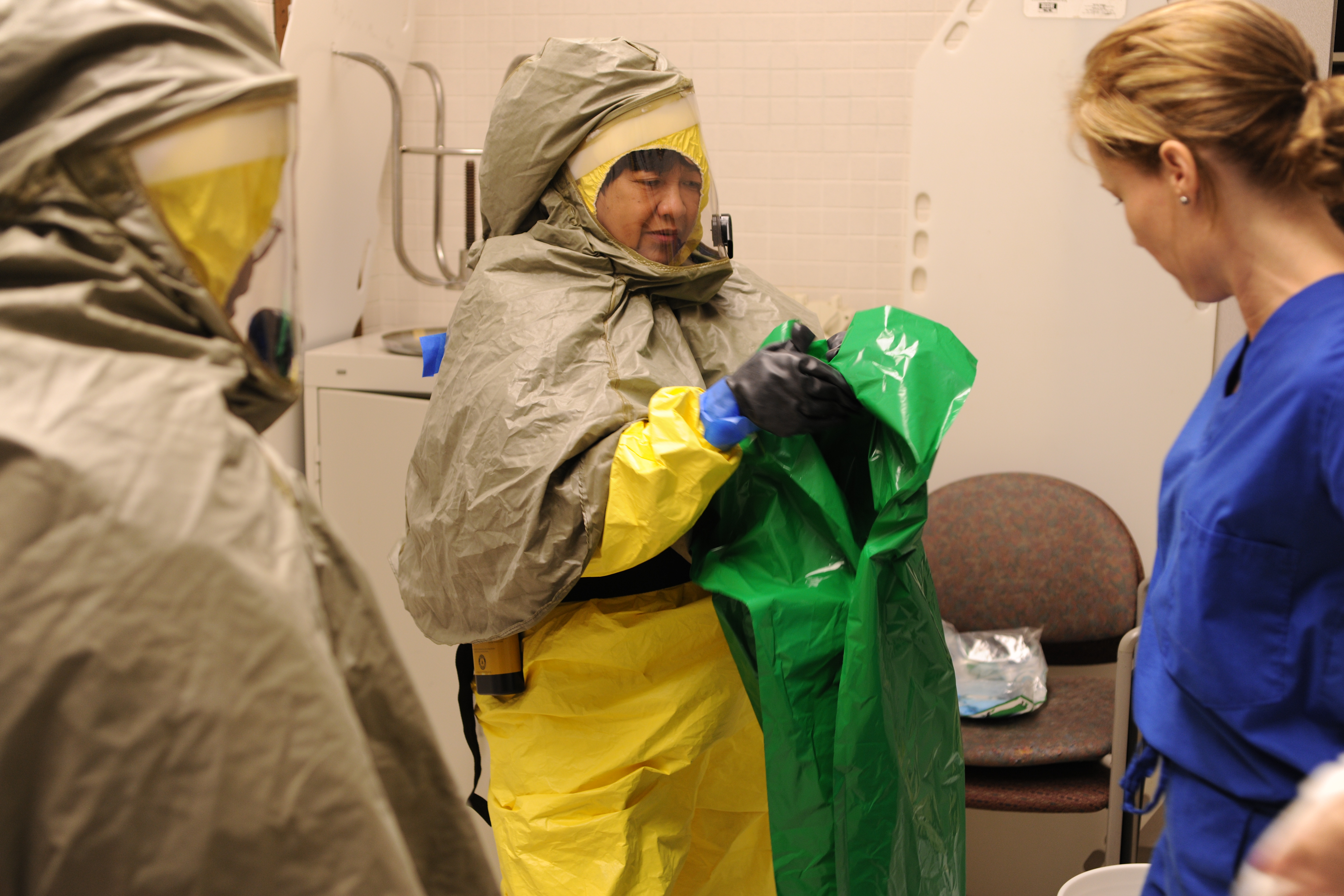
The World Health Organization recommends considering patients who arrive at the hospital after a chemical attack contaminated by default (World Health Organization, 2026). The document notes that exposure to gas, vapor or aerosol may leave no visible signs and still require decontamination. Professionals are exposed mainly through contact with the substance on the patient's skin and clothing or by inhaling vapor.

Gloves, masks and limits
The World Health Organization recommends nitrile or butyl rubber gloves, not latex, with at least two layers (World Health Organization, 2026). The document notes that ordinary surgical masks do not protect against toxic vapors and that a respirator with a filter or self-contained breathing apparatus is needed. All protective equipment reduces mobility, dexterity, vision and communication, and increases the physical effort of whoever wears it.
What changes in pesticide poisoning
Eddleston and colleagues note that, in ingested pesticide poisoning, there are no confirmed reports of significant poisoning of health professionals, and that some symptoms in the team may come from anxiety or the solvent (Eddleston and colleagues, 2008). The authors warn that reluctance to attend to these patients puts them at risk, and recommend universal precautions, good ventilation of the room and rotation of the team. The context changes the weight of the risk for the team.
Treat before decontaminating
The World Health Organization recommends that treatment of life-threatening conditions be the priority, as soon as it is safe, even before thinking about decontamination (World Health Organization, 2026). The proposed sequence starts with catastrophic hemorrhage, followed by airway with the specific antidote when available, breathing, circulation, decontamination and removal to a safer environment. The document suggests a rapid assessment of consciousness, breathing, eyes, secretions and skin.
Undress, dry and rinse
The World Health Organization describes a simple decontamination technique that requires little equipment (World Health Organization, 2026). First, the liquid is removed from the skin with absorbent material and powders are brushed off gently. Then clothing is removed as soon as possible, cutting with scissors instead of pulling over the head, and clothes and accessories are kept in labeled bags. Finally, the affected areas are rinsed with water and soap. The document notes that removing clothing greatly reduces contamination and that the patient must be told what is being done.
Those without symptoms
The World Health Organization notes that symptoms may take time to appear when contact was with the liquid substance on the skin, and recommends observing contaminated patients who do not yet have symptoms (World Health Organization, 2026). The document also recommends close monitoring of all patients, because the condition can worsen, especially if decontamination was not complete.
Atropine: titrate by the chest, not the eyes
The World Health Organization recommends atropine for all moderate and severe cases, with two milligrams intramuscularly or intravenously every five to ten minutes in adults and children aged twelve and over (World Health Organization, 2026). The document advises repeating doses until atropinization, defined by a clear chest on auscultation, heart rate above eighty and dry skin in the armpits. It also recommends not using pupil size to assess whether the dose is sufficient and not delaying atropine in order to give oxygen.


Doses that double
Eddleston and colleagues describe a regimen in which the atropine dose is doubled at each step, with the aim of bringing the pulse above eighty, systolic pressure above eighty and rapidly reversing bronchospasm and secretions (Eddleston and colleagues, 2008). The authors explain that this regimen allows high doses to be given in a short time, with rapid stabilization and low risk of toxicity. They also note that there are no trials comparing atropine regimens and that dozens of different recommendations exist. After that review, Abedin and colleagues compared, in an open-label trial, repeated fixed doses of atropine with rapid increasing doses followed by continuous infusion (Abedin and colleagues, 2012). The increasing-dose group reached atropinization much earlier and had fewer deaths, less atropine toxicity, less intermediate syndrome and less need for respiratory support. The authors stress that the evidence is still scarce and that further studies are lacking.
Oxygen and position
Eddleston and colleagues remind us that oxygen should be given as soon as possible, but that there is little evidence for the common recommendation not to give atropine before oxygen (Eddleston and colleagues, 2008). In hospitals without oxygen, atropine should be given early to reduce secretions and improve breathing. The authors recommend laying the patient on the left side, with the neck extended, to reduce the risk of aspiration. The main adverse effect of excess atropine is confusion, and so the response must be reassessed with each dose.
Oximes: an open controversy
The World Health Organization recommends, for nerve agents, pralidoxime in adults with a loading dose of thirty milligrams per kilogram, up to two grams, by slow intravenous route, repeated every four to six hours or followed by an infusion of eight to ten milligrams per kilogram per hour, with administration preferably in the first twenty-four hours (World Health Organization, 2026). Oximes reactivate the inhibited enzyme.
What the pesticide trials say
Buckley and colleagues reviewed the clinical trials of oximes in organophosphate pesticide poisoning and found very different results between them, from benefit to harm (Buckley and colleagues, 2011). The authors concluded that the evidence is insufficient to know whether oximes help or harm. The two most cited trials illustrate this divergence. Pawar and colleagues, in an open-label trial at a single center with moderately severe patients, compared continuous infusion of high-dose pralidoxime with intermittent doses and found less atropine, less intubation and fewer ventilation days in the high-dose group (Pawar and colleagues, 2006). Eddleston and colleagues, in a double-blind placebo-controlled trial, found clear reactivation of the enzyme, but no evidence that pralidoxime reduced mortality or the need for intubation, and mortality was numerically higher, without a significant difference, in the treated group (Eddleston and colleagues, 2009). Eddleston and colleagues also remind us that the response to oximes varies with the pesticide ingested and that, after large ingestions, the pesticide itself can inhibit the reactivated enzyme again (Eddleston and colleagues, 2008).
The honest picture, therefore, is this. The 2026 guidance deals with nerve agents used as weapons and recommends oximes in that context. In pesticides, the available trials do not show consistent benefit, and the systematic review does not allow us to state that oximes help or that they harm. For reasoning, atropine is the center of treatment, and the decision about oximes depends on the agent, the time since exposure and the local protocol.
Children
The World Health Organization recommends weight-adjusted doses of atropine and oximes in children under twelve years old (World Health Organization, 2026). The document reminds us that common autoinjectors were made for adults, with needles too long for the muscles of small children and doses too high. The use of an adult autoinjector can be considered in a severely poisoned child who needs urgent treatment, taking these limitations into account. For reasoning, the lack of the ideal material should not delay the antidote, but the dose must be thought through.
Seizures
The World Health Organization recommends diazepam to treat seizures or, empirically, in severe cases, and reminds us that other benzodiazepines can be used (World Health Organization, 2026). The document also describes hyoscine as a complement in patients with important central symptoms, without delaying atropine. Peter and colleagues reviewed complementary and alternative treatments to oxime, such as magnesium, human plasma, hemoperfusion and clonidine, and concluded that the evidence in humans is limited and that these treatments need more studies before entering routine practice (Peter and colleagues, 2008). The review also found no additional benefit in replacing atropine with glycopyrrolate.
Cholinergic syndrome: a table for care
The table below summarizes, in a didactic way, common findings in cholinergic syndrome and what usually weighs on the decision. It simplifies a complex topic and does not replace current guidelines, local protocols or practical training.
| Finding | What weighs on the decision | Frequent approach |
|---|---|---|
| Secretions, wheezing and bronchospasm | Risk of lack of oxygen | Repeated atropine until the chest is clear |
| Low heart rate | Muscarinic effect | Atropine until above eighty |
| Small pupils | A sign of exposure, not of dose | Do not use as a target for atropine |
| Fasciculations and weakness | Effect at the junction between nerve and muscle | Monitor breathing and consider ventilatory support |
| Seizures | Central effect | Benzodiazepine |
| Contaminated clothing or skin | Risk to the team and worsening of the patient | Protection, undress, dry and rinse |
After improvement
Eddleston and colleagues warn that patients can suddenly have respiratory failure with consciousness preserved, after seeming to recover from the cholinergic crisis (Eddleston and colleagues, 2008). The authors call this picture intermediate syndrome and recall that it is an important cause of death in patients who reached the hospital and were stabilized. They also recommend monitoring changes in the need for atropine and the return of cholinergic signs with pesticides that accumulate in fat.
Intermediate syndrome
Senanayake and Karalliedde described patients who had paralysis of the muscles near the trunk, of the neck flexors, of cranial nerves and of the respiratory muscles between twenty-four and ninety-six hours after poisoning, once the cholinergic phase had passed (Senanayake and Karalliedde, 1987). Some patients needed urgent ventilatory support, and the weakness lasted up to about two and a half weeks. For the clinician, weakness when lifting the head is a clue that anticipates respiratory failure. Jayawardane and colleagues followed patients with daily physical examination and repetitive nerve stimulation and showed that intermediate syndrome is a spectrum, with milder forms of weakness that do not reach respiratory failure (Jayawardane and colleagues, 2008). The changes on the electrical test appeared before the clinical signs and helped identify the patients at greater risk of respiratory failure.
Lavage and charcoal
Eddleston and colleagues recall that gastric lavage is usually done before resuscitation and the antidote, which can harm the patient (Eddleston and colleagues, 2008). The authors conclude that there is no evidence of benefit from gastric decontamination, that it should only be considered after stabilization with oxygen, atropine and oxime, and that there is no evidence of benefit from activated charcoal. The post on clinical decision-making helps to order actions by expected benefit.
The biases that get in the way of care
Cholinergic syndrome is rarely mismanaged for lack of knowledge. It is usually mismanaged because of predictable habits and biases:
- Taking patients inside before thinking about contamination and protection.
- Using pupil size as a target for atropine.
- Giving small doses and waiting too long between them.
- Ruling out the diagnosis because the heart is fast.
- Discharging or relaxing vigilance as soon as the patient improves.
Croskerry describes anchoring and premature closure among the most frequent cognitive errors in diagnosis (Croskerry, 2003). The post on diagnostic pause shows how a short moment of checking helps to notice what was left out. The post on heuristics in clinical reasoning helps to recognize when a single sign misleads.
What to ask and examine
Some questions and observations organize the care:
- Did several patients arrive together, from the same place, with similar symptoms?
- Is there a smell, dust, liquid or damaged clothing?
- Is the chest clear or are there secretions and wheezing?
- What is the heart rate and are the armpits dry?
- Are there fasciculations, neck weakness or weak breathing?
- Are there signs of an emotional crisis or of intentional ingestion?
Back to the scene
In the opening scene, the team that organizes its reasoning stops at the door. It considers the patients contaminated, puts on appropriate gloves and begins decontamination together with treatment of the immediate threats. The person with weak breathing receives atropine, oxygen and ventilatory support, with doses repeated until the chest is clear, the pulse is above eighty and the armpits are dry. The others are assessed by the same standard. Those who arrived without symptoms stay under observation. In the following days, the team monitors neck strength and breathing. Reasoning starts from the pattern and from protection, not from the laboratory result.
How NEXO helps train this reasoning
In NEXO, the case of the day is fictional, with a real clinical presentation and up to six progressive clues. You propose a diagnosis by looking for the ICD-10 code and receive a proximity response in five levels, which shows whether the guess landed on the exact code, the same category, the same group, the same chapter or a different chapter. This format connects with the theme of this text: several small clues can form a single pattern.
To use the case of the day as training, try three habits. Before each guess, ask whether the signs form a known syndrome. When a sign seems contradictory, ask whether it can be part of the same mechanism. After the result, note which clue would have anticipated the diagnosis.
Three exercises with cases
Put the signs together. In each case, try to group the findings into a syndrome before thinking about the disease.
Define the target. When faced with a treatment, ask which sign shows that the dose is enough.
Think about what comes after. Reread a case asking what can get worse in the days following improvement.
The post about case-based learning in clinical practice shows how cases help fix patterns that rarely appear in daily practice.
The limits on using the game are described on the NEXO Economy page. If you research the teaching of clinical reasoning, the page for Researchers explains how to get in touch. Professionals who write or review cases find information on Curator and on Creators, and institutions can learn about the proposal on the partnerships page.
Frequently asked questions
What is cholinergic syndrome?
It is the set of signs caused by excess acetylcholine, with secretions, wheezing, sweating, small pupils, vomiting, muscle tremors and weakness.
Why not use the pupils to guide atropine?
Because the pupils can stay small even with a sufficient dose. The target is a clear chest, a heart rate above eighty and dry armpits.
Is decontamination needed before treatment?
No. Treatment of immediate life threats comes first, as soon as it is safe, and decontamination happens alongside triage and treatment.
Do oximes work?
Guidance for nerve agents used as weapons recommends oximes. For pesticides, an open-label trial showed benefit with a high dose, a placebo-controlled trial showed no benefit, and the systematic review concluded that the evidence is insufficient. Atropine remains the center of treatment, and the decision about oximes depends on the agent and the local protocol.
What is intermediate syndrome?
It is a weakness that appears one to four days after poisoning and can affect the neck and the muscles of breathing.
Is the cholinesterase test necessary?
It helps confirm exposure, but it rarely comes back in time. Treatment starts from the clinical picture.
Final checklist
- I considered contaminated patients and protected the team.
- I treated immediate life threats together with decontamination.
- I titrated atropine by the chest, the heart rate and the armpits.
- I consulted the local protocol on oximes and treated seizures.
- I kept under observation those who arrived without symptoms.
- I monitored neck strength and breathing in the following days.
Want to practice reasoning with progressive clues? Play the case of the day.
References
- Abedin MJ, Sayeed AA, Basher A, et al. Open-label randomized clinical trial of atropine bolus injection versus incremental boluses plus infusion for organophosphate poisoning in Bangladesh. J Med Toxicol. 2012. PMID 22351300.
- Buckley NA, Eddleston M, Li Y, et al. Oximes for acute organophosphate pesticide poisoning. Cochrane Database Syst Rev. 2011. PMID 21328273.
- Croskerry P. The importance of cognitive errors in diagnosis and strategies to minimize them. Acad Med. 2003. PMID 12915363.
- Eddleston M, Buckley NA, Eyer P, Dawson AH. Management of acute organophosphorus pesticide poisoning. Lancet. 2008. PMID 17706760.
- Eddleston M, Eyer P, Worek F, et al. Pralidoxime in acute organophosphorus insecticide poisoning: a randomised controlled trial. PLoS Med. 2009. PMID 19564902.
- Jayawardane P, Dawson AH, Weerasinghe V, et al. The spectrum of intermediate syndrome following acute organophosphate poisoning: a prospective cohort study from Sri Lanka. PLoS Med. 2008. PMID 18630983.
- Mew EJ, Padmanathan P, Konradsen F, et al. The global burden of fatal self-poisoning with pesticides 2006-15: systematic review. J Affect Disord. 2017. PMID 28535450.
- World Health Organization. Initial clinical management of patients exposed to weaponized chemicals: interim guidance. 2026. Document.
- Pawar KS, Bhoite RR, Pillay CP, et al. Continuous pralidoxime infusion versus repeated bolus injection to treat organophosphorus pesticide poisoning: a randomised controlled trial. Lancet. 2006. PMID 17174705.
- Peter JV, Moran JL, Pichamuthu K, et al. Adjuncts and alternatives to oxime therapy in organophosphate poisoning: is there evidence of benefit in human poisoning? A review. Anaesth Intensive Care. 2008. PMID 18564794.
- Senanayake N, Karalliedde L. Neurotoxic effects of organophosphorus insecticides: an intermediate syndrome. N Engl J Med. 1987. PMID 3029588.