The Flexner report and the history of medical education
Table of contents
- Medicine before 1910
- Flexner and the Carnegie Foundation
- What the report proposed
- What changed in the following decades
- The cost the report did not measure
- Flexner around the world
- What this history teaches you
- Science and clinical case in NEXO
- Frequently asked questions
- Checklist for reading your curriculum with a historical eye
- References
You walk into your first day of class and get a familiar schedule: two years of basic sciences with anatomy, physiology, biochemistry and histology, then the clinical years, then the hospital internship. It feels like the natural order of things, as if medicine had always been taught this way. It was not. Much of this structure came from a report published in 1910 by Abraham Flexner, after visiting medical schools in the United States and Canada with a notebook and a simple question: what does this school actually teach?
This guide tells the story of the Flexner report, what he found, what he proposed, what changed in the following decades and the cost that change exacted. It also shows how the model spread around the world, what criticism it faces today and why understanding this history helps you, student or teacher, to see the curriculum as a choice, and not as a law of nature.
Key points
- Abraham Flexner visited 155 medical schools in the United States and Canada between December 1908 and April 1910 (Barzansky, 2010).
- In the decade after the report, the number of schools fell from 133 to 85, with higher entry requirements and longer courses (Barzansky, 2010).
- The model put laboratory science at the center of medical training, and its structure has changed relatively little since then (Irby et al., 2010).
- The reform closed most of the schools that trained Black physicians, with effects that are estimated to this day (Campbell et al., 2020).
- In many countries, such as Brazil, the six-year course follows the influence of the report, but the current debate calls for training centered on the student and the community (Antunes dos Santos e Nunes, 2019).
- A century later, the very foundation that funded the report called for a new reform, with integration and the formation of professional identity.
Summary
- Medicine before 1910
- Flexner and the Carnegie Foundation
- What the report proposed
- What changed in the following decades
- The cost the report did not measure
- Flexner around the world
- What this history teaches you
- Science and clinical case in NEXO
- Frequently asked questions
- Checklist for reading your curriculum with a historical eye
Medicine before 1910
At the end of the 19th century, opening a medical school in North America was relatively easy. Many schools were private businesses, kept going by tuition fees and by the teachers themselves, who were local doctors teaching at the end of the day. Several did not require a complete high school education for enrollment. The course could be done in a few months of lectures, repeated the following year, with no laboratory, no hospital of its own and no regular contact with patients. The diploma gave access to professional practice in most states.
The problem was already known before Flexner. In the twenty years before the report, the Illinois State Board of Health, the American Medical Association and the Association of American Medical Colleges carried out reviews with defined standards and identified many of the flaws (Barzansky, 2010). The number of schools was already falling, from 160 in 1905 to 133 in 1910, according to the same analysis. Flexner did not invent the criticism. He systematized it, named the schools and made it impossible to ignore.
The German model and science at the center
The reference for those who wanted reform was the German university, where medicine relied on physiology, pathology and chemistry laboratories, with professors dedicated to research. Many American physicians and educators had studied in Europe and returned enchanted with this system (Duffy, 2011). This European influence helps explain why laboratory science became, after the report, the mark of a modern physician's training.

Flexner and the Carnegie Foundation
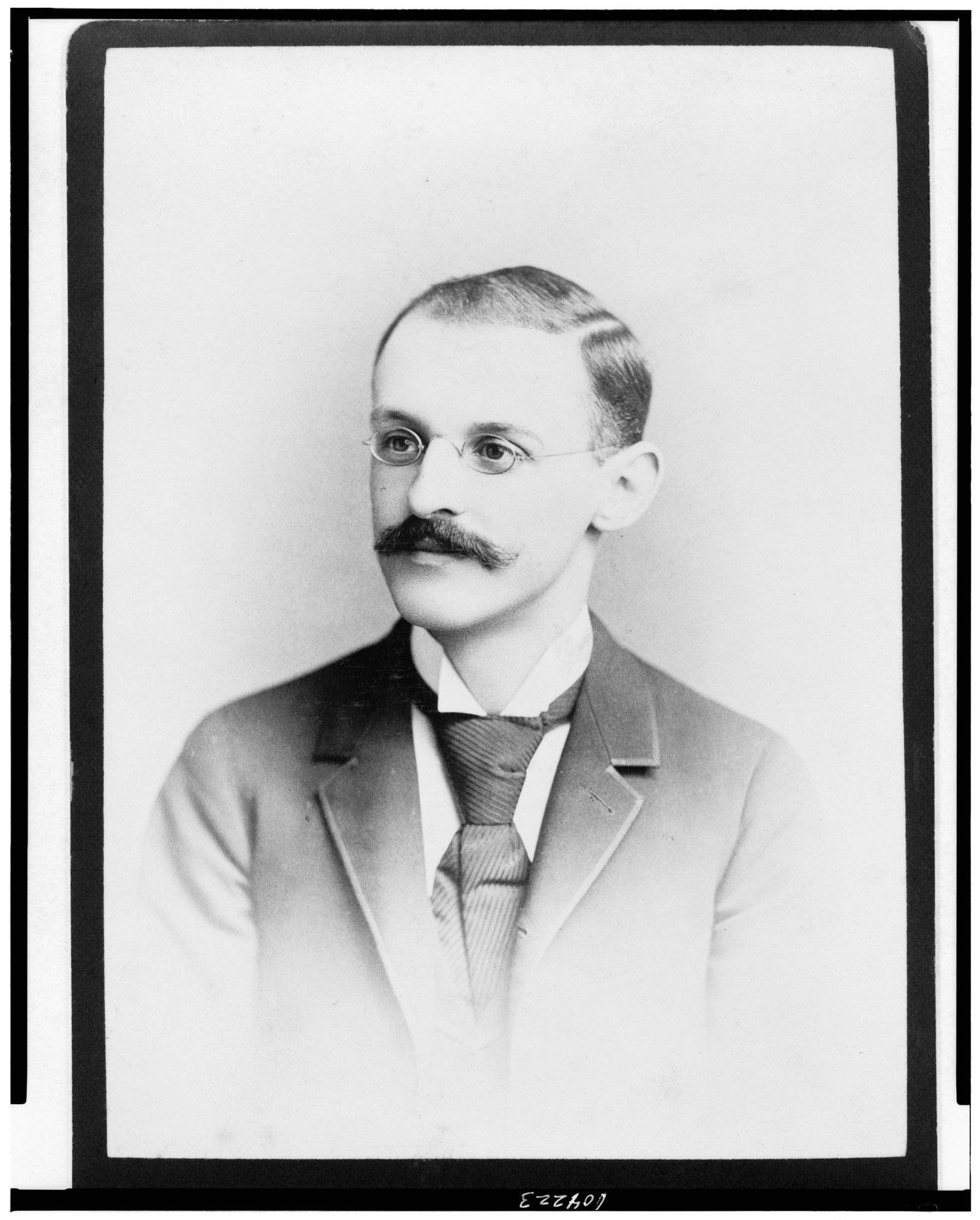
The report was commissioned by the Carnegie Foundation for the Advancement of Teaching (Irby et al., 2010). A rereading from the public health point of view shows that Flexner already advocated principles such as training doctors in quantity and quality suited to the population's needs and recognizing that doctors have social obligations to prevent disease and promote health (Maeshiro et al., 2010).
_-_Klauber,_photographer_and_art_dealer,_Louisville,_Ky_LCCN91788348.jpg)
A recent reading of the report argues that Flexner did not have only a technical view of science. He drew on John Dewey's pragmatist philosophy and saw the doctor as an investigator who applies the experimental method to each patient, with a social and ethical identity that went beyond the laboratory (Heinbokel, 2024). This reading helps explain why the report talks so much about method and not only about content.
How he carried out the assessment
Flexner visited 155 schools in the United States and Canada between December 1908 and April 1910 (Barzansky, 2010). In the report, five points recur in the assessment of each school:
- Entrance requirements: what prior education the school demanded of students.
- Faculty: how many teachers, with what dedication and with what training.
- Financial resources: where the money came from and whether it depended only on tuition.
- Laboratories: whether they existed, whether they were used and how they were equipped.
- Access to the hospital: whether students had contact with patients under supervision.
The report brought a conceptual model of what modern medical education should be like and descriptions of each school, explicit in both praise and censure (Barzansky, 2010). The frankness with which it named bad schools was part of the text's strength.
What the report proposed
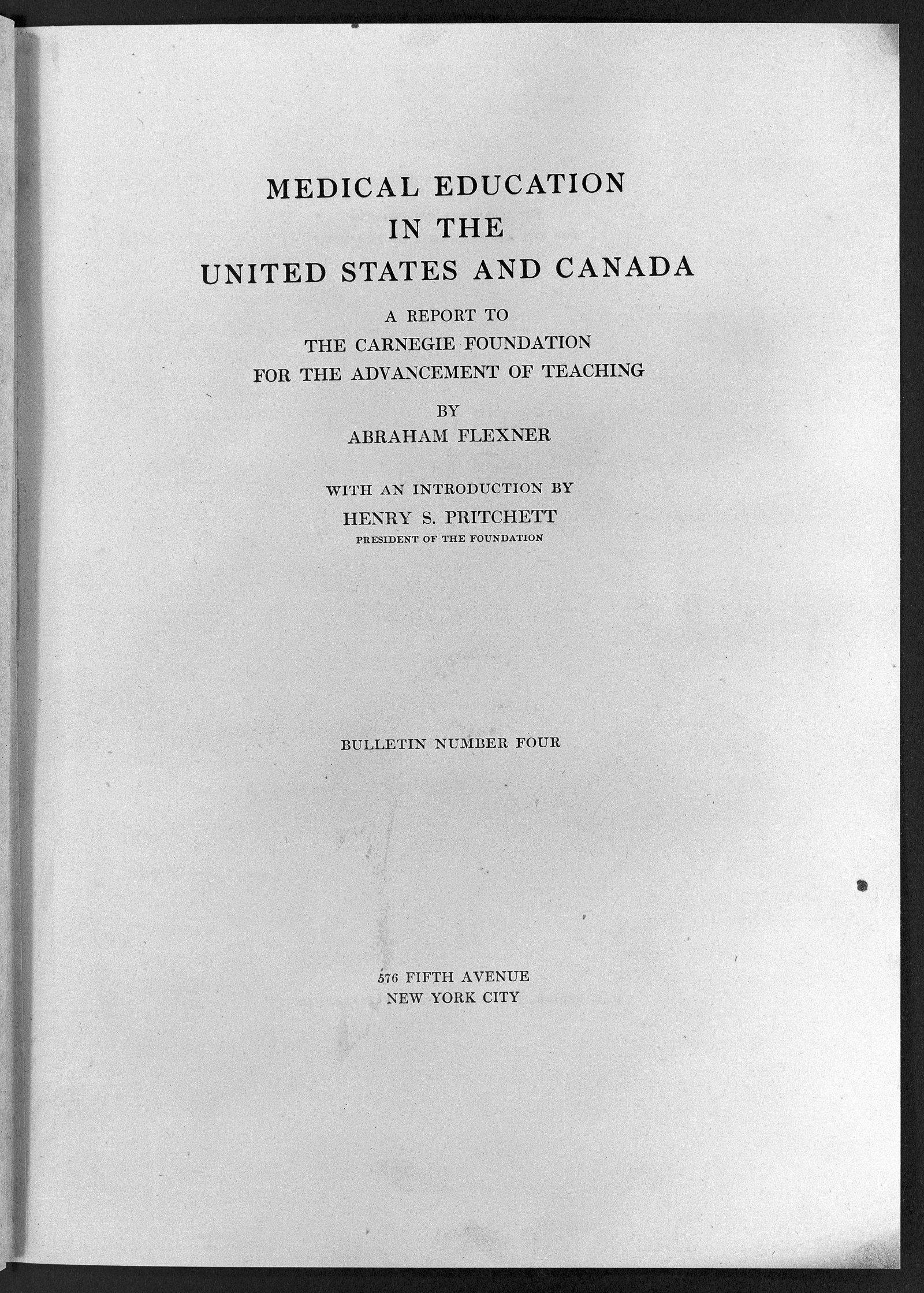
The text, published as Bulletin number four of the Carnegie Foundation, was reprinted decades later for its historical value (Flexner, 1910, 2002 reprint). The central proposals can be summed up in a few ideas that still shape most curricula:
| Flexner's proposal | How it was before | What remains today |
|---|---|---|
| Require prior scientific training for admission | Many schools accepted students who had not completed high school | Entrance exam or prior degree, depending on the country |
| Four-year course, with two years of basic sciences | A few months of repeated classes | Basic cycle followed by clinical cycle |
| Laboratories and dedicated teachers | Teachers were local doctors working part time | Basic science departments and research |
| Clinical teaching in a hospital linked to the school | Little or no contact with patients | University hospital and internship |
| School linked to a university | Isolated, for-profit schools | Medical schools within universities |
| Fewer and better schools | Many small, unequal schools | Accreditation and minimum standards |
The sentence that sums up the spirit of the report, cited in several analyses, is that the country needed fewer and better doctors (Steinecke and Terrell, 2010). The idea seemed a technical question of quality, but it had social consequences that only became clear with time.

What changed in the following decades
The effect was quick. In the decade after the report, the number of schools fell from 133 to 85, and those that remained had higher entrance requirements, longer courses and more resources (Barzansky, 2010). The closures were sealed by state licensing boards, which stopped recognizing diplomas from the weaker schools. Private foundations began funding the schools that adopted the new standard.
Within a decade, a scientific and rigorous medical education was established, and its structures and processes have changed relatively little since then, according to the authors of the 2010 Carnegie report (Irby et al., 2010). The success was great: American medicine became a reference in research during the 20th century, and the model spread around the world.
The imbalance between science and care
Along with the gain came an imbalance. The emphasis on laboratory science as the identity of the modern physician created, according to a centennial analysis, an imbalance between the art and the science of medicine, and a correction is underway to realign the professional commitment with training (Duffy, 2011). The rigid separation between basic and clinical is part of that legacy. The student memorizes metabolic pathways two years before seeing a patient, and then has to rebuild the link between mechanism and symptom, the theme of the post about connecting mechanism and symptom from the basic cycle to the clinic.
The teaching hospital and the birth of the internship
One of the most visible legacies of the report is the teaching hospital. Before 1910, many schools had no regular access to wards, and a student could graduate without having examined a patient under supervision. Flexner argued that the school should control a hospital, or have a formal link with one, so that clinical teaching would be part of the course and not a favor from city physicians. From this come organized bedside teaching, preceptor-led rounds and, later, the internship as the final stage of graduation.
This design has a strong pedagogical logic: learning to care requires seeing many patients, with supervision and with time to discuss reasoning. But it also concentrated teaching in the tertiary hospital, where the most severe and rarest cases appear. The student learns a lot about advanced disease and little about primary care, about the patient's home and about what leads someone to become ill. Much of the recent reform tries precisely to return part of the teaching to the community, without losing the rigor that the hospital brought.
The cost the report did not measure
The part of the story that was forgotten for a long time is who lost with the reform. The implementation of the report, only 48 years after the Emancipation Proclamation, obstructed opportunities for African Americans in medicine and restricted the training of physicians capable of serving an increasingly diverse population (Steinecke and Terrell, 2010). Of the schools created to train Black physicians in the 19th and 20th centuries, most closed, and for a generation only Howard University College of Medicine and Meharry Medical College remained (Harley, 2006).
Money also played a role. Between 1902 and 1919, for every dollar that Rockefeller's General Education Board donated to medical schools for Black students, it donated 123 dollars to schools for white students (Morsy, 2023). Without resources to meet the new standards, the schools closed. A study estimated that, if the historically Black schools closed in the period had remained open, the number of African American physicians trained could have been 355 higher in 2019 alone, an increase of 29% (Campbell et al., 2020).
Gender, region and class
An analysis published in a law and medicine journal describes standardization as built on hierarchies of region, gender and race (Bailey, 2017). Requiring more years of study and prior training, without scholarships, also closed the door for those who could not pay. These criticisms do not cancel the gain in quality, but they remind us that a technical standard always has social effects. Today, schools and organizations discuss how to respond to this legacy, and graduates of historically Black schools continue to make up a disproportionate share of African American physicians (Laws, 2021).
Reading the report with today's eyes
It is worth reading at least excerpts from the original report, which is available in reprint (Flexner, 1910, 2002 reprint). The reading shows two things at once. The first is the clarity of the diagnosis: Flexner describes schools without a laboratory, without a library and without patients with a precision that still serves as a checklist for any course. The second is the gaze of the time: the text treats the training of Black physicians and of women with assumptions that we now recognize as discriminatory.
Reading both layers together is a good exercise in critical reading, the same one asked for when facing a scientific article, as the post about critical reading of articles shows. A document can be right in method and wrong in consequences, and acknowledging one side does not erase the other. For those who study medical education, this is perhaps the most lasting lesson of the centennial: every reform needs to ask, from the start, who it will leave out.
Flexner around the world
The model spread beyond North America. In Korea, for example, the report shaped the curriculum, the accreditation system and the emphasis on academic excellence, and today the country debates whether to prioritize doctors for care or to continue with an academic focus (Yoon and Myung, 2024). In South Asia, authors highlighted how the 1910 recommendations remain relevant in the face of schools with weak accreditation and little clinical exposure (Amin et al., 2010).
In Brazil, as in most European countries and under the influence of the report, the medical course lasts six years (Antunes dos Santos and Nunes, 2019). The same analysis shows that research in medical education argues for a shift from teaching centered on the teacher and the hospital to teaching centered on the student and the community, and warns of the risk of opening many schools without time to prepare teachers and pedagogical structure. This warning recalls the scenario Flexner found in 1910, and other authors spoke, at the centenary, of signs of a return to conditions prior to the report with the growth of small, for-profit schools (Karle, 2010).
What the student can take from this
For you who study in a six-year course, the history helps interpret what is at stake in the curricular changes you may be experiencing. When the school swaps lectures for tutorial groups, brings forward contact with primary care or combines subjects into modules, it is touching exactly the architecture Flexner designed. Not every change is better, and not every tradition is bad. The useful question is whether the change preserves what the report brought that was good, the scientific base and supervised practice, and corrects what it left aside, the community, integration and access.
The reforms of the 21st century
In 2010, one hundred years later, the Carnegie Foundation published a new report, Educating Physicians. The authors proposed standardizing learning outcomes and individualizing the process, promoting various forms of integration, incorporating habits of inquiry and improvement and focusing on the progressive formation of professional identity (Irby et al., 2010). In the same year, an international commission published in the Lancet argued for reforms to train health professionals oriented to health systems and to the needs of the population (Frenk et al., 2010).
Public health is another gap pointed out at the centenary. A group of authors revisited the report from this angle and argued that the quantitative skills and knowledge of context needed to address population health problems, such as preventable chronic diseases, equity in access and disaster response, should be included throughout medical training (Maeshiro et al., 2010). It is a way of saying that Flexner's physician-researcher needs to look not only at the patient in front of them, but also at the community this patient comes from, and that this is learned best when it appears early and often in the curriculum, and not in an isolated subject at the end of the course.
Competency-based education is one of the paths of this reform. A review of its origins concluded that it helps define knowledge and skills and plan assessments, but that it was adopted by consensus in the face of weak empirical evidence and that its application to the more complex aspects of clinical performance is not clear (Morcke et al., 2013). The entrustable professional activities are an attempt to bring competence into day-to-day work.
What this history teaches you
Understanding the Flexner report changes the way you look at your own course. The grid you receive is a historical choice, made to solve the problems of 1910, with gains and costs. Some practical consequences:
- The basic cycle is not a toll booth: it was designed to give a scientific base to reasoning, and it is worth studying while already linking the subject to clinical situations.
- The separation between basic and clinical is artificial: you can and should build the bridge yourself, with cases and clinical questions from early on.
- Science is not the only pillar: communication, ethics and teamwork are also competencies, as the post on the hidden curriculum shows.
- Standards have social effects: when discussing accreditation, quotas or the opening of schools, ask who gains and who is left out.
- Evaluating teaching requires method: anyone who wants to change a program needs to measure the effect, as discussed in the post about the Kirkpatrick model.
For those who teach
If you are a preceptor or a professor, the lesson is similar. The model of a lecture followed by late practice comes from a time when knowledge was scarce and the laboratory was a novelty. Today, methods such as case-based learning and active learning try to recover what Flexner saw as essential: the student thinking like an investigator in front of the patient, and not just accumulating content.
A concrete suggestion for the next class: start with the patient, not with the chapter. Present a short clinical picture, ask the class for hypotheses and only then bring in the physiology or pharmacology that explain what was seen. This small shift reverses the order inherited from 1910 without giving up science, and it usually makes clear to the student why that subject matters. Then ask each one to say what they would change in the initial hypothesis with what they have just learned. It is the cycle of investigation that the report advocated, done in twenty minutes.
Science and clinical case in NEXO
The Flexner idea that has aged best is that of the doctor who reasons like an investigator: forms hypotheses, seeks data, revises the hypothesis. NEXO works exactly this movement. In the case of the day, you receive up to six clues, one at a time, and with each clue you decide whether you already know the diagnosis or need more information. The proximity in ICD-10 shows how far each guess was from the answer.
The cases are fictional with a real clinical presentation, and this allows doing what the basic cycle rarely does: using the mechanism to explain the clinical picture from the first year. The guide on what NEXO is explains the whole game, and the NEXO blog gathers other texts on medical education.
If you coordinate a medical school, a student league or a residency and want to use cases in class, see NEXO Closer. Researchers in medical education can propose studies through NEXO Researcher. Doctors who review cases take part through NEXO Curator, and those who create health content on social media can take part through NEXO Creators.
Frequently asked questions
What was the Flexner report?
It was a report published in 1910 by the Carnegie Foundation, written by Abraham Flexner after visiting 155 medical schools in the United States and Canada (Barzansky, 2010). It proposed a training model based on science, laboratory and hospital.
Who commissioned the report?
The Carnegie Foundation for the Advancement of Teaching, which a hundred years later published a new report calling for another reform (Irby et al., 2010).
What were the main consequences?
The number of schools fell from 133 to 85 in the following decade, and the remaining ones came to have higher requirements, longer courses and more resources (Barzansky, 2010).
Why is the report criticized today?
Because the reform closed most of the schools that trained Black doctors and reinforced inequalities that persist (Steinecke and Terrell, 2010). The imbalance between science and care is also criticized (Duffy, 2011).
Does today's medical course still follow the Flexner model?
In part. The six-year course reflects this influence, and the current debate advocates teaching more centered on the student and the community (Antunes dos Santos and Nunes, 2019).
What came after Flexner?
In 2010, a new Carnegie report proposed integration, individualization, habits of investigation and formation of professional identity (Irby et al., 2010).
Checklist for reading your curriculum with a historical eye
- Where the science is: which subjects support reasoning and when they appear.
- Where the patient is: in which year real, supervised contact begins.
- Where integration is: whether there are modules that bring together basic and clinical.
- Where the community is: whether there is teaching outside the hospital.
- Who is left out: what access barriers the course creates or reduces.
Want to practice the investigator's reasoning that Flexner advocated? Play the case of the day on NEXO.
References
- Flexner A. Medical education in the United States and Canada. From the Carnegie Foundation for the Advancement of Teaching, Bulletin Number Four, 1910. Bull World Health Organ. 2002. PubMed
- Barzansky B. Abraham Flexner and the era of medical education reform. Acad Med. 2010. PubMed
- Duffy TP. The Flexner Report: 100 years later. Yale J Biol Med. 2011. PubMed
- Heinbokel T. The Pragmatist roots of scientific medicine: reassessing Abraham Flexner's report on medical education. Stud Hist Philos Sci. 2024. PubMed
- Irby DM, Cooke M, O'Brien BC. Calls for reform of medical education by the Carnegie Foundation for the Advancement of Teaching: 1910 and 2010. Acad Med. 2010. PubMed
- Steinecke A, Terrell C. Progress for whose future? The impact of the Flexner Report on medical education for racial and ethnic minority physicians in the United States. Acad Med. 2010. PubMed
- Harley EH. The forgotten history of defunct black medical schools in the 19th and 20th centuries and the impact of the Flexner Report. J Natl Med Assoc. 2006. PubMed
- Morsy L. Carnegie and Rockefeller's philanthropic legacy: exclusion of African Americans from medicine. Acad Med. 2023. PubMed
- Campbell KM, Corral I, Infante Linares JL, Tumin D. Projected estimates of African American medical graduates of closed historically Black medical schools. JAMA Netw Open. 2020. PubMed
- Laws T. How should we respond to racist legacies in health professions education originating in the Flexner Report? AMA J Ethics. 2021. PubMed
- Yoon HB, Myung SJ. The impact and implications of the Flexner Report on medical education in Korea. J Korean Med Sci. 2024. PubMed
- Amin Z, Burdick WP, Supe A, Singh T. Relevance of the Flexner Report to contemporary medical education in South Asia. Acad Med. 2010. PubMed
- Antunes dos Santos R, Nunes MDPT. Medical education in Brazil. Med Teach. 2019. PubMed
- Karle H. How do we define a medical school? Reflections on the occasion of the centennial of the Flexner Report. Sultan Qaboos Univ Med J. 2010. PubMed
- Frenk J, Chen L, Bhutta ZA, Cohen J, Crisp N, Evans T, et al. Health professionals for a new century: transforming education to strengthen health systems in an interdependent world. Lancet. 2010. PubMed
- Morcke AM, Dornan T, Eika B. Outcome (competency) based education: an exploration of its origins, theoretical basis, and empirical evidence. Adv Health Sci Educ Theory Pract. 2013. PubMed
- Bailey M. The Flexner Report: standardizing medical students through region-, gender-, and race-based hierarchies. Am J Law Med. 2017. PubMed
- Maeshiro R, Johnson I, Koo D, Parboosingh J, Carney JK, Gesundheit N, et al. Medical education for a healthier population: reflections on the Flexner Report from a public health perspective. Acad Med. 2010. PubMed