Syncope in the ER: spotting the cardiac cause
Table of contents
- Why syncope worries us in the emergency department
- First step: confirm syncope and look for the cause
- Signs that point to a cardiac cause
- The Canadian Syncope Risk Score
- Other rules and clinical judgment
- Patient destination: admit, observe or discharge
- How NEXO helps train this reasoning
- Frequently asked questions
- Take-home messages
- References
A 68-year-old man fainted while climbing the stairs at home. He came to within seconds, without confusion, and arrived at the emergency department walking and a little embarrassed. His blood pressure is normal, the examination shows nothing striking and he wants to leave. The ECG, however, shows a wide QRS, and his wife reports that he had no warning before falling. The attending physician's question is not only why he fainted, but whether this fainting could repeat itself fatally in the coming days.
Most syncope seen in the emergency department is benign. A small portion, however, hides arrhythmias, structural heart disease or other serious conditions, and the challenge is to find these patients without admitting everyone. This text reviews what the history, the examination and the ECG tell us, how to use the Canadian Syncope Risk Score and what the evidence shows about the patient's disposition.
Key points
- The initial assessment with history, physical examination, standing blood pressure and ECG is the foundation, and no score replaces it.
- Exertion, absence of prodrome, known heart disease and an abnormal ECG point to a cardiac cause.
- The Canadian Syncope Risk Score was derived and validated in large cohorts and separates the risk groups well.
- No rule is perfect, and performance is worse in older adults.
- Low-risk patients can generally go home; those at medium or high risk benefit from monitoring and targeted investigation.
Why syncope worries us in the emergency department
Syncope is a frequent reason for seeking emergency care: it accounts for 0.6 to 1.0 per 100 visits in North America and 0.9 to 1.7 per 100 in Europe (Sandhu et al., 2019). It can be the final presentation of conditions ranging from benign to potentially fatal (Sandhu et al., 2019).
The short-term prognosis is generally good, but not for everyone. In the review by Sandhu et al., 30-day mortality was 0.8 per 100, and serious outcomes occurred in 10.3 per 100 (Sandhu et al., 2019). Of these outcomes, 6.9 per 100 were identified in the emergency department and 3.6 per 100 appeared after discharge (Sandhu et al., 2019). At 1 year, mortality reached 8.4 per 100 (Sandhu et al., 2019).
These numbers explain the tension of the shift. There is no strong evidence that admission improves outcomes, and in patients without a serious condition it has shown no short- or long-term benefit (Sandhu et al., 2019). Discharging without criteria lets slip the minority who will have an arrhythmia or another serious event in the following days (Thiruganasambandamoorthy et al., 2020). In the validation of the Canadian Score, 3.6 per 100 patients had a serious outcome at 30 days that was not evident at the initial visit (Thiruganasambandamoorthy et al., 2020).
The goal, therefore, is not to discover the exact cause of every syncope in the emergency department. It is to estimate the short-term risk and decide who needs monitoring, investigation or admission. This pretest probability reasoning guides every following step.
First step: confirm syncope and look for the cause
Before talking about risk, it is necessary to confirm that the episode really was syncope, because some of the transient losses of consciousness seen in the emergency department have another nature (Sandhu et al., 2019). The initial assessment includes a detailed history, physical examination with orthostatic vital signs and a 12-lead ECG (Sandhu et al., 2019). In the 2017 American guideline, this initial assessment has a class I recommendation; the European document does not assign a class to it (Sandhu et al., 2019). Blood tests, cardiac and neurological tests and specialist evaluation should be guided by what this initial assessment shows (Sandhu et al., 2019).
Orthostatic vital signs have a defined routine: blood pressure and heart rate lying down, sitting, right after standing and after 3 minutes standing (Sandhu et al., 2019). In the history, triggers such as a hot, crowded environment, standing for a long time, fear, emotion or pain suggest a vasovagal predisposition (Thiruganasambandamoorthy et al., 2020).
Measuring blood pressure while standing is simple, but it is often forgotten. In one of the series reviewed by Ojha et al., orthostatic blood pressure was recorded in only 16 out of every 100 patients (Ojha et al., 2022). When the measurement is not taken, an orthostatic cause can go unnoticed and the patient ends up undergoing unnecessary tests (Ojha et al., 2022).


In the emergency department, the most common cause is reflex syncope, in 35 to 48 out of every 100, followed by orthostatic hypotension, in 4 to 24 out of every 100, and cardiac cause, in 5 to 21 out of every 100 (Sandhu et al., 2019). From 17 to 33 out of every 100 presentations remain unexplained (Sandhu et al., 2019).
Signs that point to a cardiac cause
Some elements of the history and examination raise the suspicion of a cardiac cause. In the Brignole score, reproduced by Sandhu et al., palpitations were worth 4 points, abnormal ECG or cardiovascular disease were worth 3, syncope during exertion was worth 3 and syncope while lying down was worth 2, while autonomic prodrome and predisposing factors subtracted 1 point each (Sandhu et al., 2019). In this score, the probability of cardiac syncope was 2 out of every 100 with fewer than 3 points and 77 out of every 100 above 4 (Sandhu et al., 2019). On examination, systolic blood pressure below 90 mmHg, heart rate below 40 beats per minute and a new murmur are warning signs (Ojha et al., 2022).
The ECG provides information that no other part of the assessment provides. In the Canadian Score derivation, QRS longer than 130 ms, abnormal QRS axis and QTc above 480 ms entered the final model as independent predictors (Thiruganasambandamoorthy et al., 2016). These findings were far more frequent among those who had a serious outcome: QTc above 480 ms in 38.4 out of every 100 of these patients, versus 6.4 out of every 100 among the others (Thiruganasambandamoorthy et al., 2016). In older adults, a study of 3416 patients over 60 years old in 11 emergency departments, cited by Ojha et al., also identified ECG changes as predictors of events (Ojha et al., 2022).
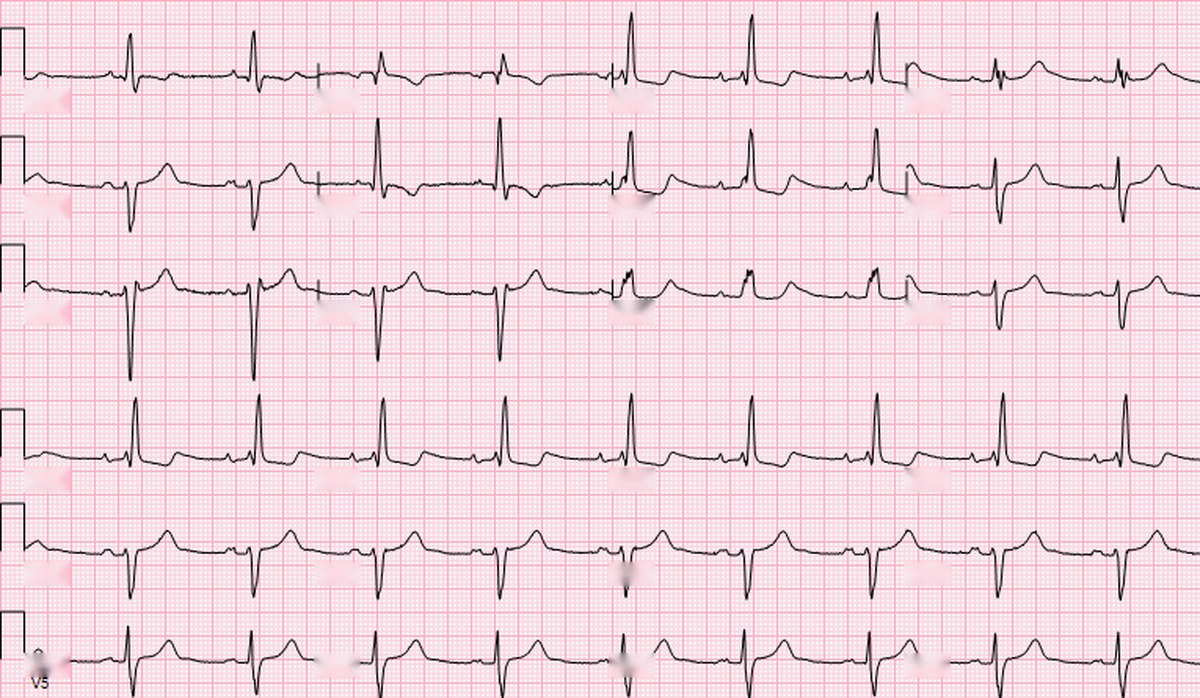

Bifascicular block is a good example of a finding that changes management. The presence of this block suggests that a syncope without another explanation may be caused by complete atrioventricular block, and the European guideline recommends investigating it with an electrophysiology study (Shabbir et al., 2022). In a single-center audit of 580 adults admitted for syncope, 65 had bifascicular block, and 29 had bifascicular block with unexplained syncope (Shabbir et al., 2022). Of these 29, only 3 received the evaluation recommended by the guideline during admission, and cardiology was called in 17 (Shabbir et al., 2022).
Troponin also has a role. Troponin above the 99th percentile of the reference population was one of the predictors in the Canadian Score (Thiruganasambandamoorthy et al., 2016). Ojha et al. describe biomarkers with accuracy of 77 to 78 out of every 100 on their own and 81 out of every 100 when combined (Ojha et al., 2022). Echocardiography is not routine for everyone: in the cited series, it confirmed aortic stenosis in 40 out of every 100 of the cases in which there was clinical suspicion and was normal in unexplained syncopes after the initial assessment (Ojha et al., 2022).
The Canadian Syncope Risk Score
The Canadian Syncope Risk Score (CSRS) was derived in 4030 adult patients seen in Canadian emergency departments (Thiruganasambandamoorthy et al., 2016). Of 43 candidate predictors, 9 entered the final model, with a C statistic of 0.88 (Thiruganasambandamoorthy et al., 2016). The risk of a serious event within 30 days ranged from 0.4 per 100 at the minimum score of −3 to 83.6 per 100 at the maximum score of 11 (Thiruganasambandamoorthy et al., 2016).
The score combines clinical assessment, tests and the diagnosis made in the emergency department (Thiruganasambandamoorthy et al., 2020). The table below reproduces the version published in the validation study (Thiruganasambandamoorthy et al., 2020).
| Item | Points |
|---|---|
| Predisposition to vasovagal symptoms | −1 |
| History of heart disease | +1 |
| Any systolic pressure below 90 or above 180 mmHg | +2 |
| Troponin above the 99th percentile | +2 |
| Abnormal QRS axis (below −30° or above 100°) | +1 |
| QRS longer than 130 ms | +1 |
| QTc above 480 ms | +2 |
| Emergency department diagnosis of vasovagal syncope | −2 |
| Emergency department diagnosis of cardiac syncope | +2 |
The prospective validation included 3819 patients (Thiruganasambandamoorthy et al., 2020). The area under the curve was 0.91, and at the cutoff of −1 the score had a sensitivity of 97.8 per 100 and a specificity of 44.3 per 100 (Thiruganasambandamoorthy et al., 2020). Serious outcomes rose steadily across the categories: 3 of 1631 patients in the very low risk group, 9 of 1254 in the low group, 55 of 687 in the medium group, 32 of 167 in the high group and 40 of 78 in the very high group (Thiruganasambandamoorthy et al., 2020). In the medium risk category, 40 patients had arrhythmic outcomes and 15 had non-arrhythmic outcomes (Thiruganasambandamoorthy et al., 2020).
The authors suggest that very low and low risk patients can be discharged (Thiruganasambandamoorthy et al., 2020). For medium risk, mortality was 0.1 per 100, and a short observation period with shared decision making may be reasonable when the service or the patient prefer more caution (Thiruganasambandamoorthy et al., 2020). For the higher risk groups, a brief hospital stay is a reasonable option (Thiruganasambandamoorthy et al., 2020).
An important detail: the score uses the diagnosis of vasovagal or cardiac syncope made by the emergency department physician (Thiruganasambandamoorthy et al., 2020). It does not replace clinical judgment. It organizes that judgment together with objective data.
Other rules and clinical judgment
The CSRS is not the only tool. A scoping review identified 19 risk stratification tools for syncope, and only about one third had external validation (Uit Het Broek et al., 2023). Many were derived in small populations or in a single service (Uit Het Broek et al., 2023).
The San Francisco rule was one of the first to gain popularity. In a meta-analysis, it had a pooled sensitivity of 0.87 and a specificity of 0.52 (Liang et al., 2022). The Boston rule reached a sensitivity of 97 per 100 and a specificity of 62 per 100 in the studies gathered by the same review (Liang et al., 2022). The authors of the CSRS validation note that the San Francisco rule performed poorly in external validation (Thiruganasambandamoorthy et al., 2020).
A meta-analysis published in 2025 gathered 31 studies and 13 decision rules (Wakai et al., 2025). Only three rules, the San Francisco rule, the CSRS and OESIL, had validation in more than two studies, and the three showed very similar operating characteristics (Wakai et al., 2025). For the CSRS, the negative likelihood ratio ranged from 0.05 to 0.50 across the five validation studies (Wakai et al., 2025). The authors concluded that most rules have low quality evidence for routine use (Wakai et al., 2025).
Older adults are the hardest group. Kiradoh and colleagues evaluated 350 patients aged 65 or older and found that the risk rules performed below the ideal (Kiradoh and colleagues, 2023). The CSRS was the best, with an area under the curve of 0.749 for 30-day outcomes, but its sensitivity for 48-hour outcomes was only 48 out of 100 (Kiradoh and colleagues, 2023). A 2026 American study, with 1263 patients aged 40 or older, compared the CSRS, the FAINT score and the physician's own estimate (Suh and colleagues, 2026). A CSRS below 0 had a sensitivity of 91.9 out of 100, a FAINT equal to 0 had a sensitivity of 96.7 out of 100 for cardiac outcomes, and only the FAINT was more sensitive than the physician's estimate (Suh and colleagues, 2026). In the series described by Ojha and colleagues, the FAINT had an area under the curve of 0.704, against 0.630 for the physician's estimate (Ojha and colleagues, 2022).
This conclusion is not new. A meta-analysis with individual patient data, discussed by Sandhu and colleagues, compared the older tools with clinical judgment and found no better diagnostic or prognostic performance with the scores (Sandhu and colleagues, 2019). The authors note, however, that the study used older scores and that the CSRS had a better area under the curve than cardiac biomarkers, alone or combined with older scores (Sandhu and colleagues, 2019). Among the limitations pointed out for the scores are inconsistent definitions of syncope and of outcome, small samples and little external validation (Sandhu and colleagues, 2019).
The guidelines reflect this uncertainty. Both the American and the European ones give a class IIb recommendation to the use of risk scores, which may be considered but should not replace clinical assessment (Sandhu and colleagues, 2019). Structured judgment also has limits: physicians who used the European guideline got the risk classification right in 80 in every 100, while nursing triage had a sensitivity of 21 out of 100 for identifying severe cases (Ojha and colleagues, 2022). This set shows that clinical decision-making works best when score and judgment are combined.
Patient destination: admit, observe or discharge
Admission rates for syncope vary widely between countries: from 12 to 15 out of 100 in Canada, from 31 to 38 in Italy, 49 in the United Kingdom and from 46 to 86 out of 100 in the United States (Sandhu and colleagues, 2019). In Italy, 30-day mortality was 1.8 out of 100 among those discharged and 14.7 out of 100 among those admitted, which indicates that the physician can separate groups of different risk (Sandhu and colleagues, 2019). In Canada, mortality was 0.4 out of 100 at 30 days and 3.0 out of 100 at 1 year (Sandhu and colleagues, 2019).
Use of the score in practice is still irregular. In an American study with 200 admissions for syncope, 77 patients had a low-risk CSRS (Harris and colleagues, 2025). Of these 77, 11 were admitted to a ward and 66 stayed under observation (Harris and colleagues, 2025). The authors suggest that applying the score could reduce admissions of low-risk patients (Harris and colleagues, 2025). In the same study, the most common score components were abnormal systolic pressure, in 42 of 200 patients, prolonged QTc, in 31 of 200, and a history of structural or ischemic heart disease, in 77 of 200 (Harris and colleagues, 2025). Admitting those who do not need it can lead to overdiagnosis and a cascade of tests.
Monitoring time also has a basis in data. In 5581 patients described by Ojha and colleagues, severe arrhythmias were generally detected within 2 hours in low-risk patients and within 6 hours in medium or high-risk patients (Ojha and colleagues, 2022). Another study cited in the same review found, with monitoring beyond 12 hours, a sensitivity of 0.89 and a specificity of 0.78 for severe events (Ojha and colleagues, 2022). A structured protocol increased admission of high-risk patients from 68.7 to 82.1 out of 100 (Ojha and colleagues, 2022).

Syncope units are another answer. For the intermediate-risk patient, the European guideline recommends class I evaluation in a syncope unit instead of admission, while the American one gives class IIa to structured observation in the emergency department (Sandhu et al., 2019). The two small randomized trials with syncope units in the emergency department showed higher diagnostic yield, fewer admissions, lower cost and no increase in adverse outcomes (Sandhu et al., 2019). In the Dutch SYNERGY study, structured evaluation had diagnostic accuracy of 69 to 86 per 100 and yield of 76 to 89 per 100 (Ghariq et al., 2023).
The European heart rhythm task force proposed quality indicators for these units, including admitting fewer than 20 per 100 of low- or intermediate-risk patients and having fewer than 5 per 100 readmissions for syncope within 1 year (Sandhu et al., 2019). In Canada, these two indicators were met even without syncope units (Sandhu et al., 2019). Integrating a unit depends on the structure and funding of each health system and may not be necessary everywhere (Sandhu et al., 2019).
In practice, the decision combines three pieces. The first is a complete initial evaluation, with ECG and standing blood pressure (Sandhu et al., 2019). The second is a validated score, such as the CSRS, to estimate 30-day risk (Thiruganasambandamoorthy et al., 2020). The third is clinical judgment, remembering that the main role of admission is to speed up treatment or investigation (Sandhu et al., 2019).
How NEXO helps train this reasoning
The limits of use of the game are described on the NEXO Economy page. If you research the teaching of clinical reasoning, the Researcher page explains how to get in touch. Professionals who write or review cases find information on Curator and Creators, and institutions can learn about the proposal on the partnerships page. Training differential diagnosis with clues and seeking the right ICD-10 code complete this practice.
Frequently asked questions
Does every patient with syncope need an ECG?
Yes. The initial evaluation of syncope includes a 12-lead ECG, with a class I recommendation in the American guideline (Sandhu et al., 2019).
Is the Canadian Score suitable for older adults?
It was validated in adults of all ages, but risk rules in general perform below the ideal in older adults (Kiradoh et al., 2023). In this group, clinical judgment weighs even more.
Can a low-risk patient go home?
In the CSRS validation, serious 30-day outcomes occurred in 3 of 1631 very-low-risk patients and in 9 of 1254 low-risk patients, and the authors suggest that these patients can be discharged (Thiruganasambandamoorthy et al., 2020).
How long is enough monitoring?
In the review by Ojha et al., serious arrhythmias generally appeared within 2 hours in low risk and within 6 hours in medium or high risk (Ojha et al., 2022).
What should be done with the intermediate-risk patient?
This is the hardest group. The European guideline prefers evaluation in a syncope unit, and the American one accepts structured observation in the emergency department; both recommendations rely on the same limited studies (Sandhu et al., 2019).
Does bifascicular block change management?
Yes. With syncope without another explanation, it suggests complete atrioventricular block, and the European guideline recommends an electrophysiology study (Shabbir et al., 2022).
Do scores replace medical evaluation?
No. The guidelines give class IIb to scores and keep clinical evaluation as the basis (Sandhu et al., 2019).
Take-home messages
- The initial evaluation with history, examination, standing blood pressure and ECG is mandatory.
- Exertion, absence of prodrome, heart disease and abnormal ECG suggest a cardiac cause.
- The CSRS has good discrimination and helps safely discharge low-risk patients.
- In older adults, scores lose performance and clinical judgment weighs more.
- Medium or high risk calls for monitoring and targeted investigation.
References
- Ghariq M, van den Hout WB, Dekkers OM, et al. Diagnostic and societal impact of implementing the syncope guidelines of the European Society of Cardiology (SYNERGY study). BMC Med. 2023. PMID 37743496.
- Harris AW, LaBonte L, Massaccesi G, et al. Potential Impact of Using Canadian Syncope Risk Score on Emergency Department Hospitalizations for Syncope. West J Emerg Med. 2025. PMID 41193023.
- Kiradoh SA, Craven TE, Rangel MO, et al. Predicting short-term adverse outcomes in the geriatric population presenting with syncope: a comparison of existing syncope rules and beyond. J Geriatr Cardiol. 2023. PMID 36875169.
- Liang Y, Li X, Tse G, et al. Syncope Prediction Scores in the Emergency Department. Curr Cardiol Rev. 2022. PMID 35319380.
- Ojha U, Ayathamattam J, Okonkwo K, et al. Recent Updates and Technological Developments in Evaluating Cardiac Syncope in the Emergency Department. Curr Cardiol Rev. 2022. PMID 35593355.
- Sandhu RK, Sheldon RS. Syncope in the Emergency Department. Front Cardiovasc Med. 2019. PMID 31850375.
- Shabbir MA, Saad Shaukat MH, Ehtesham M, et al. Bifascicular block in unexplained syncope is underrecognized and under-evaluated: A single-center audit of ESC guidelines adherence. PLoS One. 2022. PMID 35226666.
- Suh EH, Winskill C, Sacco DL, et al. Validation of 2 Syncope Risk Scores and Comparison With Physician Risk Estimation. JAMA Netw Open. 2026. PMID 42154462.
- Thiruganasambandamoorthy V, Kwong K, Wells GA, et al. Development of the Canadian Syncope Risk Score to predict serious adverse events after emergency department assessment of syncope. CMAJ. 2016. PMID 27378464.
- Thiruganasambandamoorthy V, Sivilotti MLA, Le Sage N, et al. Multicenter Emergency Department Validation of the Canadian Syncope Risk Score. JAMA Intern Med. 2020. PMID 32202605.
- Uit Het Broek LG, Ort BBA, Vermeulen H, et al. Risk stratification tools for patients with syncope in emergency medical services and emergency departments: a scoping review. Scand J Trauma Resusc Emerg Med. 2023. PMID 37723535.
- Wakai A, Sinert R, Zehtabchi S, et al. Risk-stratification tools for emergency department patients with syncope: A systematic review and meta-analysis of direct evidence for SAEM GRACE. Acad Emerg Med. 2025. PMID 39496561.