Sports MedicinePulmonology
Pulmonary rehab in COPD: what changes and who to refer



Table of contents
- What pulmonary rehabilitation is
- The components of a program
- What the evidence shows in stable COPD
- Rehabilitation after an exacerbation
- At home, at a distance or at the center
- Why so few get there
- How to refer in practice
- How NEXO helps train this reasoning
- Frequently asked questions
- Take-home messages
- References
A retired woman with COPD is discharged after five days in hospital for an exacerbation. The prescription comes out with long-acting bronchodilators, oral corticosteroids for a few more days and guidance to return to the outpatient clinic. She tells her daughter that she now avoids the building's hallway, because shortness of breath comes before she reaches the elevator. No one mentioned pulmonary rehabilitation.
The scene repeats in many countries. In the United States, among nearly 200,000 Medicare patients hospitalized for COPD, only 1.5 in 100 started rehabilitation in the three months after discharge (Lindenauer, 2020). In England and Wales, only 15 in 100 eligible people were referred (Early, 2020).
The contrast with the evidence is large. Pulmonary rehabilitation improves shortness of breath, fatigue and exercise capacity in stable COPD (McCarthy, 2015), and the American guideline strongly recommends it both in stable disease and after hospitalization (Rochester, 2023). This text shows what a program consists of, what has changed in the studies, why so few get there and how to refer.
Key points
- In stable COPD, rehabilitation improved dyspnea, fatigue and mastery over the disease beyond the minimal important difference, in a review of 65 trials (McCarthy, 2015).
- The distance on the six-minute walk test increased by an average of 43.93 meters (McCarthy, 2015).
- After an exacerbation, rehabilitation was associated with fewer readmissions, with an odds ratio of 0.44, but with very heterogeneous studies (Puhan, 2016).
- Starting rehabilitation within 90 days after discharge was associated with lower one-year mortality, with a hazard ratio of 0.63, in an observational study (Lindenauer, 2020).
- Telerehabilitation had results similar to the in-person program, with more people completing the program (Cox, 2021).
- The gains tend to be lost between three and twelve months without continued exercise (Moy, 2024).
Summary
- What pulmonary rehabilitation is
- The components of a program
- What the evidence shows in stable COPD
- Rehabilitation after an exacerbation
- At home, at a distance or at the center
- Why so few get there
- How to refer in practice
- How NEXO helps train this reasoning
- Frequently asked questions
- Take-home messages
What pulmonary rehabilitation is
Pulmonary rehabilitation is a broad intervention, based on individual assessment, that brings together physical training, education and behavior change (Gloeckl, 2018). The target is the physical and psychological condition of the person with chronic respiratory disease and adherence to habits that preserve health in the long term (Gloeckl, 2018).
The central idea is simple. In COPD, shortness of breath leads the person to move less, which weakens the leg muscles, and this weakness makes any effort generate even more dyspnea. Rehabilitation attacks this cycle through the peripheral muscles, which respond to training even when lung function changes little (Gloeckl, 2018).
The 2023 American Thoracic Society guideline recommends rehabilitation for adults with stable COPD and for adults after hospitalization for exacerbation, with a strong recommendation and moderate-quality evidence (Rochester, 2023). The same guideline extends the strong recommendation to interstitial lung disease and makes a conditional recommendation in pulmonary hypertension (Rochester, 2023).
It is worth separating two scenarios from the start. In stable COPD, the question is how much rehabilitation improves symptoms, capacity and quality of life. After an exacerbation, the question includes readmission and survival, and the evidence has another format. The next two sections address each scenario separately.
The components of a program
Physical training is the base. In Gloeckl's review, the program combines aerobic endurance exercise and strength training, and this combination improved quality of life in a meta-analysis with 750 patients (Gloeckl, 2018). Aerobic training is usually done on a stationary bike or by walking, and strength training works mainly the large muscle groups of the legs and arms (Gloeckl, 2018).
For people with severe dyspnea, interval training is an alternative to continuous training. Short periods of effort alternating with rest produced less dynamic hyperinflation and less breathlessness during exercise (Gloeckl, 2018). In practice, this lets more limited patients accumulate training time they could not sustain continuously.
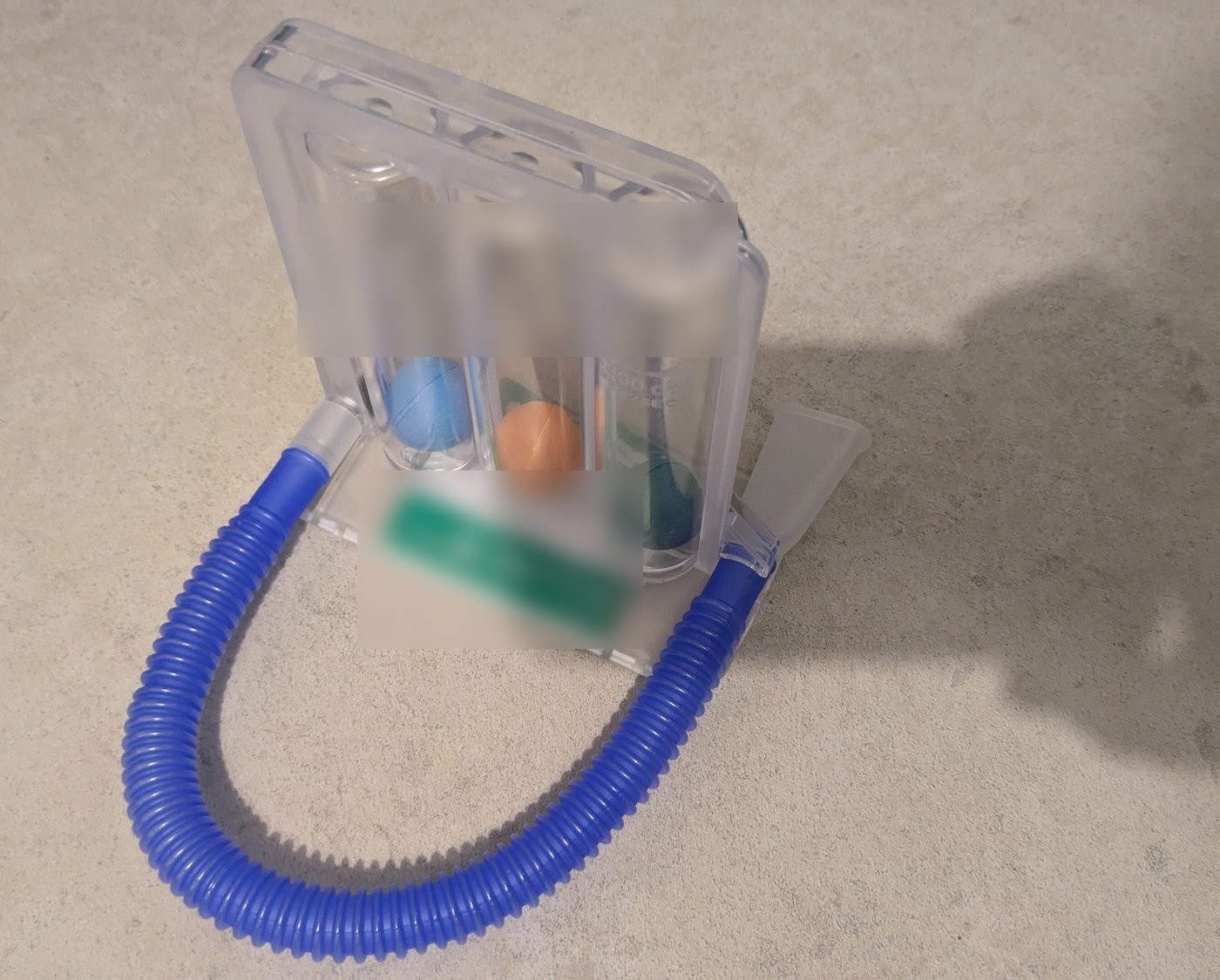
Education goes beyond classes about the disease. It includes knowing the disease and the treatment and learning breathing techniques such as pursed-lip breathing, which prolongs expiration and improves dyspnea on exertion (Gloeckl, 2018). The behavior change aims to turn the gains of the program into physical activity maintained at home (Gloeckl, 2018).
Oxygen comes in when there is an indication. For those who meet the criteria for long-term oxygen therapy, the German review stresses that it must be guaranteed (Gloeckl, 2018). For those who depend on oxygen at home, it is worth recalling the practical difficulties described in the text about the oxygen that depends on the outlet.
Psychosocial support also counts. Anxiety and depressed mood are common in COPD and feed the cycle of avoiding exertion. In the Cochrane review, rehabilitation improved the emotional component of the quality-of-life questionnaire, with a mean difference of 0.56 (McCarthy, 2015).
| Component | What it includes | Evidence cited |
|---|---|---|
| Aerobic training | Cycling or walking, continuous or interval | Less hyperinflation and dyspnea with interval training (Gloeckl, 2018) |
| Strength training | Large muscle groups of the legs and arms | Combined with aerobic training, it improved quality of life in a meta-analysis of 750 patients (Gloeckl, 2018) |
| Education | Disease, treatment and self-care | Part of the core of the program (Gloeckl, 2018) |
| Breathing techniques | Pursed-lip breathing, pace control | They help slow expiration (Gloeckl, 2018) |
| Oxygen during training | For those with an indication for oxygen therapy | Guarantee it when there is an indication (Gloeckl, 2018) |
| Maintenance | Continued supervised exercise after the program | Conditional recommendation, low-quality evidence (Rochester, 2023) |
What the evidence shows in stable COPD
The main synthesis remains the Cochrane review by McCarthy, with 65 randomized trials and 3822 participants (McCarthy, 2015). The central outcome was quality of life measured by the Chronic Respiratory Questionnaire, whose minimal important difference is 0.5 point per domain (McCarthy, 2015).
All four domains improved above that threshold. Dyspnea improved by a mean of 0.79 point, fatigue by 0.68, the emotional domain by 0.56 and the mastery domain by 0.71 (McCarthy, 2015). In other words, the average patient feels a difference they can perceive in daily life.
Functional capacity moved in the same direction. The distance in the six-minute walk test increased by a mean of 43.93 meters compared with usual care (McCarthy, 2015). The authors concluded that rehabilitation relieves dyspnea and fatigue and improves emotional function and mastery, and that further trials comparing rehabilitation with usual care would be of little use (McCarthy, 2015).
That last point deserves attention. The question "does rehabilitation work in stable COPD" has been answered. The open questions became different ones: which components are essential, how to offer the program to more people and how to maintain the gain after it ends.
What happens after the program
The benefits are not permanent. Without continued exercise, the improvement tends to return to baseline within three to six months and almost always by twelve months (Moy, 2024). That is why maintenance rehabilitation, with less frequent supervised exercise after the initial program, has been studied (Moy, 2024).
The definition used in the literature is continued supervised exercise at a lower frequency than the initial program, with or without education and self-care (Moy, 2024). The ideal frequency, content and format of maintenance are still unknown (Moy, 2024).
The American guideline makes a conditional recommendation in favor of maintenance compared with usual care, with low-quality evidence (Rochester, 2023). In clinical practice, the message is to talk from the start about what the person will do when the program ends.
Rehabilitation after an exacerbation
An exacerbation is the moment of greatest risk in COPD and also the moment when the person loses the most conditioning. The Cochrane review by Puhan gathered 20 studies with 1477 participants who started rehabilitation soon after an exacerbation (Puhan, 2016).
The effect on readmissions was favorable, with an odds ratio of 0.44, but heterogeneity between studies was large (Puhan, 2016). The more recent and larger studies showed smaller effects than the older ones, which suggests that the benefit depends on how the program is offered (Puhan, 2016).
Mortality had an odds ratio of 0.68, without statistical significance and with low-quality evidence (Puhan, 2016). Exercise capacity improved with high-quality evidence: the distance in the walk test increased by an average of 62 meters (Puhan, 2016).
The Medicare study
The finding that drew the most attention came from an observational study with 197 376 patients hospitalized for COPD in the United States (Lindenauer, 2020). Starting rehabilitation within 90 days after discharge was associated with a lower risk of death within one year, with a hazard ratio of 0.63 (Lindenauer, 2020).
There was also a relationship with the number of sessions. For every three additional sessions, the hazard ratio for death was 0.91 (Lindenauer, 2020). Even so, because it is an observational study, people who start rehabilitation may differ from those who do not in aspects that statistical adjustments do not capture.
The same study showed the size of the problem. Only 1.5 out of every 100 patients started rehabilitation within 90 days after discharge (Lindenauer, 2020). The ATS guideline, when reviewing the body of evidence, assessed rehabilitation started within three weeks after discharge and recommended offering it after hospitalization (Rochester, 2023).
When to start
Timing matters. The studies included in the Puhan review started rehabilitation soon after the exacerbation, still in the hospital or in the weeks following discharge (Puhan, 2016). In the ATS guideline, the meta-analysis of 12 trials with rehabilitation started within three weeks after discharge showed fewer readmissions, with an odds ratio of 0.48 (Rochester, 2023).
In practice, this means leaving the referral made before discharge, with the date already arranged whenever possible. Each week without a program is a week in which the person loses conditioning and confidence to move.
At home, at a distance or at the center
The lack of openings and the distance to the rehabilitation center are among the most cited reasons for low adherence. That is why alternative models have gained ground in research.
The Cochrane review of telerehabilitation gathered 15 studies with 1904 participants (Cox, 2021). Compared with the in-person program, the results for exercise capacity and quality of life were similar (Cox, 2021). Program completion was higher in telerehabilitation, with 93 out of every 100 participants completing it, versus 70 out of every 100 in the in-person program (Cox, 2021).
Safety also appeared adequate, with no adverse events attributed to telerehabilitation in the studies that reported them (Cox, 2021). The ATS guideline made a strong recommendation to offer the choice between a center-based program and telerehabilitation (Rochester, 2023).
The low-resource home program was also tested. In an equivalence trial with 166 participants, home rehabilitation with simple materials and telephone contact had a result equivalent to the center-based program (Holland, 2017). At the end of the program, the difference in the walk test was 18.6 meters in favor of the home group, and equivalence held at twelve months (Holland, 2017).
What the home program was like
The design of the home program helps explain why it is feasible. Participants did eight weeks of rehabilitation, with one physiotherapist home visit and seven weekly phone calls (Holland, 2017). At the visit, the physiotherapist set exercise goals, checked inhalation technique and supervised the first session (Holland, 2017).
The strength training used what was available at home: standing up and sitting down from a dining chair, stepping up onto a step at home and using water bottles as weights for the arms (Holland, 2017). The center group did eight weeks of supervised group sessions twice a week, with individual training and self-care education (Holland, 2017).
For those who practice in places without a rehabilitation center nearby, this design is a good starting point. It shows that the essential thing is regular, progressive training with follow-up, even with few resources.
These data do not make the in-person program dispensable. People with severe desaturation on exertion, major cardiac comorbidities or insecurity about training alone may benefit more from direct supervision. The gain of alternative models is broadening access for those who would never reach the center.
Why so few get there
The bottleneck starts at referral. In the primary care study in England and Wales, only 15 out of every 100 eligible people were referred, and 31 out of every 100 referred missed the initial assessment (Early, 2020). Nurses felt more prepared to discuss rehabilitation than general practitioners (Early, 2020).
A qualitative study with primary care professionals detailed the barriers on the referring side (Watson, 2020). Limited knowledge about the benefits, little information about available services, lack of time in the consultation and the assumption that the patient would not be motivated came up (Watson, 2020).
On the patient side, fear of breathlessness is a central barrier. Many think exercise will worsen the disease, and some feel guilty about having smoked and think they do not deserve the program (Watson, 2020). Transport, schedule and tiredness itself complete the list.
The assumption of low motivation deserves care. It can become a prophecy: the professional stops offering, and the patient never has the chance to refuse or accept. The conversation about rehabilitation follows the same logic as the brief conversation about quitting smoking: always offer, without judgment, and leave the door open.
How to refer in practice
The first step is to remember to offer. Every person with symptomatic COPD and dyspnea that limits activities is a candidate, as is every person admitted for an exacerbation (Rochester, 2023). A reminder in the discharge summary and at follow-up helps avoid relying on memory.
The second step is the conversation. Listening to what the person fears and what they would like to do again opens the way to the program. The text about the patient's agenda shows why it is worth listening before proposing, and motivational interviewing offers tools for those who are ambivalent.
The third step is explaining what to expect. Breathlessness during training is expected and controlled, and the goal is for the same activity to cause less dyspnea over the weeks (Gloeckl, 2018). Saying this clearly reduces the fear that keeps so many patients away.
The fourth step is choosing the format with the person. A center program, telerehabilitation or a structured home program are options with similar results in studies (Cox, 2021). The choice depends on access, preference, safety and local availability.
The fifth step is reviewing pharmacological treatment. Well-adjusted bronchodilators and correct inhalation technique make training easier. In patients with frequent exacerbations and eosinophilia, the text about type 2 inflammation in COPD shows another layer of treatment, which adds to rehabilitation.
The sixth step is taking care of maintenance. Agreeing on an exercise routine with the person for after the program helps preserve the gain, since it tends to be lost without continued activity (Moy, 2024).
Back to the case
In the opening retired patient, the referral would fit into the discharge itself. The conversation would start with what she misses doing most, such as going to the elevator alone or visiting her daughter. The fear of shortness of breath would be named and explained, and the choice between a center-based program, a distance program or a home program would be made with her, according to transport and family support.
At the outpatient follow-up, the question would change from "are you taking your medications?" to "how is the program going?". If she missed the assessment, it is worth understanding why before concluding that she does not want to take part. Often the barrier is practical, such as schedule, transport or fatigue, and it can be solved.
Excess and shortage
There is also the opposite risk to the lack of referral: piling up tests and appointments before releasing the program. In most cases, the assessment by the rehabilitation service itself is enough to define the initial intensity. The concept of quaternary prevention helps weigh what each additional test adds.
Respiratory comorbidities also come into this account. Someone with associated asthma, for example, needs disease control and attention to environmental triggers, as shown in the text about the asthma that remains after the flare-up.
How NEXO helps train this reasoning
In NEXO, the case of the day is fictional, with a real clinical presentation and up to six progressive clues, and you propose the diagnosis by looking for the code in ICD-10.
The limits on using the game are described on the NEXO economy page. If you research the teaching of clinical reasoning, the page for researchers explains how to get in touch. Professionals who write or review cases find information under curation and under creators, and institutions can learn about the proposal on the partnerships page. For the most frequent reasons for consultation, see the most common codes in primary care.
Frequently asked questions
Who should be referred for pulmonary rehabilitation?
Adults with stable symptomatic COPD and adults who were hospitalized for an exacerbation, both with a strong recommendation from the ATS guideline (Rochester, 2023). The guideline also recommends rehabilitation in interstitial lung disease (Rochester, 2023).
How much does rehabilitation improve shortness of breath?
In stable COPD, the dyspnea domain of the quality-of-life questionnaire improved by an average of 0.79 points, above the minimal important difference of 0.5 (McCarthy, 2015).
Does rehabilitation reduce readmissions?
After an exacerbation, studies showed an odds ratio of 0.44 for readmission, with much heterogeneity and a smaller effect in the most recent studies (Puhan, 2016).
Does rehabilitation reduce mortality?
In trials after an exacerbation, the effect on mortality was uncertain, with an odds ratio of 0.68 without significance (Puhan, 2016). In a large observational study, starting within 90 days after discharge was associated with a hazard ratio of 0.63 for death within one year (Lindenauer, 2020).
When should it start after hospitalization?
The ATS guideline assessed programs started within three weeks after discharge, which reduced readmissions (Rochester, 2023).
Does distance rehabilitation work?
It had results similar to the in-person program, and 93 out of every 100 participants completed the program, against 70 out of every 100 in the in-person program (Cox, 2021).
How long does the benefit last?
Without continued exercise, the improvement tends to return to the initial level in three to six months and almost always by twelve months (Moy, 2024).
Can people who use oxygen do rehabilitation?
They can, and long-term oxygen therapy must be guaranteed when indicated (Gloeckl, 2018).
Why are so few patients referred?
Professionals cite little knowledge about the benefits and the services, lack of time and the assumption of low motivation, and patients cite fear of shortness of breath (Watson, 2020).
Take-home messages
- Pulmonary rehabilitation combines physical training, education and behavior change.
- In stable COPD, it improves dyspnea, fatigue, emotional function and exercise capacity.
- After an exacerbation, there is a sign of fewer readmissions, with heterogeneous evidence.
- The effect on mortality comes mainly from observational data.
- Telerehabilitation and home programs widen access with similar results.
- The gain is lost without continued exercise, so maintenance needs to be arranged.
- The main bottleneck is the referral that does not happen.
- Always offer it, listen to the fear of shortness of breath and agree on a date before discharge.
Play the case of the day on NEXO.
References
- McCarthy B, Casey D, Devane D, et al. Pulmonary rehabilitation for chronic obstructive pulmonary disease. Cochrane Database Syst Rev. 2015. PMID 25705944. DOI 10.1002/14651858.CD003793.pub3.
- Rochester CL, Alison JA, Carlin B, et al. Pulmonary Rehabilitation for Adults with Chronic Respiratory Disease: An Official American Thoracic Society Clinical Practice Guideline. Am J Respir Crit Care Med. 2023. PMID 37581410. DOI 10.1164/rccm.202306-1066ST.
- Puhan MA, Gimeno-Santos E, Cates CJ, et al. Pulmonary rehabilitation following exacerbations of chronic obstructive pulmonary disease. Cochrane Database Syst Rev. 2016. PMID 27930803. DOI 10.1002/14651858.CD005305.pub4.
- Lindenauer PK, Stefan MS, Pekow PS, et al. Association Between Initiation of Pulmonary Rehabilitation After Hospitalization for COPD and 1-Year Survival Among Medicare Beneficiaries. JAMA. 2020. PMID 32396181. DOI 10.1001/jama.2020.4437.
- Cox NS, Dal Corso S, Hansen H, et al. Telerehabilitation for chronic respiratory disease. Cochrane Database Syst Rev. 2021. PMID 33511633. DOI 10.1002/14651858.CD013040.pub2.
- Early F, Wilson PM, Deaton C, et al. Pulmonary rehabilitation referral and uptake from primary care for people living with COPD: a mixed-methods study. ERJ Open Res. 2020. PMID 32083112. DOI 10.1183/23120541.00219-2019.
- Watson JS, Adab P, Jordan RE, et al. Referral of patients with chronic obstructive pulmonary disease to pulmonary rehabilitation: a qualitative study of barriers and enablers for primary healthcare practitioners. Br J Gen Pract. 2020. PMID 31988083. DOI 10.3399/bjgp20X708101.
- Holland AE, Mahal A, Hill CJ, et al. Home-based rehabilitation for COPD using minimal resources: a randomised, controlled equivalence trial. Thorax. 2017. PMID 27672116. DOI 10.1136/thoraxjnl-2016-208514.
- Moy ML. Maintenance Pulmonary Rehabilitation: An Update and Future Directions. Respir Care. 2024. PMID 38744473. DOI 10.4187/respcare.11609.
- Gloeckl R, Schneeberger T, Jarosch I, et al. Pulmonary Rehabilitation and Exercise Training in Chronic Obstructive Pulmonary Disease. Dtsch Arztebl Int. 2018. PMID 29526182. DOI 10.3238/arztebl.2018.0117.