Eosinophilia in travelers and migrants: how to investigate
Table of contents
A 34-year-old man, born in Cameroon and living in Brazil for two years, has routine tests for a new job. He feels well. The blood count shows eosinophils above normal, with no anemia and no other changes. The clinic doctor is left with two questions: does this need to be investigated in someone without symptoms, and where to start?
The scene repeats with the traveler who returned from volunteer work in Africa, with the student who spent a semester in Southeast Asia and with the refugee family arriving for their first appointment. The eosinophilia shows up almost by chance, and the risk is treating it as an unimportant finding or, at the opposite extreme, ordering a battery of tests with no logic.
This text organizes the reasoning: why isolated eosinophilia misleads, how the exposure history changes the list of causes, which tests yield the most, when to think of non-parasitic causes and what to do when nothing shows up.
Key points
- In travelers and migrants, the most frequent cause of eosinophilia is helminthiasis, but eosinophilia alone is a weak marker.
- The absence of symptoms does not rule out infection: most carriers have no complaint.
- The country of origin or the travel destination guides which parasites to look for.
- Stool examination and serologies complement each other, because each one finds a part of the infections.
- Strongyloidiasis should be remembered even without eosinophilia, especially before corticosteroid.
- When the parasitic investigation is negative, non-infectious causes enter the list.
Why isolated eosinophilia misleads
Eosinophilia is the increase of eosinophils in peripheral blood. In people who have lived in or traveled to tropical regions, the first hypothesis is usually a helminth that passes through the tissues, because it is in this phase that the parasite provokes the most intense eosinophilic response. This association is true, but it is incomplete.
The marker fails in both directions
A Dutch study evaluated 1207 travelers who returned from tropical regions and looked for schistosomiasis, strongyloidiasis, filariasis and toxocariasis by serology. The positive predictive value of eosinophilia was 15 out of 100 for previous infection and 0 for recent infection, and no symptom had predictive value (Baaten et al., 2011). In practice, most travelers with eosinophilia did not have these infections, and none of the travelers with eosinophilia had recent infection.
In another setting, with a very common infection, the result was similar. Among 2004 refugees on the Thailand-Myanmar border, about 73 out of 100 had some intestinal parasite infection, and eosinophilia had sensitivity between 51 and 73 out of 100 and specificity between 48 and 65 out of 100, depending on the parasite group, with predictive values ranging from 4 to 98 out of 100 (Webster et al., 2022). The authors conclude that eosinophilia should not be used alone in refugee screening.
The same study showed that the eosinophil count varies with characteristics that have nothing to do with the parasite. The overall median was 483 cells per microliter, the counts were higher in children aged 2 to 4 years than in people aged 65 or older, with a ratio of 4.2, and slightly lower in women (Webster et al., 2022). Among the parasites, Strongyloides and Ancylostoma ceylanicum were the ones that raised the count the most, with a ratio of 1.8 compared with those without infection. Reading the blood count without considering age and sex distorts the interpretation.
What this changes in the reasoning
These numbers help calibrate the pretest probability. Eosinophilia raises suspicion, but confirms nothing. A normal blood count also does not rule out helminthiasis in someone with exposure. The useful question is not only whether there is eosinophilia, but whether the exposure history justifies looking for a specific parasite.
That is why the investigation starts from the person, not from the number. Where they were born, where they traveled, for how long, what kind of contact they had with fresh water, soil or raw food, and whether they will receive any treatment that suppresses immunity.
No symptoms does not mean no disease
In Gran Canaria, a study of 788 immigrants from sub-Saharan Africa found eosinophilia in 213, or 27.0 per 100, and identified helminths in 75 per 100 of those with eosinophilia (Pardo and colleagues, 2006). Only 27.7 per 100 had signs or symptoms (Pardo and colleagues, 2006). Most were asymptomatic and still carried a treatable parasite.
In Spain, among immigrants and travelers with unexplained eosinophilia tested for toxocariasis, 40.9 per 100 of the positive cases had no symptoms (Niño-Puerto and colleagues, 2026). Clinical silence is the rule, and that is precisely why screening makes sense in people with exposure.
Who is in front of you: traveler or migrant
The two situations share the same finding, but not the same probability of infection. Time of exposure is what weighs most.
The short-term traveler
The traveler usually has brief, one-off exposure. This reduces the parasite load and explains why many recent infections do not produce eosinophilia. In the Dutch study of 1207 travelers, eosinophilia had a positive predictive value of 0 for recent infection (Baaten and colleagues, 2011), and recent infections were acquired mainly in Asia.
How often the traveler actually becomes infected
The same Dutch study collected blood before and after the trip, which made it possible to separate old infection from new infection. Previous infection appeared in 112 of the 1207 travelers (Baaten and colleagues, 2011). Recent infection, defined by seroconversion, was rare: schistosomiasis in 0.51 per 100 of those exposed, strongyloidiasis in 0.25, filariasis in 0.09 and toxocariasis in 0.08 per 100.
These numbers give an idea of scale. For the short-term traveler, the probability of new infection by these helminths is low, and eosinophilia does not help find it. For the traveler who has lived abroad or travels often, old infection weighs more, and the blood count alone remains a poor filter.
When exposure is recent and specific, such as bathing in a lake in a schistosomiasis area, the history weighs more than the blood count. In the Dutch study, recent infection was identified by comparing serology from before and after the trip (Baaten and colleagues, 2011), not by the eosinophil count. For anyone with a clear exposure, it is worth recording the date of contact and discussing serology with the patient, without waiting for eosinophilia to appear.
In the interview, it is worth asking about bathing in a river or lake, walking barefoot, eating undercooked meat or fish, contact with dogs and working in a rural area. A swim in an African lake changes the hypothesis to schistosomiasis, even without any symptom.
The migrant with prolonged exposure
The migrant has lived for years in an endemic area and may have chronic infections, sometimes more than one. In Denmark, among 793 newly arrived refugees, 6.8 per 100 had eosinophilia and 32.1 per 100 had raised IgE (Lanng and colleagues, 2025). Raised IgE appeared far more often than eosinophilia, which reinforces that the blood count alone underestimates the problem.
The same Danish study showed differences by origin: refugees from Syria had a lower prevalence of eosinophilia and raised IgE, and those from Eritrea had a higher prevalence (Lanng and colleagues, 2025). Origin changes the probability even before any test.
In the United States, a study of 812 refugees found eosinophilia in 147, or 18.1 per 100, and identified a parasite in 63 of them, or 42.9 per 100 (Ding and colleagues, 2024). More than half had no parasitic diagnosis, which does not mean there was no parasite: it means the available tests did not find it.
The country of origin guides the search
In the Gran Canaria study, the parasite profile changed with the country. Among immigrants from Cameroon with eosinophilia, 77 per 100 had filariasis. Among those from Mali, 63 per 100 had schistosomiasis. Among those from Nigeria, 30.8 per 100 had hookworm disease (Pardo and colleagues, 2006). The same laboratory finding calls for different tests depending on geography.
In South Asia, the parasite that causes most concern is a different one. In the United Kingdom, among 503 migrants from South Asia, Strongyloides serology was positive in 33.6 per 100 of those with eosinophilia and in 12.5 per 100 of those without it, with an adjusted odds ratio of 3.54 (Baker et al., 2020). That is, eosinophilia increased the chance, but an important share of those infected did not have it.

The causes that appear most often
The list of possible helminths is long, but a small group accounts for most diagnoses. Knowing this group avoids both random testing and false reassurance.
Filariasis, schistosomiasis and hookworm disease
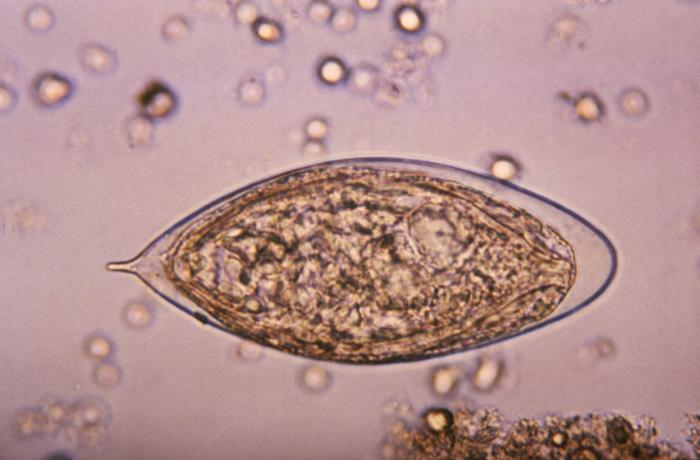
In Gran Canaria, among immigrants with eosinophilia and a defined diagnosis, filariasis accounted for 29.4 per 100, schistosomiasis for 17.2 per 100 and hookworm disease for 16.8 per 100 (Pardo et al., 2006). Those carrying helminths had a mean eosinophil count of 871, versus 643 in those with no parasite identified.
The difference between the means is real, but small for deciding case by case. A slightly raised count can hide filariasis, and a high count may come with no parasite identified. Diagnostic uncertainty is part of the process and must be explained to the patient.
Strongyloidiasis: the parasite that cannot be missed
Strongyloidiasis deserves attention because it is the infection that can become fatal if the patient receives corticosteroids. It persists for decades thanks to autoinfection and can occur without eosinophilia. In the British study with migrants from South Asia, 35 of the 115 seropositive individuals had no eosinophilia (Baker et al., 2020).
A systematic review carried out to guide screening in Europe concluded that serology is the most effective screening test for strongyloidiasis and schistosomiasis in low-endemicity regions, because it is more sensitive than conventional parasitological methods (Agbata et al., 2018). The same review notes that presumptive treatment with ivermectin for all migrants is probably cost-effective, although the certainty of the evidence on screening is low.
Toxocariasis and tropical pulmonary eosinophilia
Toxocariasis is acquired by ingesting eggs of Toxocara canis or Toxocara cati present in contaminated soil (Baaten et al., 2011) and is often forgotten. In Spain, among 192 immigrants and travelers with unexplained eosinophilia who were tested, 44 had a positive ELISA, or 23.0 per 100, and 41 were confirmed by western blot (Niño-Puerto et al., 2026). Eosinophilia below 1000 was associated with toxocariasis, with an odds ratio of 3.2, and the authors suggest including Toxocara serology in the investigation of unexplained eosinophilia, after ruling out common causes.
Tropical pulmonary eosinophilia is an exaggerated reaction to filarial antigens, seen mainly in the Indian subcontinent. It presents with wheezing, cough, fever and eosinophilia, and counts above 3000 per microliter are common (Mullerpattan et al., 2013). Bronchial asthma is among the differential diagnoses cited in the review, and about 20 per 100 patients relapse even after treatment with diethylcarbamazine (Mullerpattan et al., 2013).
In tropical pulmonary eosinophilia, total IgE levels and filaria-specific IgE and IgG levels are usually raised, and pulmonary function tests may show a mixed restrictive and obstructive pattern, with reduced diffusion capacity (Mullerpattan et al., 2013). The review highlights that, without treatment, the disease can leave significant respiratory morbidity, which contradicts the old idea of a benign course.

How to investigate step by step
The investigation starts with a good history and continues with tests chosen by exposure. The goal is to find treatable parasites and not miss strongyloidiasis.
First step: exposure history
Ask about country of birth, countries where the person has lived, time spent in each, recent travel and type of exposure. Also ask about symptoms that often go unnoticed: itching, skin lesions that move, cough with wheezing, intermittent diarrhea, blood in the urine. Ask whether corticosteroid use, chemotherapy, transplant or another immunosuppressive treatment is planned.
Recording these answers in an organized way helps whoever follows the case. A clinical reasoning template in the medical record makes clear what was asked and why each test was ordered.
Second step: stool and serologies together
Stool testing and serologies do not compete, they complement each other. In Gran Canaria, stool testing was positive in 35 out of every 100 immigrants with eosinophilia, filarial serology in 30 out of every 100 and schistosome serology in 28 out of every 100 (Pardo et al., 2006). When direct methods showed only one geohelminth, serology found another infection in 13.2 out of every 100, and the authors conclude that the methods are complementary.
For people from sub-Saharan Africa, the combination includes stool testing, Strongyloides serology, schistosome serology and filarial testing depending on the region. For people from South Asia or Southeast Asia, Strongyloides serology carries more weight. When there is exposure to fresh water in an area of urinary schistosomiasis, urine testing may enter the investigation, at the discretion of the attending physician.
Third step: repeat the blood count and follow up
Eosinophilia does not always persist. In the North American study, 81 refugees repeated the blood count, and 52 of them, or 64.2 out of every 100, had normalization (Ding et al., 2024). On the other hand, 66 refugees, or 44.9 out of every 100, had no new eosinophil count (Ding et al., 2024). Repeating helps decide who needs a broader investigation.
Following up also means making sure the result is seen. In Denmark, in a subgroup of 116 refugees with abnormal results, the family physician addressed the finding in 50.9 out of every 100, and 31.0 out of every 100 of those addressed received a diagnosis (Lanng et al., 2025). A test ordered and not read is a missed opportunity.
| Main exposure | Parasites to prioritize | Tests that help most |
|---|---|---|
| West and central Africa | Filariasis, schistosomiasis, hookworm disease, strongyloidiasis | Stool testing, serology for filaria, schistosome and Strongyloides |
| Fresh water in an area of schistosomiasis | Schistosomiasis | Schistosome serology and urine and stool testing |
| South and Southeast Asia | Strongyloidiasis, hookworm disease, filariasis | Strongyloides serology and stool testing |
| Contact with dogs, cats or contaminated soil | Toxocariasis | Toxocara serology with confirmation |
| Short, recent trip | Acute infection, often without eosinophilia | Serology at the appropriate time after exposure |
Fourth step: deciding on treatment
When a parasite is identified, treatment is targeted. When nothing appears and exposure is strong, the discussion turns to presumptive treatment. The European review considers presumptive treatment of strongyloidiasis with ivermectin probably cost-effective for migrants, but notes that the feasibility of this strategy still needs to be shown in clinical studies (Agbata et al., 2018).
The same review found that short courses of praziquantel and ivermectin were safe, highly effective and cost-effective for treating schistosomiasis and strongyloidiasis, respectively, with moderate to high certainty of evidence for treatment efficacy (Agbata et al., 2018). The greater uncertainty lies in screening, not in treatment.
This decision involves the patient, the availability of tests and the risk of future immunosuppression. In those about to start corticosteroids, the decision becomes urgent. A systematic review concluded that presumptive treatment with ivermectin is probably cost-effective (Agbata et al., 2018), which supports investigating and treating before immunosuppression, with the infectious disease specialist when possible.
When it is not a parasite and what to look at beyond the blood
Not every eosinophilia in a traveler or migrant is parasitic. Tropical exposure does not protect against the common causes of eosinophilia seen in anyone.
Non-infectious causes
In the North American study with refugees, 5 of the 147 with eosinophilia, or 3.4 in 100, had other diagnoses, such as eczema, myelofibrosis and drug allergy (Ding et al., 2024). The proportion is small, but it includes serious diseases that require another line of investigation.
The broad list includes allergies, asthma, dermatitis, drug reactions, autoimmune diseases and hematologic neoplasms. If the parasitic investigation is negative and the eosinophilia persists or increases, the reasoning needs to change direction. Training this differential diagnosis helps you avoid getting stuck on the first hypothesis.
The heart and the target organs
Eosinophils release mediators that can damage organs, and the heart is one of the targets. A Spanish study evaluated with echocardiography 37 sub-Saharan immigrants with eosinophilia and no symptoms, compared with 13 controls, and found an association between eosinophilia and mitral valve thickening (Carranza-Rodríguez et al., 2017). There was no relationship between the degree of eosinophilia and the valve lesion, nor between the type of helminth and the lesion.
The authors suggest echocardiography in every person from sub-Saharan Africa with eosinophilia, to detect early valve lesion (Carranza-Rodríguez et al., 2017). It is a recommendation from a small study, but it reminds us that chronic eosinophilia is not harmless.

Mistakes that repeat
The first mistake is ignoring the eosinophilia because the patient is well. The data show that most carriers of helminths have no symptoms (Pardo et al., 2006).
The second mistake is ending the investigation with a negative stool test. Serologies find an important part of the infections that stool does not show.
The third mistake is using the absence of eosinophilia to rule out strongyloidiasis. Some of the seropositive people have no eosinophilia (Baker et al., 2020), and it is precisely this infection that can kill after corticosteroids.
The fourth mistake is ordering tests without ensuring the follow-up. Clinical decision-making includes defining who will see the result and what will be done with it.
How NEXO helps train this reasoning
In NEXO, the case of the day is fictional, with a real clinical presentation and up to six progressive clues, and you propose the diagnosis by searching for the ICD-10 code.
The limits of use of the game are described on the NEXO economy page. If you research teaching of clinical reasoning, the page for researchers explains how to get in touch. Professionals who write or review cases find information in curation and in creators, and institutions can learn about the proposal on the partnerships page. Training the differential diagnosis with clues and searching for the right ICD-10 code complete this training.
Frequently asked questions
Does eosinophilia in a migrant without symptoms need to be investigated?
Yes. Most carriers of helminths have no symptoms, and in Gran Canaria only 27.7 in 100 of the immigrants with eosinophilia had signs or symptoms (Pardo et al., 2006).
Does a normal blood count rule out a parasite?
No. In travelers, eosinophilia had a predictive value of 0 for recent infection (Baaten et al., 2011), and among migrants from South Asia, 35 of 115 seropositive for Strongyloides had no eosinophilia (Baker et al., 2020).
Is one stool test enough?
No. Stool and serologies find different parts of the infections. In Gran Canaria, serology found another infection in 13.2 in 100 of the immigrants whose direct examination showed only one geohelminth (Pardo et al., 2006).
When should toxocariasis be considered?
When the initial investigation is negative and there is contact with animals or soil. In Spain, 23.0 in 100 of the immigrants and travelers with unexplained eosinophilia had a positive ELISA (Niño-Puerto et al., 2026).
And if no parasite is found?
Repeat the blood count, review the exposure and consider non-parasitic causes. Some eosinophilias normalize, and a small share has causes such as eczema, drug allergy or hematologic disease (Ding et al., 2024).
Take-home messages
- Eosinophilia in someone with tropical exposure suggests helminthiasis, but it is a weak marker.
- Most people carrying parasites have no symptoms.
- The country of origin or the travel destination decides which parasites to look for.
- Stool tests and serologies complement each other; a negative test does not end the investigation.
- Strongyloidiasis can exist without eosinophilia and must be ruled out before corticosteroids.
- If the parasite investigation is negative, think of non-infectious causes.
References
- Agbata EN, Morton RL, Bisoffi Z, et al. Effectiveness of Screening and Treatment Approaches for Schistosomiasis and Strongyloidiasis in Newly-Arrived Migrants from Endemic Countries in the EU/EEA: A Systematic Review. Int J Environ Res Public Health. 2018. PMID 30577567.
- Baaten GG, Sonder GJ, van Gool T, et al. Travel-related schistosomiasis, strongyloidiasis, filariasis, and toxocariasis: the risk of infection and the diagnostic relevance of blood eosinophilia. BMC Infect Dis. 2011. PMID 21466667.
- Baker EC, Ming DK, Choudhury Y, et al. High Prevalence of <i>Strongyloides</i> among South Asian Migrants in Primary Care-Associations with Eosinophilia and Gastrointestinal Symptoms. Pathogens. 2020. PMID 32041352.
- Carranza-Rodríguez C, San-Román-Sánchez D, Marrero-Santiago H, et al. Endomyocardial involvement in asymptomatic sub-Saharan immigrants with helminth-related eosinophilia. PLoS Negl Trop Dis. 2017. PMID 28234952.
- Ding A, Osorio M, Teferi M, et al. A Retrospective Longitudinal Study of Refugees With Eosinophilia at an Academic Center in the United States From 2015 to 2020. Open Forum Infect Dis. 2024. PMID 39155943.
- Lanng K, Margolinsky RV, Wejse C, et al. IgE and Eosinophilia in Newly Arrived Refugees in Denmark: A Cross-Sectional Study of Prevalence and Clinical Management in Primary Care. Int J Environ Res Public Health. 2025. PMID 40003407.
- Mullerpattan JB, Udwadia ZF, Udwadia FE. Tropical pulmonary eosinophilia--a review. Indian J Med Res. 2013. PMID 24135173.
- Niño-Puerto L, Vicente B, Pendones Ulerio J, et al. Toxocariasis in immigrants and travelers with unexplained eosinophilia. Parasit Vectors. 2026. PMID 41721365.
- Pardo J, Carranza C, Muro A, et al. Helminth-related Eosinophilia in African immigrants, Gran Canaria. Emerg Infect Dis. 2006. PMID 17176579.
- Webster JL, Stauffer WM, Mitchell T, et al. Cross-Sectional Assessment of the Association of Eosinophilia with Intestinal Parasitic Infection in U.S.-Bound Refugees in Thailand: Prevalent, Age Dependent, but of Limited Clinical Utility. Am J Trop Med Hyg. 2022. PMID 35483390.