Medical Term Game: Guide to Clinical Reasoning
The purely theoretical study of medical manuals is the least effective method for consolidating the diagnostic intuition needed in clinical practice in 2026. While a medical student seeks to validate isolated hypotheses for residency exams, the manager of a teaching institution needs tools that measure the analytical progress of groups of students in a standardized way. This distinction separates those who merely memorize disease names from those who master the logical structure needed to solve a real clinical presentation. This article establishes whether the integration of daily simulators is a technological distraction or the foundation for reducing diagnostic errors on a large scale.
NEXO is a daily medical diagnosis game: one clinical case a day, six progressive clues, and ICD-10 proximity feedback across five levels.
The medical word game, specifically within the NEXO platform, works as a navigation challenge based on the International Classification of Diseases (ICD-10). Instead of a simple word guess, the user faces hundreds of fictional clinical cases from various specialties where each attempt provides feedback by hierarchical proximity. The system indicates how close the player is to the correct code in the medical graph, turning the search for the pathology into a structured microlearning exercise. Although the tool refines reasoning, it is designed to train categorization logic and not to replace human judgment in front of patients.
Key takeaways
- The medical word game is a microlearning tool that replaces passive memorization with active navigation in ICD-10.
- Unlike common word games, diagnostic simulators such as NEXO focus on reducing clinical uncertainty.
- Daily practice through gamification improves diagnostic accuracy and the speed of ICD-10 classification.
- Accessibility and compliance with LGPD are essential requirements for modern medical education platforms.
- Proximity feedback is the mechanism that allows the student to learn from mistakes in real time.
Table of contents
- The medical word game is a diagnostic simulator based on navigation
- The evolution of word games into the health context
- Diagnosis is navigation and not just memory
- The science behind proximity feedback
- Comparison between medical diagnosis platforms
- Accessibility and privacy in digital medical training
- Frequently asked questions
- The Choice Between Rote Memorization and Clinical Navigation
The medical word game is a diagnostic simulator based on navigation
Imagine a health professional facing a detailed description of symptoms, physical signs and laboratory test results that point to a specific pathology, but whose exact name requires rigorous technical precision. The medical word game, inserted in the NEXO platform, turns this search into a tool for active and constant learning. Instead of just passively reading about a condition, the user is challenged to decipher a real clinical presentation based on fictional cases, structuring logical thinking to convert diagnostic clues into a precise code within the official medical classification system.
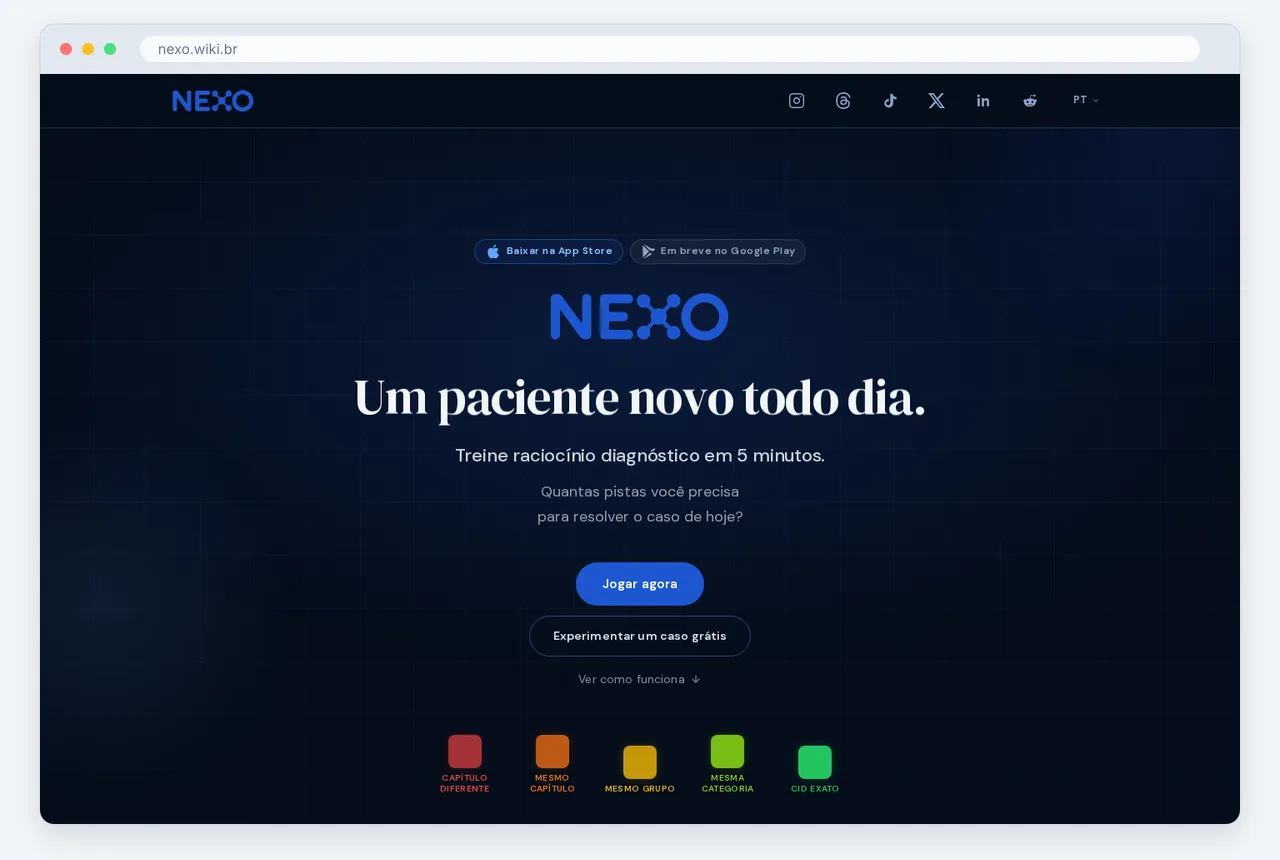
The central mechanic of the daily challenge requires the player to identify the correct pathology by navigating the structure of ICD-10, the International Classification of Diseases. The game presents hundreds of fictional clinical cases covering various specialties, forcing reasoning to go beyond the superficial guess or unregulated intuition. The user must traverse the hierarchical tree of medicine, selecting chapters, groups and subcategories until reaching the final code that defines the condition described in the case of the day, which reinforces the mental organization needed for professional practice.
The system works through a constant feedback mechanism based on taxonomic proximity. With each answer attempt, the interface reveals how close the player is to the correct code in the medical hierarchy, indicating whether the choice belongs to the same disease group or whether the path taken in the ICD-10 tree is far from the target. This teaching method allows you to visualize the relationships between different conditions and understand the logic that organizes health knowledge. For those who want to deepen their understanding of the logical paths of diagnosis and the structure of the system, exploring our story of NEXO offers a detailed view of this navigation journey.
Although the medical game term is a sophisticated tool for training clinical reasoning and for becoming familiar with technical terminology, it is essential to emphasize its nature as an educational simulator. The game dynamics serve exclusively for technical, academic and intellectual improvement, but do not replace in-person clinical judgment and the individualized assessment required in patient care. The practical application of the concepts reviewed in the virtual environment must always be mediated by professional ethics and by the sovereign analysis of each clinical situation encountered in daily medical practice.
The evolution of word games into the health context
In 2021, social isolation turned a household pastime into a global mass phenomenon. Wordle was created in 2021 during its developer's lockdown, presenting a minimalist proposal: guess a five-letter word in six attempts. The growth trajectory was exponential, jumping from just 90 players in November 2021 to 300 thousand users in early January 2022. By the end of that same month, the game had already reached 2 million daily players, consolidating the format of a single challenge every 24 hours as a new digital routine.
The success of the model lies in containing decision fatigue, a state of mental exhaustion caused by too many choices throughout the day. By limiting interaction to a single daily problem, the format protects the user from stimulus overload. For health professionals and students, who face exhausting shifts and the constant need to process critical information, the transition from pure entertainment to structured educational utility represented a strategic advance. What began as a letter game evolved into a tool for cognitive refinement, where the guessing mechanic serves as support for diagnosis.
This adaptation for the medical sector ignores the superficiality of ordinary games to focus on long-term knowledge retention. While traditional games seek only engagement, the application of this logic in medicine aims to organize thinking under pressure. The "once a day" structure forces the brain to prioritize the quality of analysis over exhaustive repetition, turning the act of playing into a deliberate exercise in reasoning. The application of this concept follows a NEXO Educational Methodology that values consistency and technical precision.
Currently, in 2026, the medical game term is already consolidated as a bridge between leisure and clinical practice. The tool uses hundreds of fictional clinical cases, covering various specialties, to simulate a real clinical presentation without the risks of the hospital environment. The goal is no longer just to find the correct word, but to logically reconstruct a clinical picture. This transition allows the user to test hypotheses and validate signs and symptoms in a controlled environment, using the immediate feedback mechanic to correct knowledge gaps quickly and efficiently.
Diagnosis is navigation and not just memory
A doctor is faced with a clinical presentation of syncope in a high-pressure environment. The immediate challenge is not to recite the complete pathophysiology of a rare syndrome, but rather to filter the information and decide which diagnostic path to follow in the face of uncertainty. The common mistake is to believe that medicine is a test of static memory, when practice requires the ability to navigate unstructured data. The medical game term in the context of NEXO turns this pressure into an exercise in mental mapping, where the priority is the organization of logical thinking and not just the storage of isolated names.
The central philosophy behind modern clinical reasoning lies in the ability to locate the correct information at the right moment. The competent professional understands that uncertainty is a constant and that the final diagnosis is the result of a rigorous process of elimination and refinement. By interacting with hundreds of fictional clinical cases based on real clinical presentations, the user learns not to despair in the face of vague or atypical symptoms. The game teaches that efficient navigation depends on a solid base of categories, allowing the brain to process several specialties without getting lost in irrelevant details that do not change the immediate course of action.
The use of ICD-10, the International Classification of Diseases, within the game mechanics serves as the essential compass of this navigation process. Instead of simply trying to guess random words, the player is trained to categorize signs and symptoms logically, using the hierarchical structure of the official classification. This method trains the brain to recognize fundamental patterns: if a symptom clearly belongs to a specific group of diseases of the circulatory system, the mental search automatically narrows to the relevant subcategories. This structured approach turns passive learning into an active diagnostic tool, reinforcing taxonomy as a language of organization.
This focus on hierarchical structure fundamentally sets NEXO apart from other competitors that limit themselves to presenting lists of diseases without an internal logical connection. While other platforms focus on isolated memorization of technical terms, this methodology prioritizes a deep understanding of how pathologies group together and relate within the global health system. For those seeking a more technical understanding of who develops these tools and the pedagogical vision behind the platform, the NEXO team offers a detailed perspective on the construction of these learning systems. Mastering clinical reasoning in 2026 requires this definitive transition from knowing the name to knowing where the pathology fits in the tree of medical knowledge.
The science behind proximity feedback
Imagine a student who, faced with a complaint of sudden flank pain, enters the diagnosis of appendicitis in a medical term game. Instead of a simple negative signal, the system processes the answer and indicates that the guess is anatomically close, but belongs to a distinct organ system. This mechanism prevents the error from becoming a cognitive dead end, turning each attempt into a compass that points to the correct topography of the pathology.
The technical engine of this feature is a complex medical graph that audits interactions in real time. A graph is a data structure made up of nodes and connections that maps the relationship between signs, symptoms and diseases. When the user submits a term, the algorithm calculates the semantic and clinical distance between the input and the correct answer within this network. This processing allows the tool to identify whether the error was a confusion between related pathologies or a total deviation in reasoning.
The precision of the feedback is based on the hierarchy of the International Classification of Diseases, ICD-10. The system guides the player by informing whether they got the chapter of the classification right, such as diseases of the circulatory system or of the digestive system, even if they got the specific etiology wrong. This structuring is essential for those seeking to understand the documentary organization of the Brazilian Unified Health System, because it teaches the professional to think in terms of diagnostic categories before reaching a verdict.
By applying microlearning, the platform breaks knowledge into manageable doses through hundreds of fictional clinical cases. The focus is not memorizing isolated names, but understanding the real clinical presentation of each illness across several specialties. This proximity learning method reinforces the connections needed so that, in professional practice in 2026, the doctor can navigate the tree of diagnostic decisions with agility without relying exclusively on intuition.
Comparison between medical diagnosis platforms
A medical student opens a crossword app to review terminology during the break between classes. Although they can identify names of conditions in games like Medtermo or Doctordle, they notice that the letter-guessing mechanic does not simulate the pressure of an anamnesis, which is the initial interview conducted by the health professional to collect the patient's history. This gap between casual entertainment and professional practice defines the boundary between simple pastimes and structured medical education tools.

Platforms like Doctordle and Medtermo work as variations of the popular Wordle, focused on memorizing isolated terms. In contrast, the medical term game NEXO proposes a simulation environment. While the former test vocabulary, NEXO requires the application of clinical reasoning, the mental process by which doctors integrate information to reach a diagnosis. The tool uses hundreds of fictional clinical cases across various specialties, allowing the user to interpret signs and symptoms instead of just counting characters.
Scientific integrity is the differentiator that separates entertainment from technical training. NEXO is built to reflect a real clinical presentation through fictional cases, ensuring that the user faces diagnostic dilemmas grounded in medical guidelines updated in 2026. Conventional word games often lack clinical context, treating complex terms as mere arrangements of letters. In NEXO, progression depends on the ability to filter out irrelevant information and prioritize critical data, an essential skill for patient safety.
Beyond the depth of content, compliance with digital accessibility standards sets high-level platforms apart. NEXO is developed to be inclusive, allowing professionals with different navigation needs to access the training equitably. Casual games often prioritize simple visual aesthetics, neglecting screen reader or keyboard navigation features. When choosing a tool, the student or professional should check the plans and features on the developers' official websites, since functionalities and terms of use may be updated frequently.
| Feature | NEXO | Others (Doctordle/Medtermo) |
|---|---|---|
| Main Mechanic | Clinical reasoning and differential diagnosis | Word and letter guessing |
| Database | Hundreds of fictional clinical cases | Dictionary of isolated medical terms |
| Educational Focus | Practical application across various specialties | Vocabulary and spelling memorization |
| Accessibility | Follows technical standards for digital inclusion | Focus on simplified visual interfaces |
Accessibility and privacy in digital medical training
Imagine a medical resident with low vision trying to review diagnostic approaches in a dynamic hospital environment. Without adapted tools, access to practical knowledge becomes an insurmountable physical barrier. The use of a medical term game should not be just a form of entertainment, but an inclusive platform that respects the functional diversity of the clinical staff. Digital accessibility allows professionals with different sensory abilities to take part in training equitably, ensuring that learning based on hundreds of fictional clinical cases reaches all users without distinction.
To achieve this goal, NEXO adopts the WCAG (Web Content Accessibility Guidelines) standards, which are the international guidelines for making digital content more accessible to people with disabilities. Integration with assistive technologies, such as VoiceOver, turns visual elements and interface buttons into accurate auditory descriptions. This is essential so that doctors with visual impairments can navigate through various specialties and interpret each real clinical presentation with full autonomy. By following these standards, educational institutions ensure that digital training does not exclude talent due to technical interface limitations.
Information security is another fundamental pillar for the sector in 2026, where digital integrity is a top priority for hospital management. Compliance with the LGPD (Lei Geral de Proteção de Dados) in Brazil and the GDPR (General Data Protection Regulation) in Europe is not just a legal obligation, but an ethical commitment to the professional. Healthcare institutions deal with constant flows of sensitive information and technical training must take place in an environment that shields users' identities and activities from unauthorized access or leaks.
NEXO ensures that individual progress and clinical reasoning patterns are protected by encryption protocols and strict access management. The system was designed to be safe for all users, from undergraduate students to experienced preceptors in large medical centers. Those who want to understand in detail how information is processed and what privacy guarantees the platform offers can consult the Data Rights section. This transparency consolidates the trust needed for the physician's focus to remain on diagnostic excellence and patient safety.
Frequently asked questions
What are some medical games I can play?
The medical term game and simulators like Prognosis or Clinical Sense are accessible options for training. A student who uses these tools can explore hundreds of fictional clinical cases across various specialties outside the hospital environment. This practice turns theoretical study into an interactive decision-making experience.
What game is similar to Termo?
The NEXO simulator is the closest alternative for those seeking the daily challenge format applied to health. A professional used to word games will find a similar structure, but focused on deciphering a real clinical presentation through diagnostic clues. The platform organizes hundreds of fictional clinical cases to test the precision of reasoning.
What are the 10 best games?
The list of top titles includes the medical term game, BioDigital Human and various surgery or triage simulators. A beginner physician can use these apps to visualize a real clinical presentation in a safe and controlled environment. These tools cover various specialties and offer hundreds of fictional clinical cases for professional improvement in 2026.
What is the Termo of the day?
The daily challenge consists of a new diagnostic puzzle that is renewed every twenty-four hours in the system. When accessing the platform, the user finds a specific real clinical presentation that must be solved with the fewest number of attempts. This recurring exercise allows consolidating knowledge across various specialties through hundreds of fictional clinical cases.
Medical Term Game: The Guide to Mastering Clinical Reasoning
Imagine a resident physician in 2026 facing a real clinical presentation where the symptoms of fatigue and dyspnea are confused among various differential diagnoses. The success of this professional does not depend on the ability to memorize a static encyclopedia, but on their skill in navigating the available clues with precision. This scenario demonstrates that modern clinical reasoning requires tools that simulate the uncertainty and complexity of daily practice, turning learning into a dynamic process of discovery.
The Choice Between Rote Memorization and Clinical Navigation
- Evaluate the mechanics, check whether the simulator prioritizes the logic of exclusion and diagnostic hierarchy over the pure memorization of names.
- Analyze the feedback, confirm whether the platform offers explanations about the semantic proximity and the relationship between the terms chosen in the game.
- Consider diversity, make sure the tool offers hundreds of fictional clinical cases that cover various essential medical specialties.
- Check privacy, ensure that your performance data and search patterns are handled with total anonymity and digital security.
- Test accessibility, validate whether the navigation interface allows agile and intuitive training on any type of mobile device or desktop.
Deliberate practice through digital simulators is the most effective method to refine the diagnostic intuition needed in a real clinical presentation. Access NEXO at https://nexo.wiki.br/ to start training your clinical reasoning today.