What is a good Wordle-like game for doctors? Meet NEXO
Most word games fail to develop real clinical skills because they replace diagnostic reasoning with simple character guessing. A medical student who uses generic puzzles to memorize technical terminology is wasting the cognitive potential that a logic simulator offers. While traditional Wordle only requires identifying linguistic patterns, medical practice in 2026 demands navigating uncertainty and the precise correlation between symptoms and the International Classification of Diseases, ICD-10.
NEXO is a daily medical diagnosis game: one clinical case a day, six progressive clues, and ICD-10 proximity feedback across five levels.
The choice of a microlearning tool depends fundamentally on your career stage. For the student who needs to consolidate basic semiology, the trial-and-error mechanics of a common game may seem sufficient, but for the physician seeking to maintain mental agility across several specialties, the scientific structure of a medical graph is indispensable. This text defines the criteria for identifying what makes a good Wordle-like game for doctors and demonstrates how NEXO fills the gap between entertainment and continuing education through hundreds of fictional clinical cases and real clinical presentations.
Key takeaways
- NEXO is the best alternative to Wordle for doctors because it focuses on clinical reasoning and navigation through ICD-10 instead of just memory.
- Unlike vocabulary games, NEXO uses a proximity feedback system to guide diagnosis under uncertainty.
- Daily practice with gamified clinical cases improves diagnostic accuracy and agility with ICD-10 classification.
- Accessibility and compliance with the LGPD make the platform safe and inclusive for all health professionals.
Table of contents
- NEXO is the ideal game for training daily clinical reasoning
- Medical diagnosis is navigation, not just memorization
- The proximity feedback system guides learning
- NEXO's mechanics surpass generic Wordle clones
- Accessibility and privacy are pillars of the platform
- Daily microlearning accelerates diagnostic accuracy
- Identify when NEXO is the right tool for you
- Frequently asked questions
- Choosing between generic entertainment or deliberate clinical practice
NEXO is the ideal game for training daily clinical reasoning
A doctor starts a shift and is faced with a complaint of diffuse abdominal pain associated with intermittent fever. Instead of just listing random diseases, the professional must filter hypotheses based on specific signs and symptoms to reach the correct conclusion. This investigative dynamic is the foundation of NEXO, which establishes itself as the best option for doctors seeking a daily challenge similar to Wordle, but focused exclusively on professional practice. The game turns diagnosis into a structured intellectual exercise, requiring the user to apply their technical knowledge in controlled scenarios.
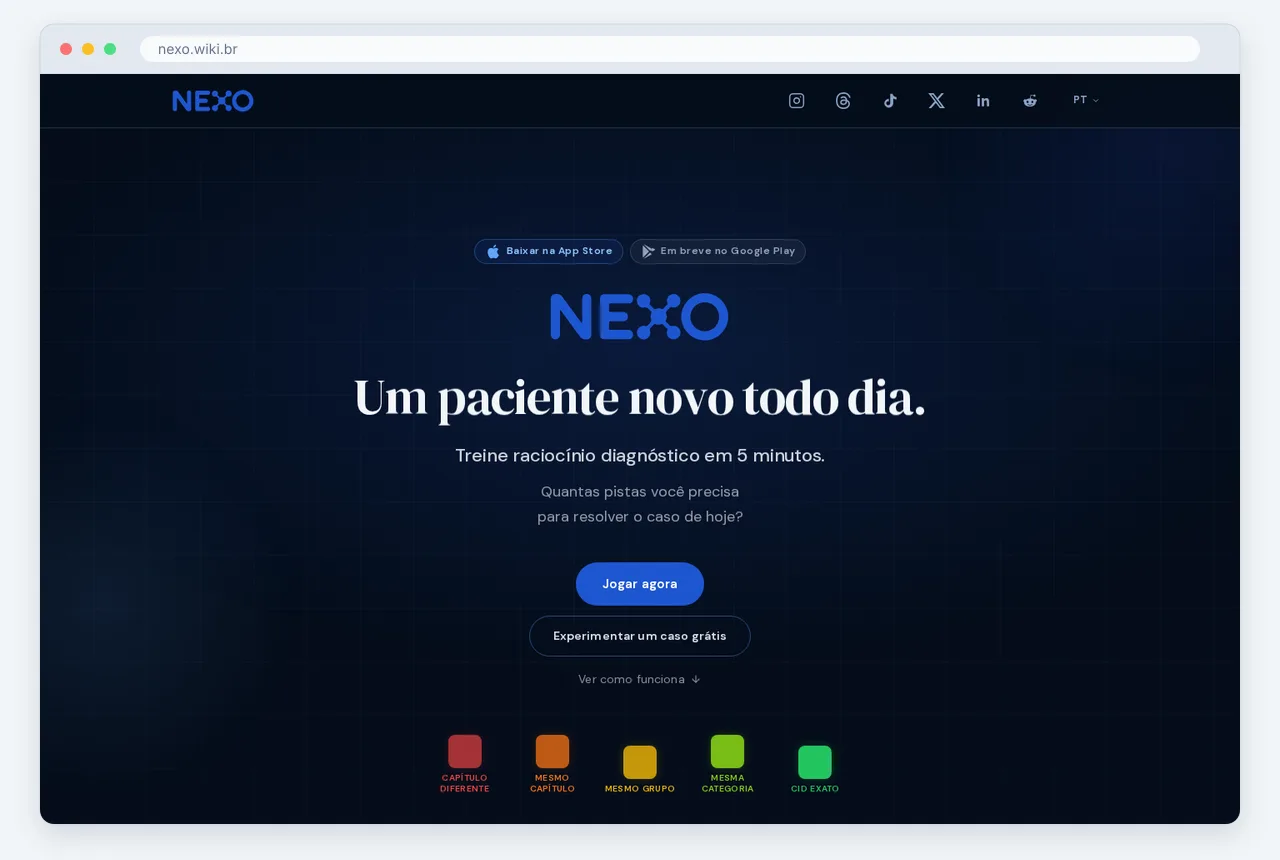
Unlike traditional word games that use letters as clues, NEXO works through proximity navigation within the International Classification of Diseases, ICD-10. The system presents a real clinical presentation composed of hundreds of fictional clinical cases covering several specialties. With each guess, the player receives information about how close they are to the correct diagnosis in terms of nosological hierarchy. This mechanic forces reasoning to move between large groups of pathologies until reaching the necessary specificity, simulating the precision required in a hospital or outpatient setting.
Medical logic replaces luck or the generic vocabulary found in other digital pastimes. While Wordle focuses on language structure, this simulator requires understanding the relationships between symptoms and etiologies. For those who want to deeply understand the methodology behind this learning structure, the article Our story details how diagnostic navigation was conceived. By treating diagnosis as an interactive map rather than simple guessing, the platform helps keep the brain trained to identify complex patterns quickly and with solid reasoning.
Medical diagnosis is navigation, not just memorization
A doctor facing a patient with persistent fatigue and mild anemia faces a labyrinth of possibilities. The textbook offers exhaustive lists of causes, but clinical practice requires deciding which path to follow when the signs are ambiguous and the data is incomplete. The challenge lies not in the lack of information, but in the ability to filter out the noise and identify the underlying pattern in a scenario of uncertainty.
NEXO bases its philosophy on the premise that diagnosis is an exercise in navigation, not just recall. While traditional teaching focuses excessively on memorizing isolated symptoms, practice requires clinical reasoning, which is the cognitive process of organizing information to solve health problems. The game fills a pedagogical gap by turning passive learning into an active exploration of diagnostic hypotheses.
To simulate this complexity, the platform uses hundreds of fictional clinical cases spanning various specialties. Each challenge is structured as a real clinical presentation, in which the user must interpret successive clues to reach the correct conclusion. This approach teaches the professional to deal with uncertainty, prioritizing the most likely diagnoses and ruling out distractions that often arise during a consultation.
By treating diagnosis as a journey, the game prepares doctors for the unpredictable nature of hospital and outpatient routines in 2026. The methodology encourages building a dynamic mental map instead of a static list of diseases. Those who want to understand the theoretical foundations and the technical structure behind this tool can consult the NEXO Team to gain more depth on the development of the project.
The proximity feedback system guides learning
When faced with persistent cough and weight loss, a doctor must filter dozens of diagnostic possibilities before concluding the approach. In NEXO, this situation is transposed into a logic challenge where the goal is to identify the diagnosis of the day from a real clinical presentation. Instead of letters, the player uses ICD-10 codes (International Classification of Diseases, 10th Revision), which serves as the fundamental language for progression in the game. Each attempt is not an isolated mistake, but a clue that reveals the distance between the hypothesis raised and the correct answer.
The technical operation is based on a proximity feedback system that evaluates the category and group of the pathology entered. When the professional enters a code, the interface signals whether it belongs to the same chapter or anatomical group as the final answer. This mechanism is supported by a structured medical graph, a data network that organizes medical knowledge into logical hierarchies. If the player suggests a respiratory infection when the case is a lung neoplasm, the system indicates that the location is correct, but the nature of the disease differs, forcing refinement of clinical reasoning.
This dynamic turns the search for the diagnosis into an exercise in navigating the layers of medicine. The precision required by the game reflects the need for technical rigor in medical documentation, especially for professionals working in the Brazilian Public Health System, where correct ICD-10 classification is vital for epidemiological management and the flow of care. By interacting with hundreds of fictional clinical cases from various specialties, the user practices differentiating between similar symptoms and consolidates mastery of the ICD-10 structure intuitively.
The scientific integrity of each session is guaranteed by the rigor of the medical graph, which prevents random associations and maintains coherence between the signs presented and the expected outcome. Each case is built to represent a real clinical presentation within a controlled environment, ensuring that learning is transferable to professional practice. Thus, the feedback system ceases to be just a scoring rule and becomes a silent tutor, which uses the international classification of diseases structure to guide the doctor through the complexity of differential diagnosis.
NEXO's mechanics go beyond generic Wordle clones
A doctor seeking to improve clinical reasoning often encounters recreational adaptations that merely replace common vocabulary with technical terms. Games like Taylordle, which offers six attempts to guess five-letter words tied to pop culture, or Queerdle, whose words range from four to eight characters, focus exclusively on spelling memory. These variations, listed among 12 themed Wordle versions for different audiences, keep the letter-guessing structure without requiring deep logical analysis from the user. For the health professional, simply identifying a medical term does not replace the need to process symptoms and signs to reach a well-founded diagnostic conclusion.

Even the versions that introduce logical variables operate under direct substitution rules. Nerdle requires five attempts to solve mathematical calculations that can involve any number from zero to nine, while Squirdle allows up to seven attempts to identify a specific character based on fixed attributes. Although these mechanics increase complexity compared with the original Wordle, they are still limited to a system of right and wrong within a closed set of data. NEXO breaks this barrier by using hundreds of fictional clinical cases that simulate a real clinical presentation, requiring the player to apply knowledge from several specialties instead of merely testing combinations of characters or numbers.
The depth of NEXO lies in the transition from guessing to structured clinical deduction. While generic clones worry about the position of a letter in a grid, this platform organizes medical thinking through diagnostic categories and semiological evidence. The challenge stops being a fill-in-the-blanks exercise and becomes a decision-making simulation, where each choice reflects the interpretation of tests and symptoms. To understand how this structure is maintained in an inclusive and technical way, the user can consult the tool's Accessibility statement, which details the commitment to clarity and the system's functional rigor.
This technical differentiation places NEXO in a category distinct from purely recreational tools. The feedback system does not just point out whether a letter is correct, but whether the hypothesis raised is consistent with the real clinical presentation described in the fictional case. The practical application of this model ensures that the time invested by the doctor results in cognitive refinement, surpassing the ephemeral nature of traditional word games. The table below summarizes the main distinctions between the structure of the original game and the diagnostic model implemented in NEXO.
| Feature | Traditional Wordle | NEXO (Diagnosis) |
|---|---|---|
| Main goal | Guess a hidden word | Identify the correct diagnosis |
| Attempt unit | Individual letters | Diagnostic hypotheses and symptoms |
| Database | Dictionary of common terms | Hundreds of fictional clinical cases |
| Nature of the challenge | Recognition of linguistic patterns | Clinical reasoning across several specialties |
| Feedback to the user | Colors indicating letter positions | Validation based on medical criteria |
Accessibility and privacy are pillars of the platform
A doctor with visual impairment who uses screen readers needs the same agility as colleagues to process information during a break in a shift. If the interface of educational software is not optimized, learning is interrupted by technical barriers. NEXO solves this issue by strictly following the WCAG (Web Content Accessibility Guidelines), a set of international recommendations that make digital content more accessible. The platform is compatible with VoiceOver, a technology that describes by audio what appears on the screen, allowing the professional to navigate hundreds of fictional clinical cases in several specialties fully independently.
Information security is another critical point for those working in healthcare and requires tools that respect the integrity of their digital routine. Even when dealing with a real clinical presentation made up of fictional data, the user must be certain that their interaction with the platform is private. For this reason, the tool operates in compliance with the LGPD (Brazilian General Data Protection Law) and with the GDPR (General Data Protection Regulation), the European standard that is a global reference in privacy. To understand how these protocols protect the specialist's browsing, it is essential to consult the Data rights section of the platform.
This solid technical structure ensures that the doctor's focus remains exclusively on developing their skills. By removing navigation obstacles and ensuring data protection, the environment becomes conducive to continuous engagement. The commitment to inclusion and privacy turns what could be just a pastime into a reliable professional tool. Thus, doctors from different backgrounds and with different needs can test their knowledge in a safe environment, where technology acts as an enabler of constant clinical improvement.
Daily microlearning accelerates diagnostic accuracy
A doctor in the middle of a busy shift receives a patient with nonspecific symptoms that may indicate multiple conditions. How quickly the professional processes information and rules out hypotheses depends on the strength of their mental models. Microlearning is an educational strategy that uses short, focused units of content to make it easier to absorb information without overloading the routine. By dedicating a few minutes a day to a real clinical presentation made up of fictional cases, the user trains the brain to identify diagnostic patterns with greater agility and precision.

Constant practice in NEXO turns study into a low-effort, high-reward habit. The game presents hundreds of fictional clinical cases distributed across various specialties, requiring the player to use deductive reasoning to reach the correct diagnosis. This daily repetition is essential for encoding speed, the process by which the brain turns external stimuli into retrievable memories. Unlike long reading sessions, the daily challenge format encourages long-term retention, ensuring that knowledge remains accessible at the moment when the clinical decision becomes critical.
For medical students, the tool serves as a clinical exposure simulator that anticipates complex scenarios. For specialists, the platform offers the opportunity to take part in curation, reviewing and refining the logic behind each challenge in their areas of practice. This active involvement with the game's database allows professionals to maintain fluidity in diagnostic reasoning and contribute to the technical quality of the simulated real clinical presentations. Access to plans and features should be confirmed on the developer's current page, as conditions may change.
Identify when NEXO is the right tool for you
Imagine a doctor who, after a day on shift, looks for a quick mental stimulus on their phone. They can choose a traditional word game to relax their vocabulary or a platform that requires applying technical knowledge. The choice between a linguistic pastime and a clinical reasoning simulator depends on the user's goal. While word games focus on the structure of letters, NEXO directs effort toward building hypotheses and correlating medical data.
Simple terminology games work as semantic memory exercises, useful for passing the time without requiring technical depth. A clinical reasoning tool, on the other hand, is designed to simulate professional decision-making. For those asking what is a good Wordle-like game for doctors?, the answer varies according to the intention. If the goal is only entertainment with words, Wordle clones are enough. If the search is for maintaining agility in differential diagnosis, NEXO is the indicated tool because it offers layers of complexity absent from purely literary games.
The platform is recommended for professionals who want to tackle hundreds of fictional clinical cases across various specialties, turning free time into a refinement of skills. The user should check the plans and features available on the developer's official website, as the terms may be updated. By choosing NEXO, the physician opts for an environment where the real clinical presentation is simulated with technical rigor, standing apart from apps that treat medical terms merely as pieces of a letter puzzle.
Frequently asked questions
A medical resident faces a complex diagnostic puzzle during a shift and needs to refine their deductive logic quickly. This situation shows how specialized games turn passive study into active problem solving. Educational games use pattern recognition mechanics to connect theoretical knowledge to practice in various fields of knowledge.
What are some immunology games?
Immune Attack and Cytosis are prominent examples that let you navigate the human body or manage cellular resources. While these titles focus on biological processes, professionals seeking clinical reasoning prefer NEXO. The platform uses hundreds of fictional clinical cases to simulate a real clinical presentation across various specialties with a focus on diagnosis.
What games can help with literacy?
GraphoGame and Endless Alphabet are effective tools for developing reading and writing skills. These apps use phonics and interactive puzzles to help children recognize sounds and letters. Just as these games build the foundation of language, advanced tools apply similar logic to professional training, ensuring that complex concepts are mastered.
What is Wordle with shapes?
Shapele is a variation of the word game that uses geometric figures instead of letters. Players must identify a specific hidden shape based on visual clues and spatial orientation. In the medical field, NEXO adapts this deductive structure to help physicians identify diagnoses from a real clinical presentation through a feedback system.
What are some educational games for teaching about healthy eating?
Food Hero and Smash Your Food are popular choices for teaching basic nutritional concepts. These games teach the nutritional value of different ingredients and the impact of sugar or salt on the body. By turning health education into a challenge, these platforms encourage better lifestyle choices through interactive and constant learning.
Choosing between generic entertainment or deliberate clinical practice
A physician between appointments opens a word game on their phone to rest their mind, but notices that the mechanical task does not require any of their vast technical knowledge. This moment reveals the missed opportunity to apply microlearning, which consists of using small units of information for constant, focused learning. When defining what makes a good Wordle-style game for physicians, the key lesson is that fun should align with clinical reasoning, the cognitive method professionals use to process evidence and formulate diagnoses.
- Define your priority choose whether the focus of the moment is casual entertainment or professional improvement.
- Analyze the feedback observe whether the game offers clues based on diagnostic proximity instead of random letters.
- Examine the content validate whether the tool presents hundreds of fictional clinical cases covering various specialties.
- Check the speed test whether the dynamics allow a real clinical presentation to be solved in brief intervals.
- Validate the safety ensure that using the platform does not require creating accounts or sharing data.
NEXO fills the gap between casual gaming and serious study by turning diagnosis into a daily logic challenge. Visit https://nexo.wiki.br/ to test your skills now.