Best game based learning platforms in 2026
Implementing a game based learning platform is a useless investment if the goal is only the passive delivery of mandatory information. Many organizations fail by confusing points and badges with effective behavioral change. An HR manager who needs to reduce accidents on an assembly line requires a data architecture and operational safety distinct from an independent consultant seeking to validate a quick sales course. The wrong choice results in superficial engagement that disappears as soon as the aesthetic novelty of the interface wears off.
NEXO is a daily medical diagnosis game: one clinical case a day, six progressive clues, and ICD-10 proximity feedback across five levels.
This guide resolves the conflict between the need for entertainment and the pedagogical rigor demanded by the market in 2026. By analyzing the leading solutions, we differentiate tools aimed at memorizing technical terms from those focused on decision-making under pressure. The focus falls on each system's ability to turn performance indicators into game mechanics that sustain long-term learning. The reader will find the path to select the technology that best fits their structure, whether for mass teaching in classrooms or for the high complexity of medical diagnosis and clinical navigation.
Key takeaways
- The gamified education market is expected to reach US$ 25.33 billion by 2034, reflecting the effectiveness of active learning.
- Choose platforms based on 'proximity feedback' to develop complex skills such as clinical reasoning.
- Prioritize tools with WCAG compliance and data privacy (LGPD/GDPR) for institutional implementations.
- Daily microlearning outperforms long, sporadic sessions in retaining technical knowledge and ICD-10 codes.
Table of contents
- The exponential growth of gamified education through 2034
- Selection criteria for high-performance platforms
- Leaders in corporate training and mass engagement
- Tools for performance management and sales
- Content creation and instructional design platforms
- Technical education and active memorization
- Direct comparison of Game Based Learning solutions
- Where diagnosis meets navigation: The NEXO case
- Frequently asked questions
- Choosing your ideal game based learning platform
The exponential growth of gamified education through 2034
Imagine a medical resident who, instead of just reading manuals, must solve a real clinical presentation in a virtual environment. They analyze symptoms and prescribe treatments in hundreds of fictional clinical cases from various specialties, receiving immediate feedback on their decisions. This approach defines game based learning, a methodology that uses game elements and dynamics to support knowledge retention and the development of practical skills in controlled environments.
The transition to interactive digital models consolidated this sector as a strategic pillar for companies and educational institutions. In 2025, the gamified education market moved 1.55 billion dollars, reflecting the effectiveness of gamification in engaging users. Currently, in 2026, it is observed that the annual growth of the education sector is projected at 36.4%, demonstrating a constant acceleration in the adoption of technologies that prioritize interactivity.
This pace of expansion signals that implementing a game based learning platform is not just a passing trend, but a long-term investment grounded in measurable results. Projections indicate that the global gamified education market should reach 25.33 billion dollars by the year 2034. This financial volume validates the migration of resources to tools that turn passive learning into dynamic experiences, ensuring that corporate and academic training keeps up with the technological evolution of the decade.
Selection criteria for high-performance platforms
Imagine a manager who implements training software only to notice that employees abandon the activities after the first week. This common scenario shows that an effective game based learning platform is not just about attractive visual elements or superficial scoring systems. To avoid this waste of resources, the author evaluated ninety applications before selecting the ten best gamified learning apps available in 2026. The first pillar of analysis is the engagement capacity based on the Octalysis Framework, a design methodology that analyzes human motivations and has more than 3,700 academic citations. Beyond engagement, each tool was subjected to a scientific rigor scrutiny to ensure that the game mechanics support real knowledge retention.
Inclusion in this selection also required strict compliance with the accessibility guidelines known as the Web Content Accessibility Guidelines (WCAG), ensuring that the content is operable by all users. Data protection and information security form the fourth indispensable pillar for the modern educational environment. The order in which the platforms are presented in this list reflects the versatility of application and the pedagogical depth of each solution. Priority was given to the tool's ability to adapt to different contexts, from technical education to the development of interpersonal skills, without sacrificing the soundness of the educational foundations that support the user experience.
Leaders in corporate training and massive engagement
Imagine an industrial yard where workers need to review safety protocols without interrupting production for long hours. Instead of lengthy manuals, they access quick challenges on their mobile devices during brief breaks, consolidating knowledge in a fragmented and continuous way. This strategy is known as microlearning, a technique that delivers content in small doses to support retention. A game based learning platform acts as the engine of this methodology, turning technical instructions into game mechanics that encourage active participation and practical learning in professional and educational contexts.
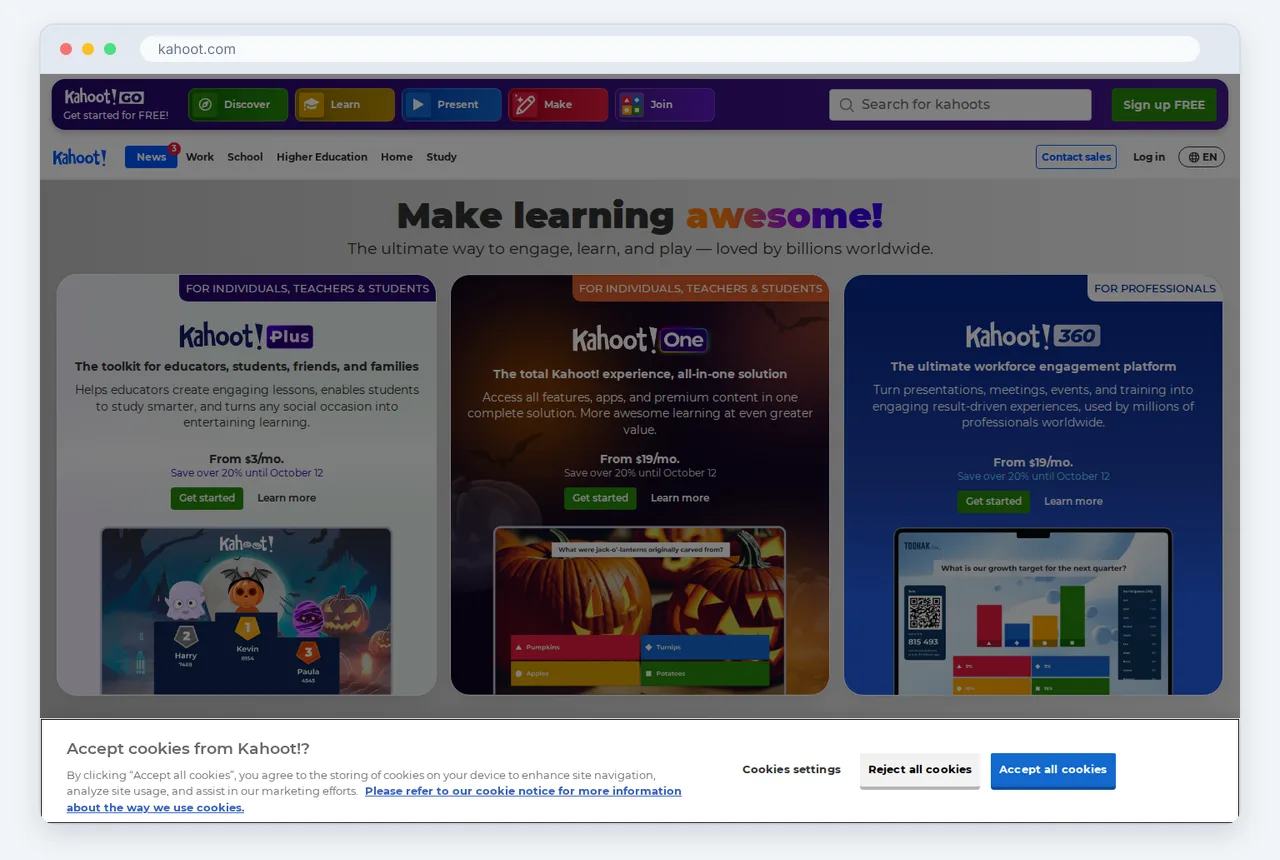
Kahoot! maintains its position as an essential tool for creating high-energy environments, being widely adopted in classrooms and large conventions. The platform works through real-time competitions, in which participants answer questions projected on a common screen using their own devices as controllers. This format generates a cycle of immediate feedback, allowing instructors to identify comprehension gaps at the exact moment they occur. Users should confirm the details of the plans and features available on the supplier's official page, since commercial offers and technical capabilities undergo frequent updates.
For sectors that require technical precision and strict compliance, Mitti stands out by focusing on operational safety and specialized training. The platform uses hundreds of fictional clinical cases distributed across various specialties to simulate decision-making processes under pressure. By structuring each real clinical presentation as an interactive challenge, the system allows teams to practice critical protocols in a safe and controlled environment. Interested companies should consult the developer's website to check the specific modules and current cost structures for the year 2026.
Gametize complements the corporate scenario by converting organizational goals into interactive missions, known as quests. The tool uses game design elements, such as scoring systems and leaderboards, to motivate employees in onboarding processes or skills development. This approach allows companies to customize the user journey according to the internal culture, turning routine tasks into stages of visible progress. As with other digital solutions, it is essential to validate prices and service levels directly with the supplier company to ensure the accuracy of budget planning.
Tools for performance and sales management
A sales manager watches their team lose enthusiasm in the face of static monthly goal spreadsheets. To reverse this scenario, platforms like Centrical convert Key Performance Indicators (KPIs) into objectives within a playful environment. Instead of just monitoring numbers, the system turns closing contracts and customer service into missions that earn points and level progression. This approach uses immediate positive reinforcement to keep employees focused on practical results, connecting individual effort to the organization's collective success.
Hoopla and GoSkills also occupy a relevant space in this segment, offering distinct forms of engagement. Hoopla focuses on the visibility of results, broadcasting rankings and achievements in real time to create a climate of celebration and healthy competition. GoSkills, in turn, combines learning in small doses with gamification elements, allowing the team to develop technical skills while competing for medals. These solutions show that an efficient game based learning platform can integrate continuous training into the work routine, reducing the friction between learning and the execution of commercial tasks.
However, implementing these tools requires attention to technical and structural details. The complexity of the initial setup is one of the main obstacles, since it requires the precise integration of databases and the definition of game rules that are balanced. If the parameters are not well adjusted, the system can generate frustration instead of motivation. In addition, licensing costs vary according to the volume of users and the features activated. It is essential to check prices and contractual conditions directly with the vendors on their official pages to ensure up-to-date data on the investment needed in 2026.
Content creation and instructional design platforms
A teacher needs to turn a static presentation about biology into a digital escape room by the end of the afternoon. Without programming knowledge, this task would have been impossible in past decades, but in 2026 instructional design tools, which is the practice of creating effective and engaging learning experiences, have removed the technical barriers. Genially exemplifies this change by offering an environment where users drag and drop elements to build infographics and interactive games. Confidence in this solution is supported by its reputation in the market, since Genially has more than 800 reviews on sites like G2 and Trustpilot, simplifying the choice for educational managers.
Following this trend of simplification, Archy Learning and Raptivity offer distinct paths to interactivity. Archy Learning acts as a learning management system focused on visual structure, allowing the instructor to organize knowledge tracks without dealing with complex code. Raptivity, in turn, focuses on microinteractions, providing a library of pre-configured templates, such as puzzles and interactive diagrams, that can be customized quickly. These tools ensure that any game based learning platform is fed with materials that keep the student engaged through visual stimulation and active participation.
The effectiveness of these platforms is reflected in the ongoing satisfaction of their global users. As evidence of this stability, Genially has a score of 4.6 on G2 and Trustpilot, which demonstrates the delivery of a consistent experience for content creators. By using these resources, it is possible to implement game mechanics, such as reward systems and progressive difficulty levels, intuitively. It is important to confirm the details of each plan and specific features on the vendors' official pages, since offers may change. This ease of use democratizes the creation of modern teaching materials, allowing the focus to remain on pedagogy and not on solving software problems.
Technical education and active memorization
A medical student facing a vast list of anatomical terms illustrates the immediate usefulness of a game based learning platform. Tools like Quizlet and Gimkit turn exhaustive repetition into a competitive and dynamic activity. Quizlet uses the spaced repetition technique through digital flashcards, while Gimkit applies video game mechanics to keep classroom engagement through virtual rewards. Both are effective for consolidating basic vocabulary and fundamental nomenclature. It is advisable to check the prices and features of the plans directly on the suppliers' official pages, since the offers may change.

For corporate environments and industrial training, ProProfs and Hurix Digital offer structures aimed at compliance and specific technical learning. ProProfs allows the creation of quick quizzes that validate immediate knowledge, while Hurix Digital stands out in customizing content for sectors that require high technical precision. These solutions support active recall, which is the process where the brain is stimulated to retrieve information deliberately instead of just reading it passively. As with the other platforms, you should consult each company's website to confirm details about subscriptions and features available at the moment.
Despite their efficiency in fixing isolated data, these tools have limitations in developing complex reasoning. Memorizing the function of an enzyme or a security code is a process distinct from interpreting a real clinical presentation made up of fictitious cases in several specialties. Where critical analysis and the synthesis of contradictory information are required, the linear structure of question and answer games may be insufficient. Game based learning aimed at memorization focuses on fast pattern recognition, but it does not always prepare the student for decision making in scenarios involving hundreds of fictitious clinical cases and ambiguous variables.
Direct comparison of Game Based Learning solutions
A manager who needs to train teams in hundreds of fictitious clinical cases from several specialties realizes that the ideal tool depends on pedagogical depth. Choosing a game based learning platform requires aligning the challenges with retention goals. Evaluating each alternative involves balancing ease of implementation with technical constraints.
| Option | Best for | Strongest point | Main trade-off |
|---|---|---|---|
| Mitti | Corporate training | Agile microlearning | Limited customization |
| Kahoot! | Engagement at events | Ease of use | Content depth |
| Gametize | Behavior change | Game mechanics | Complex interface |
| Centrical | Sales performance | Real-time feedback | Implementation time |
| Archy Learning | Course creation | LMS integration | Focus on small groups |
| Hoopla | Team motivation | Visual transmission | Restricted scope of use |
| Raptivity | Interactivity | HTML5 templates | Learning curve |
| ProProfs | Test creation | Technical simplicity | Visual refinement |
| GoSkills | Professional skills | Ready-made library | Creating your own content |
| Hurix Digital | Tailor-made solutions | Enterprise scale | Cost per project |
Where diagnosis meets navigation: The NEXO case
A health professional facing a complex clinical picture deals with the challenge of filtering essential information amid a series of vague symptoms. The pressure to decide between ordering an expensive imaging test or starting immediate drug treatment creates a high cognitive load that can lead to error. In this scenario, the game based learning platform NEXO emerges as a simulation tool dedicated specifically to the medical niche. Unlike static questionnaires or traditional multiple choice tests, the platform turns clinical reasoning into an interactive environment where each choice changes the outcome of the simulation. Game based learning here does not seek only the correct answer, but the construction of a safe and efficient logical path in the face of a real clinical presentation made up of fictitious elements.
The fundamental difference of this approach lies in the concept that diagnosis is navigation. Instead of treating medical practice as a simple checklist, the platform uses ICD-10, which is the International Classification of Diseases and Related Health Problems, as the coordinates of a vast map. The user navigates this coded system to locate the correct pathology, simulating the mental process of exclusion and confirmation that occurs daily in clinics and hospitals. This structure turns medical taxonomy into an active game mechanic, forcing the student or professional to understand the hierarchy of diseases and the relationship between different codes while seeking the definitive solution for the proposed case.
To handle the uncertainties inherent to clinical practice, the tool implements proximity feedback. In situations where signs and symptoms overlap, the system does not punish the error in a binary way, but indicates how close the guess made by the user is to the final diagnosis within the logical tree of ICD-10. This allows the practitioner to learn to differentiate similar conditions, such as cardiac and pulmonary pathologies that share shortness of breath as the predominant symptom. This continuous feedback helps calibrate clinical perception, teaching the user to value specific findings that could go unnoticed in traditional teaching methods based purely on theoretical memorization.
The experience is supported by hundreds of fictional clinical cases covering various specialties, ensuring that the training is diverse and representative of medical reality. Each simulation is built to mirror the complexity of a real clinical presentation, allowing the user to practice in a controlled and safe environment before applying the knowledge in high-pressure situations. For those who want to understand the methodology and philosophy behind this training structure, Our story offers a detailed view of the process of developing these skills. By combining the technical precision of the international classification with the interactivity of simulations, the platform consolidates itself as an essential reference in the educational landscape of 2026.
Frequently asked questions
Title: Frequently asked questions about game-based learning in 2026 Meta description: Clear up your doubts about the game-based learning method and discover the leading platforms for technical training and educational engagement in 2026. Image alt text: Digital interface displaying gamification elements and learning progress in a modern educational environment.
What is the game-based learning method?
A medical student uses a simulator to diagnose a virtual patient and learn in practice before human contact. Game-based learning is the use of game mechanics and structures to achieve specific educational goals. This method turns passive study into an active experience where progress depends on solving logical challenges.
What are some examples of game-based learning?
A salesperson tests different approaches in a digital scenario to understand which strategy closes more deals without the risk of losing the sale. Common examples include flight simulators, virtual escape rooms for corporate training and interactive quizzes. In healthcare, the NEXO platform uses hundreds of fictional clinical cases from various specialties so that professionals can practice real clinical presentation safely.
What is the most popular gamification platform?
Millions of users compete in global leagues to learn new languages through daily micro-challenges and immediate rewards. Duolingo remains the most popular tool for the general public due to its massive reach and intuitive interface. For specialized technical teaching, a game based learning platform like NEXO stands out by integrating complex diagnostic reasoning into a competitive and social environment.
What are the 10 best learning platforms?
An organization selects a set of tools to balance the development of interpersonal skills with rigorous technical mastery. The 2026 ranking includes leaders such as Kahoot for group engagement, Coursera for academic certifications and NEXO for specialized medical training. These solutions are selected for offering accurate data analysis, adaptive difficulty levels and interfaces that support performance management at scale.
Choosing your ideal game based learning platform
Imagine a training director who hands out dense PDF manuals and watches productivity stall while the team completely ignores the content. This scenario, common in 2026, reinforces the urgency of Game Based Learning, a term that defines the application of game mechanics and elements to support knowledge acquisition and complex problem solving. The transition to an efficient game based learning platform requires the manager to abandon abstract theory in favor of measurable practice and real engagement.

- Identify the gap, determining which specific technical or behavioral competency needs immediate reinforcement through gamification.
- Validate compatibility, ensuring that the tool works flawlessly on the various mobile device models used by your workforce.
- Prioritize analytics, choosing systems that provide detailed reports and data on the progress and individual engagement of each employee.
- Examine customization, checking whether the platform allows you to adapt scenarios and challenges to the particular needs of your industry sector.
- Consider the cost, calculating the financial return on investment based on reduced training time and increased retention.
NEXO uses hundreds of fictional clinical cases inspired by every real clinical presentation across various specialties to ensure practical and safe learning, accessible through the website https://nexo.wiki.br/.